 Back
Basic Chemistry Concepts in Anatomy & Physiology
 02:13

Terms in this set (20)
Matter is anything that has mass and occupies space. It can be seen, smelled, or felt and exists in three states: solid, liquid, and gas.
Energy is the capacity to do work or put matter into motion. It exists as kinetic energy (energy in action) and potential energy (stored energy).
Carbon, oxygen, hydrogen, and nitrogen make up 96% of the human body mass.
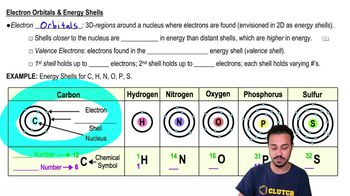
An atom consists of a nucleus containing protons (+) and neutrons (neutral), with electrons (-) orbiting in an electron cloud around the nucleus.
The planetary model shows electrons in fixed orbits, while the orbital model depicts electrons in probabilistic regions called orbitals, forming an electron cloud.
Atomic number is the number of protons in the nucleus. Mass number is the total number of protons and neutrons.
Isotopes are atoms of the same element with the same number of protons but different numbers of neutrons, resulting in different mass numbers.
A molecule is two or more atoms bonded together. A compound is a molecule with two or more different kinds of atoms bonded.
Solutions are homogeneous mixtures with tiny solute particles. Colloids are heterogeneous with larger particles that do not settle. Suspensions have large particles that settle out.
Mixtures do not involve chemical bonding and can be separated physically; compounds involve chemical bonds and are homogeneous.
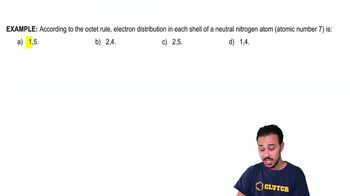
Electrons in the valence shell determine chemical bonding by being gained, lost, or shared to achieve stability.
Atoms tend to gain, lose, or share electrons to have 8 electrons in their valence shell (2 for hydrogen and helium) for stability.
Ionic bonds form when valence electrons are transferred from one atom to another, creating oppositely charged ions that attract.
Covalent bonds form by sharing valence electrons. They can be nonpolar (equal sharing) or polar (unequal sharing).
Hydrogen bonds are weak attractions between a hydrogen atom with a partial positive charge and an electronegative atom of another molecule.
Synthesis: atoms/molecules combine to form larger molecules.
Decomposition: molecules break down into smaller parts.
Exchange: bonds are both made and broken.
The pH scale measures hydrogen ion concentration in a solution, ranging from 0 (acidic) to 14 (basic), with 7 being neutral.
Dehydration synthesis joins monomers by removing water. Hydrolysis breaks polymers into monomers by adding water.
Monosaccharides are single sugars, disaccharides are two sugars joined, and polysaccharides are many sugars linked together.
Saturated fatty acids have no double bonds and are solid at room temperature. Unsaturated fatty acids have one or more double bonds and are liquid at room temperature.