 Back
BackBasic Chemistry for Anatomy & Physiology
 02:13
02:13
Terms in this set (23)
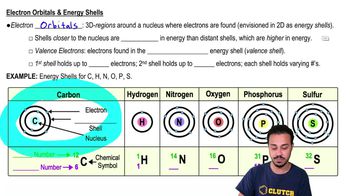
Atoms consist of a nucleus containing protons (positive charge) and neutrons (no charge), surrounded by orbitals of electrons (negative charge).
Atomic number is the number of protons in the nucleus, defining the element. Mass number is the sum of protons and neutrons in the nucleus.
Isotopes are atoms of the same element with the same number of protons but different numbers of neutrons.
The number of valence electrons in the outermost electron shell determines an atom's chemical properties.
A molecule is two or more atoms held together by chemical bonds. A compound is a molecule made of atoms of different elements.
Ionic bonds form when electrons transfer from one atom to another, creating charged ions (cations and anions) held together by electrostatic attraction.
Covalent bonds form when atoms share electrons. They can be polar (unequal sharing) or nonpolar (equal sharing).
Hydrogen bonds are weak attractions between a hydrogen atom covalently bonded to one molecule and an electronegative atom of another molecule.
Kinetic energy is energy in motion; potential energy is stored energy that can be used later.
Chemical, electrical, mechanical, and radiant (electromagnetic) energy.
Bonds are formed to build larger molecules from smaller ones (A + B → AB). These are anabolic reactions.
Bonds are broken to break down molecules into smaller parts (AB → A + B). These are catabolic reactions.
Temperature, concentration of reactants, particle size, and presence of catalysts.
Enzymes are biological catalysts that lower activation energy and speed up reactions without being consumed.
Exergonic reactions release energy; endergonic reactions require energy input.
Organic compounds contain carbon; inorganic compounds include salts, water, acids, and bases.
Water has high heat capacity, high heat of vaporization, polarity for solvent properties, reactivity, and cushioning ability.
Acids release hydrogen ions (proton donors) and have pH < 7; bases accept hydrogen ions (proton acceptors) and have pH > 7.
Carbohydrates are sugars and starches used primarily as fuel to produce ATP.
Saturated fats have single covalent bonds and are solid at room temperature; unsaturated fats have one or more double bonds and are liquid at room temperature.
Proteins are made of amino acids linked by peptide bonds and perform most cellular work, including acting as enzymes.
Nucleic acids (DNA and RNA) store and process genetic information within cells.
ATP (adenosine triphosphate) is the energy currency of the cell, providing energy for chemical, transport, and mechanical work.