Skip to main content
Anatomy & Physiology
My Course
Learn
Exam Prep
AI Tutor
Study Guides
Textbook Solutions
Flashcards
Explore
Try the app
My Course
Learn
Exam Prep
AI Tutor
Study Guides
Textbook Solutions
Flashcards
Explore
Try the app
Back
Bio Lecture 4
You can tap to flip the card.
What is dehydration synthesis?
You can tap to flip the card.
👆
What is dehydration synthesis?
A chemical reaction where monomers are joined by removal of H2O, forming covalent bonds between them.
Track progress
Control buttons has been changed to "navigation" mode.
1/29
Recommended videos
Guided course
01:22
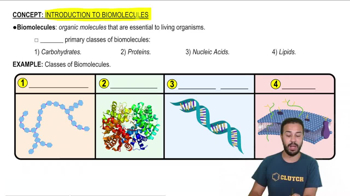
Introduction to Biomolecules
30779
views
661
rank
Guided course
02:00
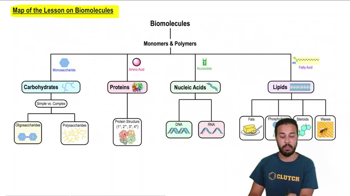
Map of the Lesson on Biomolecules
25227
views
830
rank
1
comments
Terms in this set (29)
Hide definitions
What is dehydration synthesis?
A chemical reaction where monomers are joined by removal of H2O, forming covalent bonds between them.
What is hydrolysis?
A reaction where water is added to break covalent bonds between monomers, releasing them.
What are monosaccharides?
Simple sugars and monomers of carbohydrates, containing 3 to 7 carbon atoms, e.g., glucose, fructose.
What are disaccharides?
Carbohydrates made of two linked monosaccharides, e.g., sucrose, maltose, lactose.
What are polysaccharides?
Long chains (polymers) of linked monosaccharides, e.g., glycogen, starch, cellulose.
What is the structure of a triglyceride?
One glycerol molecule bonded to three fatty acids via dehydration synthesis.
What characterizes saturated fats?
Fatty acids with only single bonds between carbons, fully saturated with hydrogen, solid at room temperature.
What characterizes unsaturated fats?
Fatty acids with one or more double bonds causing kinks, liquid at room temperature.
What is a phospholipid?
A lipid with a glycerol, two fatty acid tails (nonpolar, hydrophobic), and a phosphate-containing polar head (hydrophilic).
What is the main function of phospholipids in the body?
They form the bilayer structure of cell membranes.
Name the major lipid types found in the body.
Triglycerides, phospholipids, steroids, cholesterol, bile salts, vitamin D, sex hormones, corticosteroids, and eicosanoids.
What is a peptide bond?
A covalent bond linking amino acids in proteins formed by dehydration synthesis.
What are structural proteins? Give an example.
Proteins providing mechanical support, e.g., collagen in connective tissue.
What is the function of enzyme proteins?
Catalyze biochemical reactions; examples include disaccharidases and oxidases.
What is the role of transport proteins?
Move substances across membranes or in blood, e.g., hemoglobin transports oxygen.
What are contractile proteins?
Proteins involved in movement, e.g., actin and myosin in muscle contraction.
What are communication proteins?
Transmit signals between cells, acting as chemical messengers or receptors, e.g., insulin.
What are defensive proteins?
Protect against disease, e.g., antibodies that bind and inactivate foreign substances.
Describe the primary structure of a protein.
The linear sequence of amino acids forming the polypeptide chain.
What is the secondary structure of proteins?
Local folding into alpha helices or beta pleated sheets stabilized by hydrogen bonds.
What is the tertiary structure of a protein?
The 3D folding of secondary structures into a compact shape held by intramolecular bonds.
What is the quaternary structure of proteins?
The interaction and assembly of two or more polypeptide chains into a functional protein.
What happens during protein denaturation?
Proteins lose their 3D shape and function due to factors like heat or pH changes; often reversible.
What is the role of enzymes?
Biological catalysts that speed up chemical reactions without being consumed.
How do enzymes work?
Substrate binds to enzyme's active site forming a complex, substrate is converted to product, then released.
What factors affect enzyme activity?
Temperature and pH; enzymes have optimal conditions for maximum activity.
What are nucleic acids?
Polymers of nucleotides; DNA stores genetic information, RNA helps synthesize proteins.
What is ATP and its function?
Adenosine triphosphate; the main energy currency of the cell powering biochemical reactions.
How is energy released from ATP?
By hydrolysis of high-energy phosphate bonds, converting ATP to ADP or AMP and releasing energy.
 BackBack
 01:22