 Back
Biological Membranes - Anatomy & Physiology
 02:21

Terms in this set (20)
Biological membranes regulate the movement of substances in and out of cells and organelles, maintaining homeostasis.
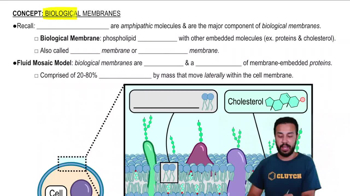
A phospholipid bilayer with embedded proteins, cholesterol, and carbohydrates.
Integral proteins span the membrane; peripheral proteins attach to the membrane surface.
Cholesterol stabilizes membrane fluidity and integrity across temperature changes.
Membrane fluidity refers to the viscosity of the lipid bilayer, allowing lateral movement of lipids and proteins.
Selective permeability allows some substances to cross the membrane while blocking others.
Diffusion and facilitated diffusion are passive transport methods that do not require energy.
Active transport moves substances against their concentration gradient using energy (ATP).
Glycoproteins serve in cell recognition and signaling.
The fluid mosaic model describes membranes as a fluid lipid bilayer with proteins floating like mosaics.
Osmosis is the diffusion of water across a selectively permeable membrane.
Carrier proteins bind specific molecules and change shape to transport them across membranes.
Channel proteins form pores that allow specific ions or molecules to pass through membranes.
Endocytosis is the process of engulfing substances into the cell by membrane invagination.
Exocytosis is the process of vesicles fusing with the membrane to release contents outside the cell.
Membranes create distinct compartments within cells, allowing specialized environments for different functions.
Membrane carbohydrates are involved in cell recognition, adhesion, and protection.
Membrane permeability depends on molecule size, polarity, charge, and membrane composition.
Facilitated diffusion uses membrane proteins to help molecules cross membranes down their concentration gradient.
Increasing temperature generally increases membrane fluidity; decreasing temperature reduces it.