 Back
Biomolecules and Enzymes - Anatomy & Physiology
 01:22

Terms in this set (44)
Complex molecules made in nature by living organisms.
Biomolecules are organic compounds.
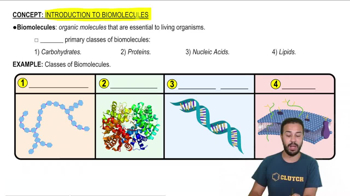
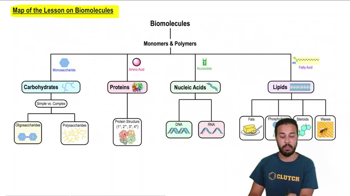
Carbohydrates, Lipids, Proteins, Nucleic Acids.
Subunits or building blocks of biomolecules.
Long chains of repeating monomer subunits.
Polymer.
Monomer.
Polymer.
Monosaccharides.
Glucose, Fructose, Galactose.
DNA: Deoxyribose, RNA: Ribose.
Table sugar: Sucrose, Milk sugar: Lactose, Grain sugar: Maltose.
Plants: Starch, Cellulose; Animals: Glycogen.
Cellulose.
Fatty acids, Phospholipids, Steroids, Triglycerides.
Steroids.
Long carbon chains with hydrogen atoms and a carboxyl group; used for energy and membrane components.
Glycerol attached to two fatty acids and a phosphate group; major cell membrane components.
Long-term energy storage, insulation, and cushioning; glycerol with three fatty acids.
Steroid.
Amino acids.
Enzymes, structural support, transport, defense, signaling, movement, storage, regulation.
Peptide bond.
Amino end (NH2) and carboxyl end (COOH).
Dipeptide, polypeptide, protein.
Shape determines function.
Primary, Secondary, Tertiary, Quaternary.
Quaternary structure.
Secondary structure due to hydrogen bonds.
Loss of protein shape and function due to changes in pH, temperature, or ion balance.
Enzyme.
Substrate.
The region where the substrate binds and the reaction occurs.
Nucleotides.
Deoxyribonucleic acid (DNA) and Ribonucleic acid (RNA).
RNA.
DNA.
DNA.
RNA.
Nitrogenous base, phosphate group, sugar; does not contain a carboxyl group.
Uracil.
Thymine.
Two high-energy phosphate bonds.
\(\mathrm{ATP} \rightleftharpoons \mathrm{ADP} + P_i + \text{energy}\)