Skip to main content
Anatomy & Physiology
My Course
Learn
Exam Prep
AI Tutor
Study Guides
Textbook Solutions
Flashcards
Explore
Try the app
My Course
Learn
Exam Prep
AI Tutor
Study Guides
Textbook Solutions
Flashcards
Explore
Try the app
Back
blood
You can tap to flip the card.
Functional characteristics of WBCs
You can tap to flip the card.
👆
Functional characteristics of WBCs
Diapedesis
,
ameboid motion
, and
positive chemotaxis
are functional characteristics;
granulosis
is not.
Track progress
Control buttons has been changed to "navigation" mode.
1/29
Recommended videos
Guided course
2:36
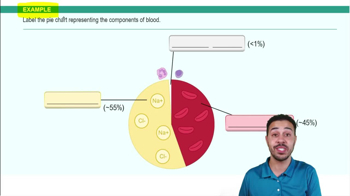
Introduction to Blood Example 1
11285
views
332
rank
Guided course
7:49
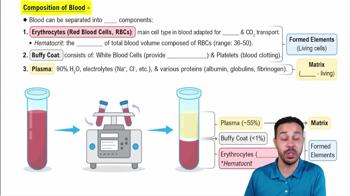
Composition of Blood
11827
views
336
rank
Guided course
1:55
Introduction to Blood Example 2
9308
views
223
rank
Terms in this set (29)
Hide definitions
Functional characteristics of WBCs
Diapedesis
,
ameboid motion
, and
positive chemotaxis
are functional characteristics;
granulosis
is not.
Normal blood pH range
The average normal blood pH range is
7.35-7.45
.
Special hemoglobin in fetal red blood cells
Fetal red blood cells contain
hemoglobin F
.
Parent cell for all formed blood elements
The
hemocytoblast
is the parent cell for all formed elements of blood.
Universal blood donor type
Blood type
O
is generally called the universal donor.
Blood distribution functions
Blood distributes oxygen, metabolic wastes, and hormones, but does not transport salts to maintain blood volume.
Protective function of blood
Blood protects by
preventing blood loss
through clotting mechanisms.
Incorrect blood transfusion statement
Blood typing for Kell, Lewis, and Duffy factors is
not always
done before transfusion.
Trigger for erythropoiesis
Erythropoiesis is triggered by
hypoxia of EPO-producing cells
.
Information from blood reticulocyte counts
Reticulocyte counts indicate the
rate of erythrocyte formation
.
Blood type AB negative can receive
AB negative individuals can receive any blood type except those with the
Rh antigen
.
False statement about blood
Blood does
not
carry body cells to injured areas for repair.
Blood type when no agglutination with anti-A or anti-B serum
Blood type is
O
when neither anti-A nor anti-B serum causes clotting.
Incorrect statement about blood cell formation
Platelets are
not
formed from myeloblasts; they come from megakaryocytes.
Blood volume restorers exclude
Packed cells
are not blood volume restorers.
Normal hemoglobin measurement
A hemoglobin level of 16 g/100 ml blood is
within the normal range
.
Major plasma protein for osmotic pressure
Albumin
is the major contributor to plasma osmotic pressure.
Polycythemia does not cause
Polycythemia does not cause
low blood viscosity
.
WBCs without visible cytoplasmic granules
Monocytes
lack visible cytoplasmic granules.
Non-phase of hemostasis
Fibrinolysis
is not a phase of hemostasis.
Erythrocyte structural characteristic not contributing to gas transport
Erythrocytes are
not mitotically active
.
Anemia caused by lack of intrinsic factor
Lack of intrinsic factor causes
pernicious anemia
with large pale macrocytes.
Slowest step in clotting process
The slowest step is the
formation of prothrombin activator
.
Thromboembolic disorders include
They include
embolus formation
, a clot moving within the circulatory system.
Not a cause of bleeding disorders
Excess secretion of
platelet-derived growth factor (PDGF)
is not a cause.
Characteristic of all leukocytes
All leukocytes are
nucleated
.
Main component of blood plasma
Blood plasma is about
90% water
.
Platelet function
Platelets
stick to damaged blood vessels
and help seal breaks.
Correct sequence in clotting events
Sequence: 3. formation of thromboplastin, 4. prothrombin → thrombin, 1. fibrinogen → fibrin, 2. clot retraction.
 BackBack
 2:36