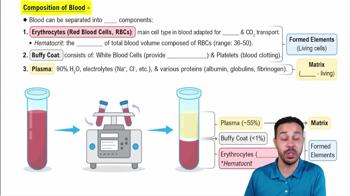
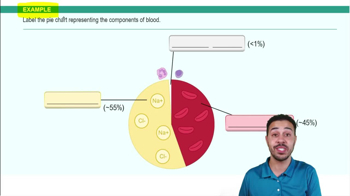
Blood consists of plasma (non-living fluid matrix) and formed elements (living blood cells: erythrocytes, leukocytes, and platelets).
What layers form when blood is centrifuged?
Blood separates into plasma (~55%), buffy coat (WBCs and platelets, <1%), and erythrocytes (~45%).
What are the physical characteristics of blood?
Blood is a sticky, opaque fluid with a metallic taste, pH 7.35–7.45, color varies with oxygen content, and makes up about 8% of body weight.
List the primary functions of blood.
Blood functions in distribution (O2, nutrients, wastes, hormones), regulation (temperature, pH, fluid volume), and protection (clotting, immune defense).
What is the composition of blood plasma?
Blood plasma is about 90% water and contains over 100 dissolved solutes including nutrients, gases, hormones, wastes, proteins, and ions.
Describe erythrocytes and their function.
Erythrocytes are biconcave, anucleate cells filled with hemoglobin for gas transport; they provide flexibility and contribute to blood viscosity.
What is hematopoiesis?
Hematopoiesis is the formation of blood cells in red bone marrow from hematopoietic stem cells (hemocytoblasts).
How is erythropoiesis regulated?
Erythropoiesis is regulated by hormonal controls like erythropoietin (EPO) and requires adequate iron, amino acids, and B vitamins.
What causes sickle-cell anemia?
Sickle-cell anemia is caused by a single amino acid mutation in hemoglobin beta chain, leading to crescent-shaped RBCs that rupture easily.
What are leukocytes and their categories?
Leukocytes are white blood cells involved in defense; categorized as granulocytes (neutrophils, eosinophils, basophils) and agranulocytes (lymphocytes, monocytes).
What is the function of platelets?
Platelets are cytoplasmic fragments that form temporary plugs to seal vessel breaks and release chemicals to promote clotting.
What are the three steps of hemostasis?
Hemostasis involves (1) vascular spasm, (2) platelet plug formation, and (3) coagulation to stop bleeding.
How do atrioventricular (AV) valves function?
AV valves prevent backflow into atria during ventricular contraction; chordae tendineae anchor valve cusps to papillary muscles.
What is the role of semilunar valves?
Semilunar valves prevent backflow into ventricles when they relax, opening and closing in response to pressure changes.
Describe the pulmonary and systemic circuits of the heart.
The pulmonary circuit pumps oxygen-poor blood to lungs; the systemic circuit pumps oxygen-rich blood to body tissues.
What are the differences between the right and left ventricles?
The left ventricle has thicker walls (3x) and pumps blood at higher pressure through the systemic circuit; the right ventricle pumps to the pulmonary circuit.
What is the function of the coronary circulation?
Coronary circulation supplies blood to the heart muscle itself, mainly during heart relaxation.
What are the ABO blood groups based on?
ABO blood groups are determined by the presence or absence of A and B antigens on RBC membranes and corresponding plasma antibodies.
What happens during a transfusion reaction?
Mismatched blood causes agglutination and hemolysis of donor RBCs, leading to diminished oxygen capacity, blocked vessels, and possible kidney failure.
What is the universal donor and universal recipient blood type?
Type O is the universal donor (no A or B antigens); Type AB is the universal recipient (no anti-A or anti-B antibodies).
 Back
 2:36