 Back
BackBlood and Hematology - Anatomy & Physiology
 2:36
2:36
Terms in this set (26)
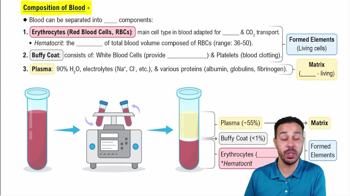
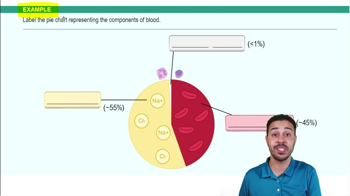
Plasma is mostly water with dissolved solutes including plasma proteins like albumin, globulins, and fibrinogen, produced mainly by the liver. These proteins maintain osmotic pressure, transport substances, and aid in clotting.
Red blood cells are biconcave, anucleate cells specialized for oxygen transport via hemoglobin.
Neutrophils, lymphocytes, monocytes, eosinophils, and basophils; classified as granulocytes (neutrophils, eosinophils, basophils) or agranulocytes (lymphocytes, monocytes).
Erythrocytes are small, biconcave, and lack nuclei; leukocytes are larger, nucleated, and vary in shape and granule presence.
RBC count: males ~4.7-6.1 million/µL, females ~4.2-5.4 million/µL; hematocrit: males ~42-52%, females ~37-47%.
Leukocytes: 4,500-11,000 cells/µL; platelets: 150,000-450,000/µL.
Most to least common: neutrophils, lymphocytes, monocytes, eosinophils, basophils; granulocytes include neutrophils, eosinophils, basophils; agranulocytes include lymphocytes and monocytes.
Platelets are small, cell fragments without nuclei, derived from megakaryocytes, unlike whole cells of RBCs and WBCs.
Hematopoiesis occurs primarily in the red bone marrow of flat bones and proximal epiphyses of long bones.
Erythropoiesis is RBC production stimulated by erythropoietin, a hormone from the kidneys in response to low oxygen levels.
Megakaryocytes are large bone marrow cells that fragment to form platelets essential for clotting.
RBCs transport oxygen from lungs to tissues and carry carbon dioxide back to lungs.
Hemoglobin is a protein with four heme groups that bind oxygen; it carries oxygen and facilitates CO2 transport. Breakdown produces bilirubin and iron recycling.
Neutrophils: phagocytosis; lymphocytes: immune response; monocytes: become macrophages; eosinophils: combat parasites; basophils: release histamine in inflammation.
Platelets initiate blood clotting by forming a platelet plug and releasing clotting factors.
Hemostasis is the overall process to stop bleeding; coagulation is the blood clotting phase involving fibrin formation.
Includes vascular spasm, platelet plug formation, and coagulation to seal vessel injury.
Thrombus (clot in vessel), embolus (dislodged clot), hemophilia (clotting factor deficiency), disseminated intravascular coagulation (DIC, widespread clotting).
Surface antigens (A, B, Rh) on RBCs determine blood group and compatibility for transfusions.
Type A: A antigen, anti-B antibodies; Type B: B antigen, anti-A antibodies; Type AB: A and B antigens, no antibodies; Type O: no antigens, anti-A and anti-B antibodies.
Presence of Rh antigen = Rh positive; absence = Rh negative.
Anti-A and anti-B antibodies develop naturally; anti-Rh antibodies develop only after exposure to Rh-positive blood.
Incompatible transfusions cause agglutination and hemolysis; compatibility depends on matching ABO and Rh antigens.
Universal donor: type O negative (no A, B, or Rh antigens); universal recipient: type AB positive (no antibodies).
Anemias include iron-deficiency, pernicious, aplastic, hemolytic, and sickle cell, each with different causes and effects on RBCs.
Polycythemia: excess RBCs; thrombocytopenia: low platelets; leukemia: cancer of WBCs; erythroblastosis fetalis: hemolytic disease of newborn due to Rh incompatibility.