 Back
Blood: Structure, Function, and Clinical Relevance
 2:36

Terms in this set (31)
Hematopoiesis is the process of blood cell formation, primarily occurring in the red bone marrow.
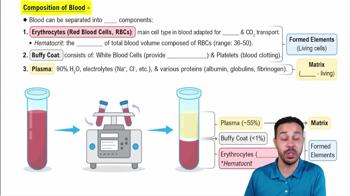
Plasma is the liquid extracellular matrix of blood, about 55% of blood volume, containing water, proteins, nutrients, hormones, and waste products.
Serum is plasma without clotting factors such as fibrinogen.
Erythrocyte (red blood cell) transports oxygen and carbon dioxide in the blood.
Erythropoietin is a hormone produced mainly by the kidneys that stimulates erythrocyte production in response to low oxygen.
Hemoglobin is the oxygen-carrying protein in erythrocytes; each molecule binds up to four oxygen molecules.
Leukocytes are white blood cells involved in immune defense.
Antibodies are proteins produced by B lymphocytes that bind specific antigens to neutralize or mark them for destruction.
Thrombocytes or platelets are cell fragments involved in blood clotting (hemostasis).
Hemostasis is the process of stopping bleeding, involving vascular spasm, platelet plug formation, and coagulation.
Coagulation is blood clot formation via a cascade of enzymatic reactions forming a fibrin mesh.
Anemia is a condition with deficient erythrocytes or hemoglobin, reducing oxygen-carrying capacity.
Polycythemia is an abnormal increase in erythrocyte number, increasing blood viscosity.
Leukocytosis is an elevated leukocyte count, often indicating infection or inflammation.
Leukopenia is a decreased leukocyte count, increasing infection risk.
Thrombocytosis is an abnormally high platelet count.
Thrombocytopenia is an abnormally low platelet count, increasing bleeding risk.
Blood functions include transport of gases and nutrients, regulation of temperature and pH, and protection via clotting and immune defense.
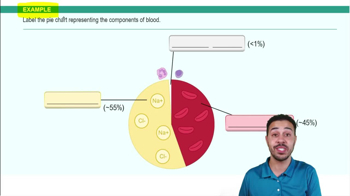
Blood is composed of formed elements (erythrocytes, leukocytes, platelets) ~45% and plasma ~55%.
Erythrocytes are biconcave, anucleate cells optimized for gas exchange with a lifespan of about 120 days.
Main leukocytes: Neutrophils (phagocytize bacteria), Lymphocytes (adaptive immunity), Monocytes (macrophages), Eosinophils (parasites/allergy), Basophils (histamine release).
Plasma is 90% water, 8% proteins (albumin, globulins, fibrinogen), and 2% solutes; maintains pH 7.35–7.45.
Hemostasis involves: 1) vascular spasm, 2) platelet plug formation, 3) coagulation forming fibrin mesh.
Intrinsic pathway starts inside vessel; extrinsic triggered by external trauma; both activate factor X leading to fibrin formation.
The liver synthesizes most clotting factors; calcium ions (Ca2+) are essential cofactors in coagulation steps.
ABO groups depend on A and/or B antigens on RBCs; antibodies in plasma determine compatibility for transfusion.
Rh factor is presence (+) or absence (−) of D antigen; important for transfusion and pregnancy compatibility.
Baroreceptors in carotid sinuses and aortic arch detect pressure changes and adjust heart rate and vessel diameter.
Short-term: nervous system via baroreceptors (seconds-minutes). Long-term: kidneys regulate blood volume hormonally (hours-days).
Fluid moves by hydrostatic pressure out of capillaries and osmotic pressure in; substances diffuse along concentration gradients.
Venous return aided by skeletal muscle pump and respiratory pump increasing blood flow to the heart.