Effect of caffeine on stroke volume, heart rate, and mean arterial pressure
Caffeine causes an increase in stroke volume, heart rate, and mean arterial pressure due to its stimulant effects on the heart and blood vessels.
Effect of dehydration on stroke volume, heart rate, and mean arterial pressure
Dehydration causes a decrease in stroke volume and mean arterial pressure, but an increase in heart rate to compensate for lower blood volume.
Effect of anaphylactic shock on blood vessels
Anaphylactic shock causes blood vessels to vasodilate due to massive histamine release from mast cells.
Effect of anaphylactic shock on stroke volume, heart rate, and mean arterial pressure
Stroke volume and mean arterial pressure decrease, while heart rate increases as compensation during anaphylactic shock.
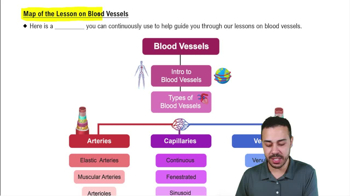
Most common and least permeable capillaries
Continuous capillaries are the most common and least permeable, found in muscle, skin, lungs, and the central nervous system.
Capillaries found in kidney and small intestine with increased permeability
Fenestrated capillaries have pores that increase permeability and are found in the kidney and small intestine.
Most permeable capillaries and their locations
Sinusoidal capillaries are the most permeable and found in liver, bone marrow, and spleen to allow large molecules and cells to pass.
Predominant adrenergic receptor on the heart
The predominant adrenergic receptor on the heart is the beta-1 receptor.
Predominant adrenergic receptor on blood vessels
The predominant adrenergic receptor on blood vessels is the alpha-1 receptor.
Function of precapillary sphincters
Precapillary sphincters regulate blood flow into capillary beds and increase diameter when tissue is metabolically active to allow more flow.
Net hydrostatic pressure effect in capillaries
Net hydrostatic pressure tends to move fluid out of the capillaries.
Fluid flow on arterial side of capillaries
On the arterial side, fluids generally flow out of the capillaries into the tissue.
Fluid flow on venous side of capillaries
On the venous side, fluids generally flow into the capillaries due to higher osmotic pressure inside.
Locations of arterial baroreceptors
Arterial baroreceptors are located in the aortic arch and carotid sinuses.
Layer involved in vasoconstriction and vasodilation
The tunica media layer of blood vessels narrows or widens during vasoconstriction or vasodilation.
Adrenergic receptor responsible for vasoconstriction
Vasoconstriction results primarily from activation of alpha-1 adrenergic receptors.
Sympathetic system effects on heart and vessels
Sympathetic activation increases heart rate and contractility and causes vasoconstriction of blood vessels.
Short-term blood pressure regulation mechanisms
Short-term regulation involves controlling peripheral vascular resistance and cardiac output via baroreceptors, chemoreceptors, and autonomic nervous system.
Major determinants of peripheral vascular resistance
Blood vessel radius, blood viscosity, and vessel length are major determinants of peripheral vascular resistance.
Relationship of blood vessel resistance to radius
Resistance varies inversely to the fourth power of the radius. Doubling radius decreases resistance 16-fold; halving radius increases resistance 16-fold.
Long-term blood pressure regulation controls
Long-term mechanisms regulate blood volume to control blood pressure.
Definition of hypertension
Hypertension is defined as persistent blood pressure readings over 140/90 mmHg.
Primary hypertension
Primary hypertension has no identifiable cause and accounts for most cases.
Secondary hypertension
Secondary hypertension is caused by a known abnormality, such as renal artery narrowing in kidney disease.
Orthostatic hypertension
Orthostatic hypertension refers to blood pressure changes depending on body position.
Organ releasing renin in response to low blood pressure
The kidney releases the enzyme renin to initiate the RAAS pathway.
Potent end product of RAAS and its effects
Angiotensin II causes vasoconstriction and stimulates thirst, ADH, and aldosterone release; blocked by ACE inhibitors to treat hypertension.
 Back
 3:38