Skip to main content
Anatomy & Physiology
My Course
Learn
Exam Prep
AI Tutor
Study Guides
Textbook Solutions
Flashcards
Explore
Try the app
My Course
Learn
Exam Prep
AI Tutor
Study Guides
Textbook Solutions
Flashcards
Explore
Try the app
Back
Blood Vessels Anatomy & Physiology
You can tap to flip the card.
What are the three main types of blood vessels?
You can tap to flip the card.
👆
What are the three main types of blood vessels?
Arteries
,
veins
, and
capillaries
.
Track progress
Control buttons has been changed to "navigation" mode.
1/20
Recommended videos
Guided course
3:38
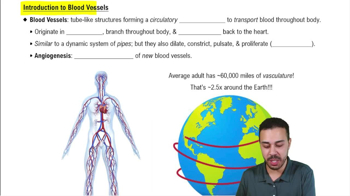
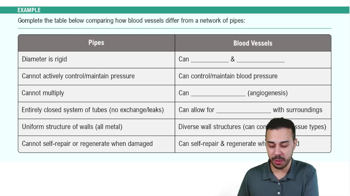
Introduction to Blood Vessels Example 1
6814
views
137
rank
Guided course
4:59
Blood Vessels
9788
views
219
rank
2
comments
Guided course
2:04
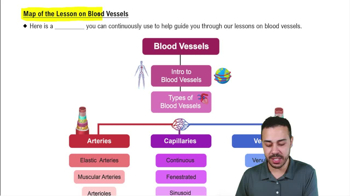
Map of the Lesson on Blood Vessels
6994
views
219
rank
1
comments
Terms in this set (20)
Hide definitions
What are the three main types of blood vessels?
Arteries
,
veins
, and
capillaries
.
What type of cells line the lumen of all blood vessels?
Squamous epithelium
called
endothelium
.
Name the three layers of a typical blood vessel wall.
Tunica interna
,
tunica media
, and
tunica externa
.
What is the function of the internal and external elastic membranes in vessels?
They provide
elasticity
allowing vessels to stretch and recoil.
What are the general characteristics of arteries?
They are
elastic
,
contractile
, and capable of
vasoconstriction
and
vasodilation
.
What is the role of elastic arteries?
They act as
pressure reservoirs
to maintain blood flow during diastole.
What distinguishes muscular arteries from elastic arteries?
Muscular arteries have more
smooth muscle
for regulating blood flow by vasoconstriction and vasodilation.
What are arterioles?
Small arteries that regulate blood flow into capillary beds through vasoconstriction and vasodilation.
Name the three types of capillaries.
Continuous
,
fenestrated
, and
sinusoids
.
What feature characterizes continuous capillaries?
They have
intercellular clefts
allowing limited passage of substances.
What is a fenestrated capillary?
A capillary with pores (
fenestrations
) that allow increased permeability.
What are sinusoids?
Wide, leaky capillaries that allow passage of large molecules and cells.
What is a metarteriole?
A vessel that links arterioles to capillary beds and controls blood flow into true capillaries.
What is the function of precapillary sphincters?
They regulate blood flow into individual capillaries by opening or closing.
Define vasomotion.
The rhythmic contraction and relaxation of precapillary sphincters controlling capillary blood flow.
What are anastomoses in the circulatory system?
Connections between blood vessels that provide alternative pathways for blood flow.
What structural feature do veins have to prevent backflow?
Veins contain
valves
that prevent blood from flowing backward.
What mechanisms assist venous return against gravity?
The
skeletal muscle pump
and the
respiratory pump
.
What are varicose veins?
Veins with damaged valves causing blood pooling and vein enlargement.
Why are veins considered blood reservoirs?
Because they can hold a large volume of blood and regulate its return to the heart.
 BackBack
 3:38