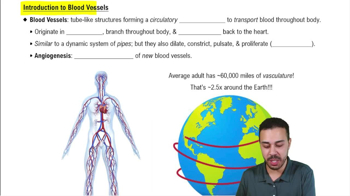
Transport blood to tissues for exchange of gases, nutrients, and wastes; regulate blood flow and pressure; secrete chemicals.
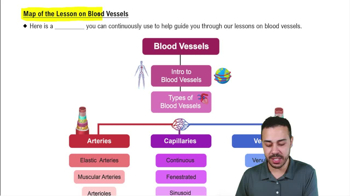
Three types of blood vessels
Arteries distribute blood from heart; capillaries exchange substances with tissues; veins collect blood and return it to heart.
Tunics of blood vessel walls
From inside out: tunica intima (endothelium), tunica media (smooth muscle and elastic fibers), tunica externa (connective tissue).
Role of tunica media
Contains smooth muscle controlling vessel diameter; regulates blood flow and pressure via vasoconstriction and vasodilation.
Differences between arteries and veins
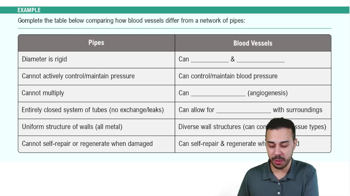
Arteries have thicker tunica media and more elastic laminae; veins have larger lumens, thinner walls, and valves to prevent backflow.
Classification of arteries by size
Elastic arteries (largest, near heart), muscular arteries (medium, distribute blood), arterioles (smallest, regulate flow to capillaries).
Baroreceptors and chemoreceptors
Pressure receptors in aorta and carotid arteries detect blood pressure; chemoreceptors detect oxygen, carbon dioxide, and pH levels.
Vein characteristics
Veins outnumber arteries, have larger lumens, thinner walls, less smooth muscle, and contain valves to prevent blood backflow.
Atherosclerosis
Plaque buildup in arterial tunica intima caused by injury to endothelium; leads to vessel inflammation, narrowing, and risk of clots.
Hemodynamics
Study of blood flow; blood moves down pressure gradients created by the heart; flow is proportional to pressure gradient and inversely proportional to resistance.
Effect of cross-sectional area on blood velocity
As total cross-sectional area increases (in smaller vessels), blood velocity decreases, allowing efficient exchange in capillaries.
Factors determining blood pressure
Blood pressure depends on cardiac output, peripheral resistance, and blood volume.
Peripheral resistance factors
Resistance increases with smaller vessel radius, higher blood viscosity, and longer vessel length.
MAP ≈ diastolic pressure + 1/3 (systolic pressure − diastolic pressure); average pressure in systemic arteries.
Pulse pressure
Difference between systolic and diastolic pressures; reflects force generated by heart during contraction.
Venous return mechanisms
Venous valves prevent backflow; skeletal muscle pump and respiratory pump assist blood return to heart.
Varicose veins
Dilated, bulging veins caused by valve failure and blood pooling, often in lower limbs.
Short-term blood pressure regulation
Autonomic nervous system adjusts heart rate and vessel diameter; sympathetic increases BP via vasoconstriction and increased CO; parasympathetic decreases BP.
Baroreceptor reflex
Negative feedback loop where baroreceptors detect BP changes and medulla adjusts autonomic output to restore normal BP.
Vasovagal syncope
Fainting caused by sudden parasympathetic activation and sympathetic inhibition, leading to decreased cardiac output and vasodilation.
Hormones affecting blood pressure
Epinephrine, norepinephrine, thyroid hormone increase CO and resistance; angiotensin-II causes vasoconstriction; ANP decreases resistance.
Long-term blood pressure regulation
Kidneys regulate blood volume via urine output; hormones like ADH and aldosterone increase volume; ANP decreases volume.
Capillary exchange mechanisms
Substances cross capillaries via diffusion through membranes, movement through pores, and transcytosis for larger molecules.
Types of capillaries
Continuous (least leaky), fenestrated (pores for rapid exchange), sinusoidal (large gaps for blood cells and proteins).
 Back
 3:38