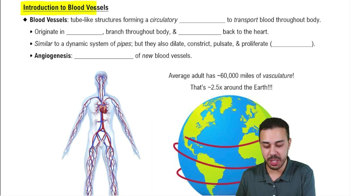
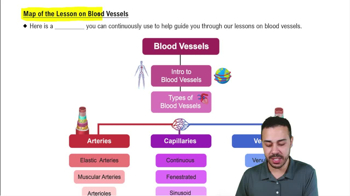
What are the main types of blood vessels and their primary functions?
Arteries carry blood away from the heart, arterioles are the smallest arterial branches, capillaries are the site of diffusion, venules collect blood from capillaries, and veins carry blood toward the heart.
What are the three layers of blood vessel walls?
Tunica intima (innermost, endothelial lining), tunica media (smooth muscle and connective tissue), and tunica externa (outer connective tissue sheath).
How does the tunica intima differ in arteries compared to veins?
In arteries, the tunica intima contains a thick layer of elastic fibers called the internal elastic membrane, which is absent in veins.
What is the function of the tunica media in blood vessels?
Contains smooth muscle that contracts to decrease vessel diameter (vasoconstriction) and relaxes to increase diameter (vasodilation), regulating blood flow and pressure.
What is the role of the tunica externa in veins?
It is usually thicker than the tunica media, contains collagen and elastic fibers, some smooth muscle cells, and stabilizes and anchors veins to surrounding tissues.
What are vasa vasorum and their function?
Small blood vessels that supply blood to the walls of large arteries and veins, providing nutrients since diffusion is insufficient.
List key differences between arteries and veins.
Arteries have thicker walls and tunica media with more smooth muscle, retain shape when compressed, and lack valves. Veins have thinner walls, contain valves to prevent backflow, and collapse when empty.
Define vasoconstriction and vasodilation in arteries.
Vasoconstriction is the contraction of smooth muscle decreasing artery diameter; vasodilation is relaxation increasing diameter, affecting heart workload, blood pressure, and capillary flow.
What are the three types of arteries and their characteristics?
Elastic arteries tolerate pressure changes (e.g., aorta), muscular arteries distribute blood to organs with more smooth muscle, and arterioles have thin tunica externa and regulate diameter locally.
Describe continuous capillaries and their function.
Have a complete endothelial lining, found in most tissues, allow diffusion of water, solutes, and lipid-soluble molecules, and help form the blood-brain barrier.
What distinguishes fenestrated capillaries?
Contain pores in the endothelium allowing rapid exchange of materials; found in kidneys, endocrine glands, and small intestine.
What are sinusoids and where are they found?
Flattened, irregular capillaries with gaps allowing free exchange of water and large solutes; found in liver, bone marrow, spleen, and some glands.
What is the function of precapillary sphincters in capillary beds?
Smooth muscle rings that regulate blood flow into capillaries by contracting to reduce or stop flow and relaxing to allow flow.
What is an arteriovenous anastomosis?
A direct connection between arterioles and venules that bypasses capillary beds, regulated by the medulla oblongata.
Why do veins have valves and how do they function?
Valves prevent backflow of blood in low-pressure venous system, aiding venous return especially during skeletal muscle contraction.
What is blood capacitance and which vessels have high capacitance?
Capacitance is the relationship between blood volume and pressure; veins have high capacitance, storing most of the blood volume.
How does blood pressure change across the cardiovascular system?
Highest in arteries, decreases through arterioles and capillaries, and is lowest in veins.
Define systolic and diastolic blood pressure.
Systolic pressure is peak arterial pressure during ventricular contraction; diastolic pressure is minimum pressure during ventricular relaxation.
What determines whether filtration or reabsorption occurs in capillaries?
Net filtration pressure (NFP) = difference between net hydrostatic pressure and net osmotic pressure; filtration occurs if hydrostatic > osmotic, reabsorption if less.
What causes edema in tissues?
Excess fluid accumulation due to decreased capillary reabsorption or increased hydrostatic pressure, often from injury, starvation, or heart failure.
What are the three main factors cardiovascular regulation depends on?
Cardiac output, blood pressure, and peripheral resistance.
What is autoregulation in cardiovascular control?
Local changes in blood flow caused by vasodilators (e.g., CO2, lactic acid, NO) or vasoconstrictors (e.g., prostaglandins) responding to tissue needs.
What role do baroreceptors play in blood pressure regulation?
They detect blood pressure changes and signal cardiovascular centers to adjust cardiac output and vessel diameter to maintain homeostasis.
How do chemoreceptors affect cardiovascular function?
They monitor blood CO2, O2, and pH levels, stimulating increased cardiac output and vasoconstriction when CO2 rises or pH falls.
What is the function of angiotensin II in blood pressure regulation?
How do natriuretic peptides regulate blood volume and pressure?
ANP and BNP promote sodium and water loss, reduce thirst, block ADH and aldosterone, and cause vasodilation to lower blood volume and pressure.
Describe cardiovascular responses to exercise.
Light exercise causes vasodilation and increased venous return; heavy exercise adds sympathetic activation restricting blood flow to nonessential organs and increasing flow to muscles, skin, heart, and lungs.
What are the short-term and long-term cardiovascular responses to hemorrhaging?
Short-term: increased cardiac output and vasoconstriction via reflexes and hormones. Long-term: fluid retention, increased thirst, and RBC production to restore blood volume.
How does fetal circulation bypass the lungs?
Through the foramen ovale (right to left atrium) and ductus arteriosus (pulmonary trunk to aorta), allowing blood to bypass nonfunctional fetal lungs.
 Back
Back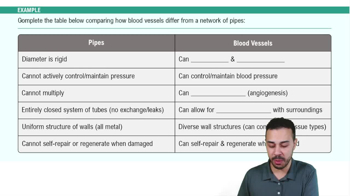
 3:38
3:38