Back

Blood Vessels and Circulation - Anatomy & Physiology

Control buttons has been changed to "navigation" mode.
1/26
  • What is the general flow of blood through the vessels starting from the heart?

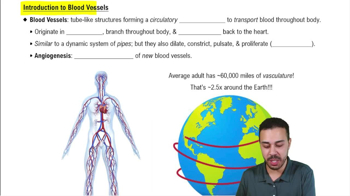
    Heart → Arteries → Arterioles → Capillaries → Venules → Veins → Heart
  • What are the three major layers of an artery wall?

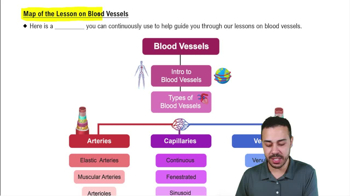
    Tunica interna (intima): innermost layer with endothelium and elastic lamina.
    Tunica media: middle layer of smooth muscle for vasoconstriction/dilation.
    Tunica externa: outer layer of elastic and collagen fibers.
  • Difference between elastic and muscular arteries?

    Elastic arteries are near the heart, have more elastic fibers, and conduct blood under pressure.
    Muscular arteries are near organs, have more smooth muscle, and control blood flow by vasoconstriction/dilation.
  • What is arteriosclerosis and its two main types?

    Arteriosclerosis is thickening and toughening of arterial walls.
    Types: Focal calcification (calcium deposits replacing muscle) and atherosclerosis (lipid plaque deposits in tunica media).
  • What role do arterioles play in circulation?

    Arterioles are small arteries that regulate blood flow into capillaries via vasoconstriction and vasodilation.
  • What is the primary function of capillaries?

    Capillaries permit exchange of nutrients, gases, and wastes between blood and tissues.
  • Name and describe the three types of capillaries.

    Continuous capillaries: no pores, continuous endothelial lining.
    Fenestrated capillaries: have pores for increased permeability.
    Sinusoids: large fenestrations, incomplete basement membrane, allow passage of large molecules.
  • How do veins differ structurally from arteries?

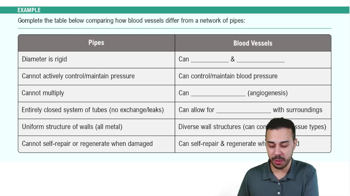
    Veins have thinner walls, less smooth muscle and elastic tissue, larger lumen, and contain valves to prevent backflow.
  • What causes varicose veins?

    Weakening of vein valves causes blood pooling and vein swelling, leading to varicose veins.
  • What are anastomoses and their function?

    Anastomoses are unions of two or more arteries supplying the same region, providing alternate blood routes.
  • Define blood flow and its relationship to pressure and resistance.

    Blood flow is the volume of blood passing through tissue per time.
    It is directly proportional to pressure and inversely proportional to resistance.
  • What are the three main pressures measured in the cardiovascular system?

    Blood pressure (BP): pressure in arteries.
    Capillary hydrostatic pressure (CHP): pressure in capillaries.
    Venous pressure: pressure in veins, lowest among the three.
  • How is mean arterial pressure (MAP) calculated?

    MAP = diastolic pressure + \(\frac{pulse\ pressure}{3}\)
  • Describe the skeletal muscle pump in venous return.

    Muscle contractions compress veins, opening valves to push blood toward the heart; valves close to prevent backflow.
  • What factors contribute to vascular resistance?

    Vascular resistance depends on lumen size (smaller lumen = higher resistance) and total vessel length (longer vessel = higher resistance).
  • What is the role of blood viscosity in resistance?

    Blood viscosity, influenced by RBC and plasma protein concentration, affects resistance; higher viscosity increases resistance.
  • Explain the three mechanisms of capillary exchange.

    Diffusion: movement of substances down concentration gradients.
    Filtration: hydrostatic pressure forces fluid out.
    Reabsorption: osmotic pressure draws fluid back in.
  • What is net filtration pressure (NFP) and its significance?

    NFP = hydrostatic pressure – osmotic pressure.
    Positive NFP at arterial end causes fluid to leave capillaries; negative NFP at venous end causes fluid reabsorption.
  • What is the cardiovascular center and its function?

    A group of neurons in the medulla that regulate heart rate, contractility, and vessel diameter via sympathetic and parasympathetic outputs.
  • How does the renin-angiotensin-aldosterone system regulate blood pressure?

    Low BP triggers renin release → angiotensinogen to angiotensin → aldosterone release → increased water reabsorption and vasoconstriction → increased BP.
  • What is autoregulation in local blood flow control?

    Tissues adjust their own blood flow to meet metabolic demands by changing vessel diameter locally.
  • How does the cardiovascular system respond to heavy exercise?

    Sympathetic activation increases cardiac output up to 4x resting, redirects blood to muscles, lungs, heart, and restricts flow to nonessential organs.
  • Describe the pulmonary circulation route.

    Right ventricle → pulmonary arteries → lungs (air sacs) → pulmonary veins → left atrium.
  • Describe the systemic circulation route.

    Left ventricle → aorta → arteries → arterioles → capillaries → venules → veins → superior/inferior vena cava → right atrium.
  • What happens to fetal circulation structures after birth?

    Ductus arteriosus → ligamentum arteriosum; foramen ovale → fossa ovalis; ductus venosus → ligamentum venosum; umbilical arteries/vein become ligaments.
  • List three age-related changes in blood vessels.

    Arteries become less elastic, calcium deposits form plaques, and risk of aneurysm and thrombi increases.