 Back
Blood Vessels and Circulatory System - Anatomy & Physiology
 3:38

Terms in this set (29)
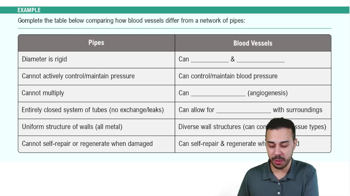
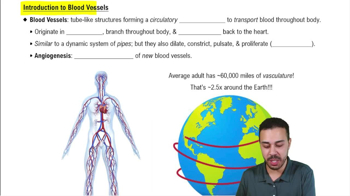
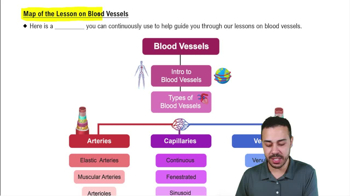
Include arteries, arterioles, capillaries, venules, and veins. They differ in structure and function related to blood flow and pressure.
Tunica intima (inner layer), tunica media (middle muscular layer), and tunica adventitia (externa, outer connective tissue layer).
The lumen is the hollow interior through which blood flows.
Small vessels that supply blood to the walls of large arteries and veins, nourishing their outer layers.
Blood flows from large elastic arteries to muscular arteries, then arterioles, capillaries, venules, and finally large veins.
They act as pressure reservoirs, maintaining blood pressure by stretching and recoiling during the cardiac cycle.
Arterioles regulate resistance to blood flow and control blood pressure by vasoconstriction and vasodilation.
Veins have a large capacity to hold blood due to their thin walls and large lumen, acting as blood reservoirs.
Blood flow is influenced by pressure gradients, vessel radius, blood viscosity, and vessel length.
Blood flow is proportional to the fourth power of the radius; small changes in radius cause large changes in flow.
Continuous, fenestrated, and sinusoidal capillaries differ in permeability and function as exchange vessels.
Flow is influenced by hydrostatic pressure, colloid osmotic pressure, bulk flow, and diffusion.
Include neural and hormonal controls that adjust cardiac output and vessel diameter rapidly.
Primarily involve regulation of blood volume by the kidneys.
Blood pressure (BP) = Cardiac output (CO) × Total peripheral resistance (TPR). \(BP=CO\times TPR\)
Vasoconstriction increases resistance; vasodilation decreases resistance, controlling blood flow and pressure.
Includes active hyperemia (increased flow with activity) and autoregulation (maintaining flow despite pressure changes).
Flow (F) = Change in pressure (ΔP) / Total peripheral resistance (TPR). \(F=\frac{\Delta P}{TPR}\)
Due to increasing total cross-sectional area and resistance as blood moves from arteries to capillaries and veins.
Systolic pressure is the peak arterial pressure during heart contraction; diastolic pressure is the minimum pressure during relaxation.
Sounds heard when measuring blood pressure caused by turbulent blood flow as the cuff pressure is released.
Pulse pressure (PP) = Systolic - Diastolic; Mean arterial pressure (MAP) = Diastolic + 1/3 Pulse pressure. \(PP=SP-DP\), \(MAP=DP+\frac{1}{3}PP\)
By adjusting their diameter through autoregulation, they regulate resistance and direct blood to tissues as needed.
Include autonomic nervous system and hormones that affect cardiac output, heart rate, stroke volume, and arteriole radius.
Baroreceptors detect pressure changes and trigger reflexes to maintain stable blood pressure.
Include the skeletal muscle pump and respiratory pump that assist venous return.
Increased blood volume raises blood pressure; decreased volume lowers it.
Arteries have thicker walls and higher pressure; veins have valves and larger lumens to accommodate blood volume.
Transports nutrient-rich blood from the digestive organs to the liver for processing before returning to the heart.