 Back
Body Organization and Directional Terms
 05:04

Terms in this set (23)
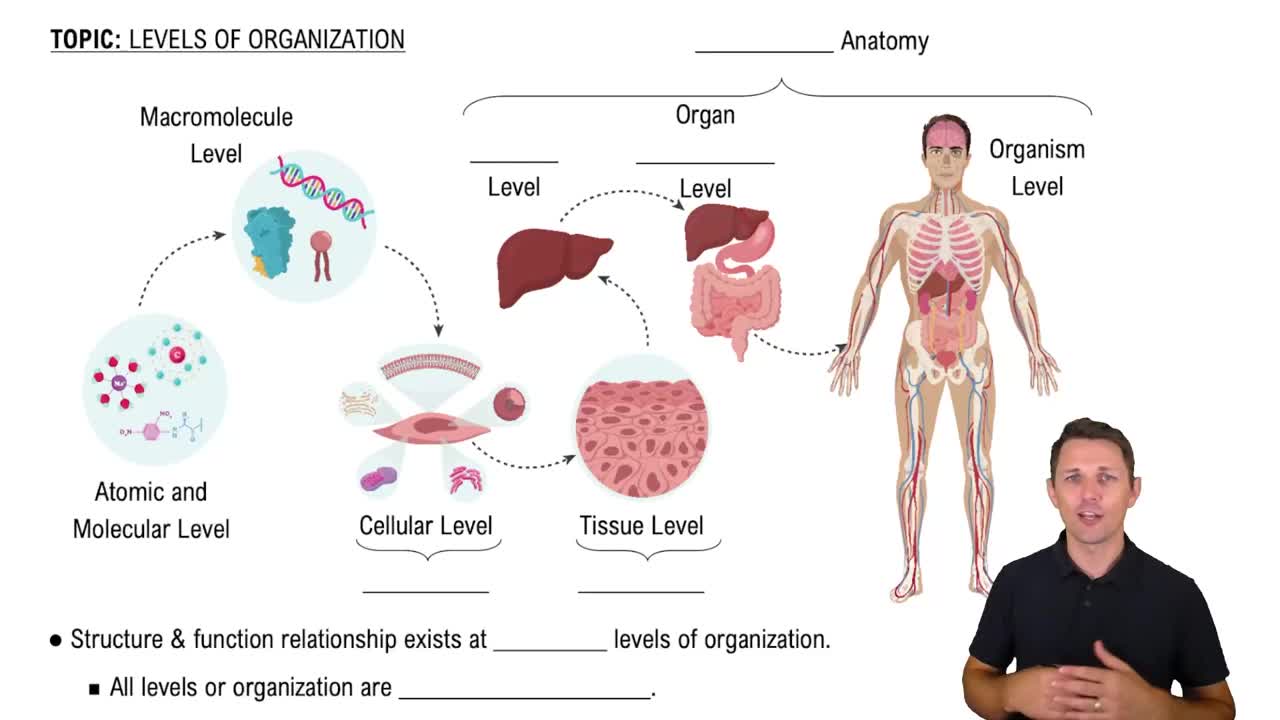
The cell is the basic structural and functional unit of the human body.
Tissue is a group of similar cells that perform a common function.
Epithelial, connective, muscle, and nervous tissues.
An organ is a structure composed of two or more tissue types working together to perform specific functions.
An organ system is a group of organs that work together to perform complex functions.
The anatomical position is the standard reference posture: standing upright, facing forward, arms at sides, palms facing forward.
Superior means toward the head or upper part of a structure.
Inferior means away from the head or toward the lower part of a structure.
Anterior or ventral means toward the front of the body.
Posterior or dorsal means toward the back of the body.
Medial means toward the midline of the body.
Lateral means away from the midline of the body.
Proximal means closer to the point of attachment or origin.
Distal means farther from the point of attachment or origin.
Superficial means toward or on the surface of the body.
Deep means away from the surface, more internal.
The sagittal plane divides the body into left and right parts.
The frontal or coronal plane divides the body into anterior and posterior parts.
The transverse or horizontal plane divides the body into superior and inferior parts.
Body cavities are spaces within the body that house and protect internal organs.
The dorsal cavity and the ventral cavity.
The brain and spinal cord are in the dorsal cavity.
The thoracic and abdominopelvic cavities contain organs like the heart, lungs, digestive organs, and reproductive organs.