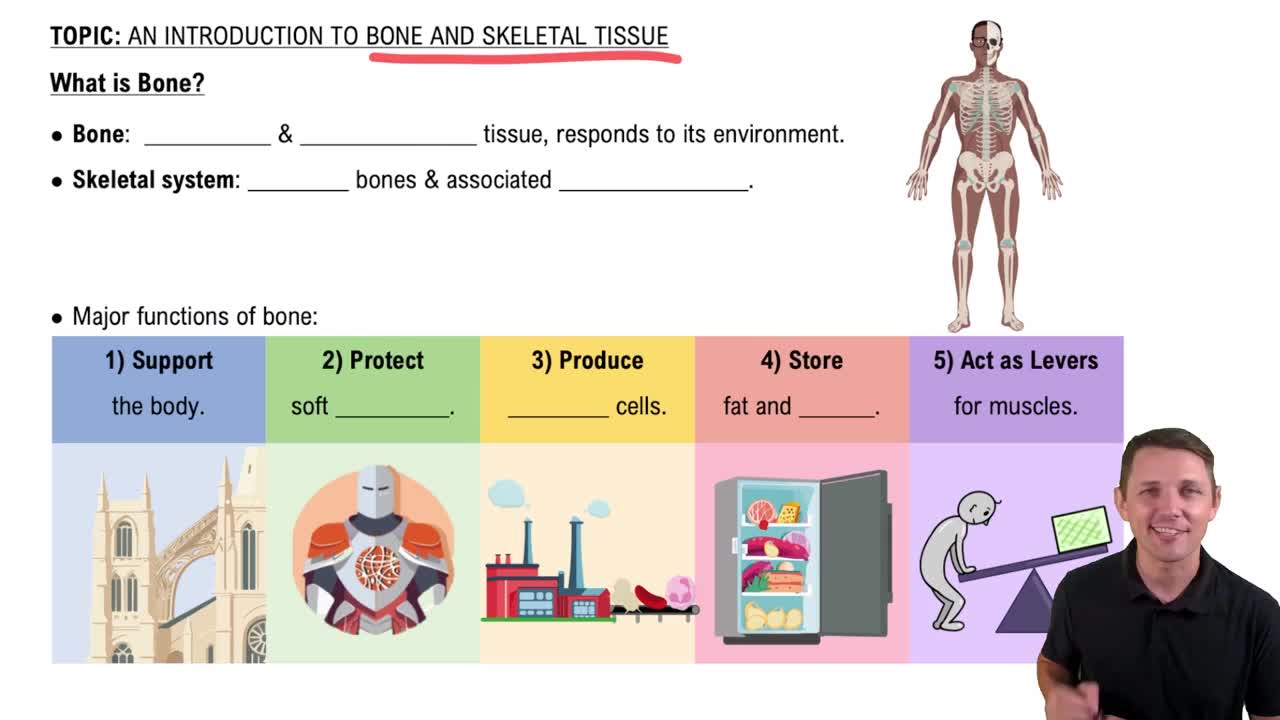
Support, protection, movement, mineral storage and acid-base homeostasis, blood cell formation, and fat storage.
What tissues compose bones?
Bones are composed of osseous (bone) tissue, dense regular and irregular connective tissue, and bone marrow.
Role of yellow bone marrow
Stores fat cells (adipocytes) that contain triglycerides, which can be broken down into fatty acids for cellular fuel.
Role of red bone marrow
Specialized connective tissue involved in hematopoiesis, the formation of blood cells.
What is the periosteum?
A membrane of dense irregular collagenous connective tissue surrounding the outer surface of a long bone, containing blood vessels, nerves, and bone cells.
Difference between diaphysis and epiphysis
The diaphysis is the shaft of a long bone, while the epiphyses are the ends of the bone.
What is the marrow (medullary) cavity?
A hollow cavity within the diaphysis containing either red bone marrow or yellow bone marrow depending on age and bone.
Function of articular cartilage
A thin layer of hyaline cartilage covering epiphyses to reduce friction and absorb shock at joints.
Compact bone vs spongy bone
Compact bone is dense and resists linear compression and twisting; spongy bone has a honeycomb structure that resists forces from multiple directions and houses bone marrow.
What is the endosteum?
A thin membrane covering the bony struts of spongy bone and all inner surfaces of bone.
How do long bones grow in length?
Through longitudinal growth at the epiphyseal plate by division of chondrocytes and ossification on the diaphyseal side.
What are the 5 zones of the epiphyseal plate?
Zone of reserve cartilage, zone of proliferation, zone of hypertrophy and maturation, zone of calcification, and zone of ossification.
What happens when the epiphyseal plate closes?
Longitudinal growth stops and the plate becomes the epiphyseal line, a calcified remnant.
Composition of bone extracellular matrix (ECM)
About 65% inorganic matrix (mostly hydroxyapatite crystals) and 35% organic matrix (osteoid) including collagen fibers.
Role of hydroxyapatite crystals in bone
Provide hardness and resistance to compression in bone.
Role of collagen fibers in bone
Provide tensile strength and resistance to twisting forces by forming cross-links aligned with hydroxyapatite crystals.
Functions of osteoblasts
Bone-building cells that perform bone deposition by secreting organic matrix and assisting in inorganic matrix formation.
Functions of osteocytes
Mature bone cells that maintain the bone matrix and communicate with osteoblasts to reinforce bone under tension.
Functions of osteoclasts
Large multinucleated cells responsible for bone resorption by secreting hydrogen ions and enzymes to break down bone matrix.
Structure of an osteon
A cylindrical unit of compact bone consisting of concentric lamellae surrounding a central (Haversian) canal containing blood vessels and nerves.
What are lacunae and canaliculi?
Lacunae are small cavities housing osteocytes; canaliculi are tiny canals connecting lacunae allowing cell communication.
What are interstitial and circumferential lamellae?
Interstitial lamellae fill spaces between osteons; circumferential lamellae form outer and inner layers of compact bone adding strength.
Role of perforating (Volkmann's) canals
Canals that connect neighboring osteons and carry blood vessels from the periosteum, running perpendicular to central canals.
Characteristics of spongy bone
Less dense, contains trabeculae that resist forces in multiple directions, and houses bone marrow within its cavities.
 Back
 3:56