 Back
Bones and Skeletal Tissues - Anatomy & Physiology
 3:56

Terms in this set (28)
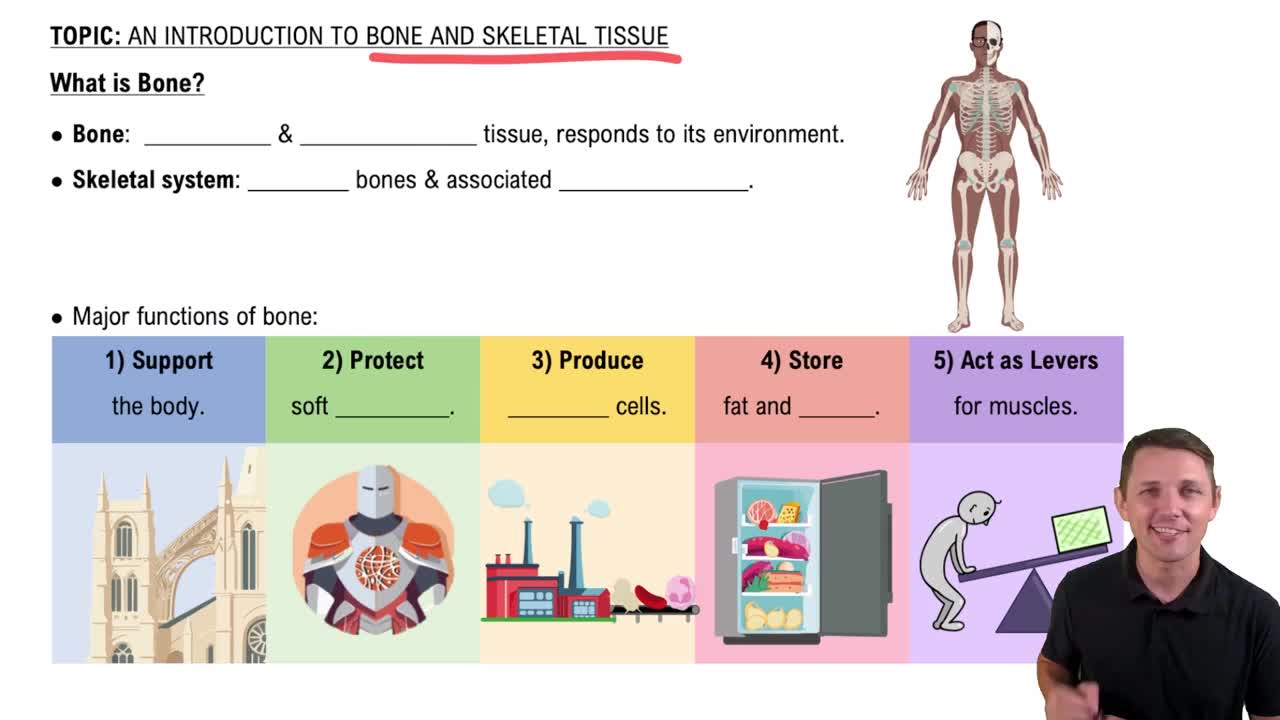
Support, protection, movement, mineral storage, blood cell formation (hemopoiesis), and energy storage in yellow marrow.
Compact bone is dense and solid, forming the outer layer; spongy bone is porous, found inside bones, and contains trabeculae with marrow spaces.
Hyaline cartilage, fibrocartilage, and elastic cartilage, each with distinct locations and functions.
Diaphysis (shaft), epiphyses (ends), medullary cavity, articular cartilage, periosteum, and endosteum.
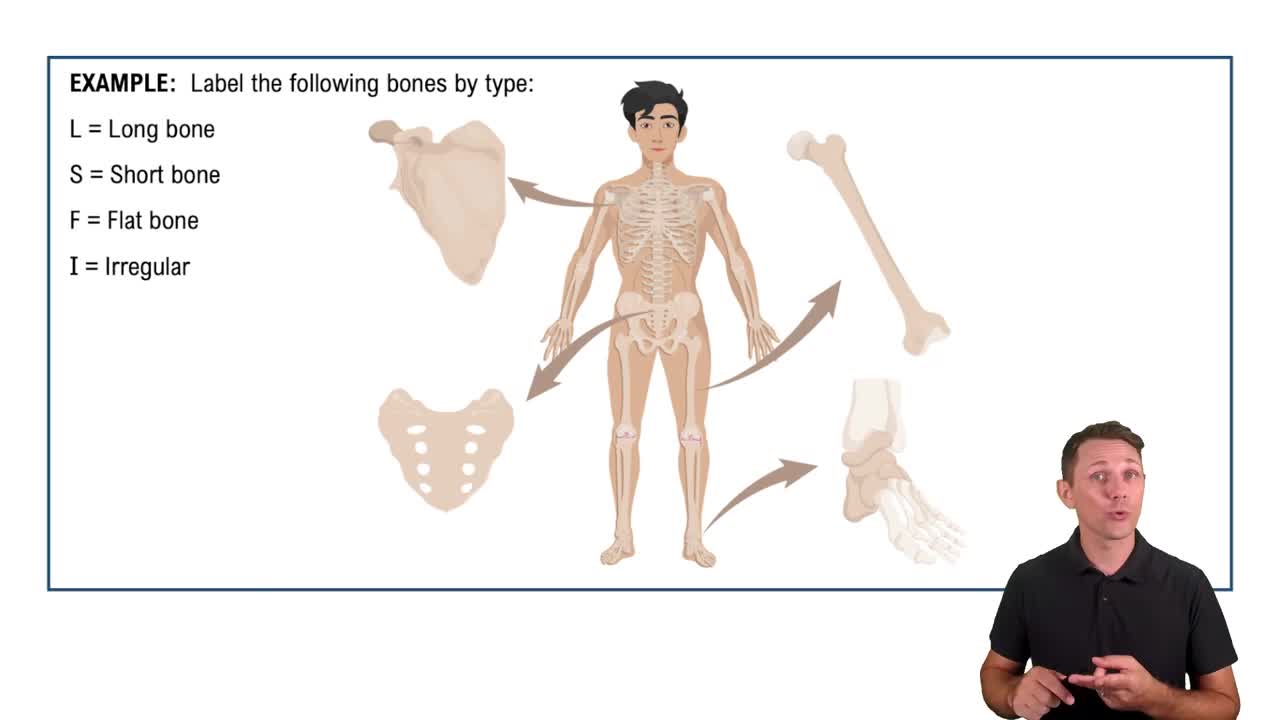
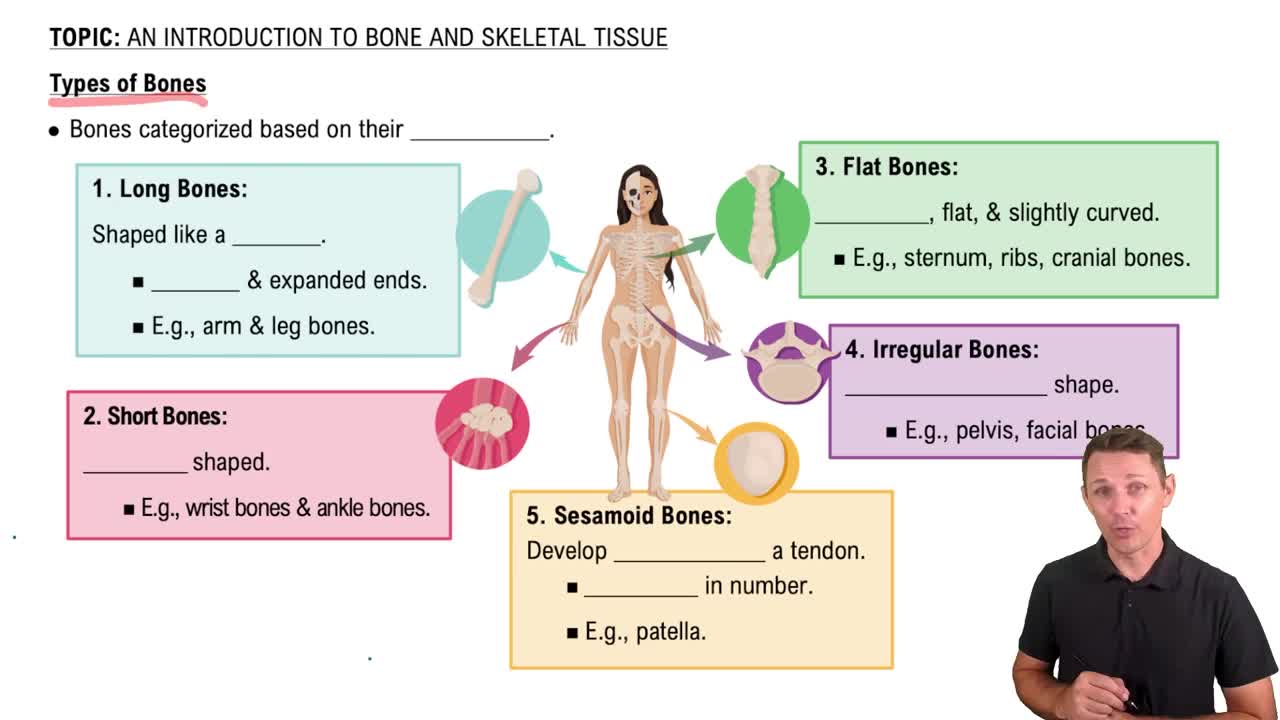
Long, short, flat, and irregular bones.
Red bone marrow produces blood cells and is found in spongy bone; yellow bone marrow stores fat and is found in the medullary cavity.
Osteoprogenitor cells (stem cells), osteoblasts (build bone), osteocytes (maintain bone), and osteoclasts (resorb bone).
Organic osteoid (collagen fibers) and inorganic hydroxyapatite crystals (\(\mathrm{Ca}_{10}(\mathrm{PO}_4)_6(\mathrm{OH})_2\)) for strength and flexibility.
Bone forms directly from mesenchymal tissue; occurs mainly in flat bones like the skull.
Bone develops by replacing hyaline cartilage; typical in long bones.
Resting, proliferative, hypertrophic, calcification, and ossification zones; responsible for lengthwise bone growth.
Bone growth in thickness by adding new bone tissue to the surface.
Continuous process of bone resorption and formation to maintain strength and mineral homeostasis.
Increases bone density and strength by stimulating osteoblast activity.
Growth hormone, thyroid hormone, sex hormones, parathyroid hormone, calcitonin, and calcitriol.
Vitamin D is converted in the liver and kidneys to calcitriol, which increases calcium absorption in the intestines.
Increases blood calcium by stimulating osteoclasts and enhancing calcium absorption and reabsorption.
Decreases blood calcium by inhibiting osteoclast activity and promoting calcium deposition in bone.
Complete vs incomplete, simple (closed) vs compound (open), and displaced vs nondisplaced fractures.
Hematoma formation, fibrocartilaginous callus formation, bony callus formation, and bone remodeling.
Consists of osteons with central (Haversian) canals, concentric lamellae, lacunae with osteocytes, and canaliculi.
A dense connective tissue membrane covering bone surfaces; contains osteogenic cells and provides attachment for tendons and ligaments.
Ligaments connect bone to bone; tendons connect muscle to bone; both are dense regular connective tissue.
The process of blood cell formation, primarily occurring in red bone marrow.
Small opening in bone that allows blood vessels and nerves to enter and nourish the bone.
Irregular lattice of thin plates providing structural support and housing red bone marrow.
A dense connective tissue layer surrounding cartilage, containing blood vessels for nutrient delivery.
Interstitial growth increases cartilage length from within; appositional growth increases thickness by adding layers on the surface.