What are the two main tissue types that comprise the skeleton?
Skeletal cartilage and bone.
What is the embryonic skeleton primarily formed from?
Formed from hyaline cartilage and fibrous membrane, which are replaced by bone early in development.
What is the perichondrium and its function?
A connective tissue layer that helps cartilage resist outward expansion and contains blood vessels for nutrient delivery.
Name the three types of cartilage found in the human skeleton.
Hyaline cartilage, elastic cartilage, and fibrocartilage.
Describe appositional growth of cartilage.
Cartilage-forming cells in the perichondrium secrete matrix against the external face of existing cartilage, adding new matrix on the surface.
Describe interstitial growth of cartilage.
Chondrocytes within lacunae divide and secrete new matrix, expanding cartilage from within.
List the seven important functions of bones.
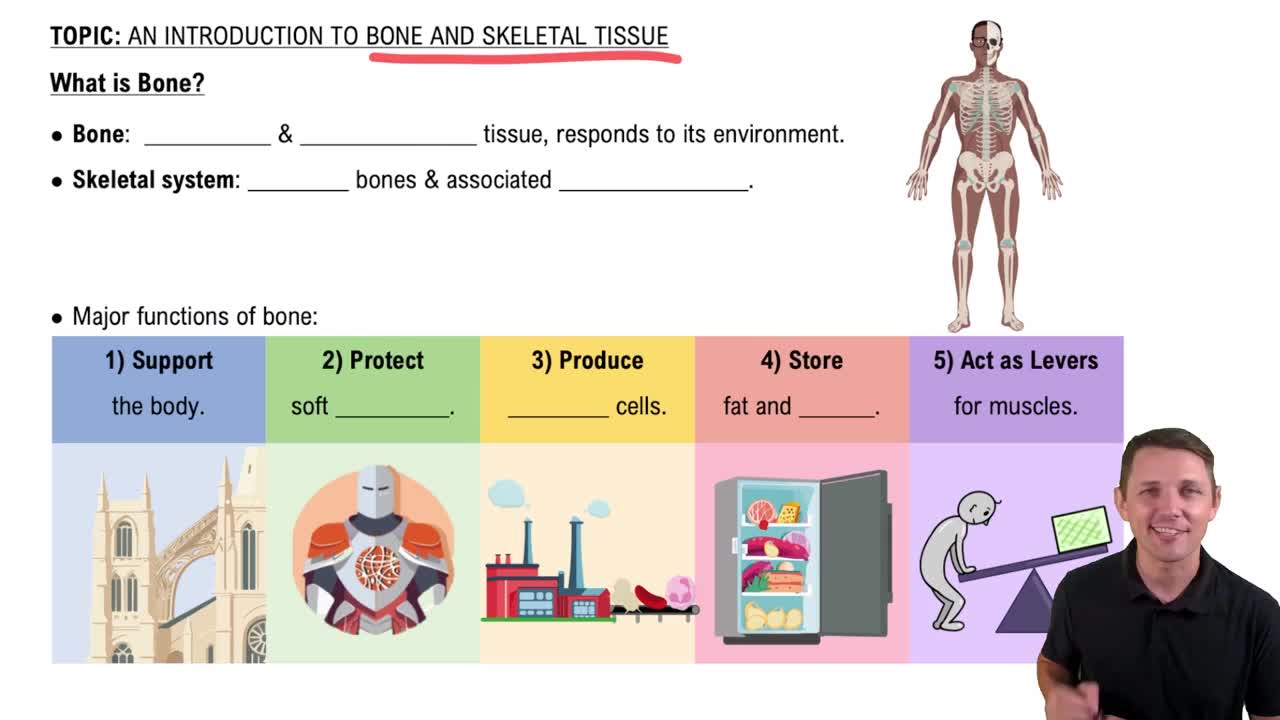
Support, protection, movement, mineral and growth factor storage, blood cell formation, triglyceride storage, and hormone production.
What hormone is secreted by bones and what is its role?
Osteocalcin helps regulate insulin secretion, glucose levels, and metabolism.
How are bones classified by location?
Into axial skeleton (skull, vertebral column, rib cage) and appendicular skeleton (limbs and girdles).
What are the four shapes of bones?
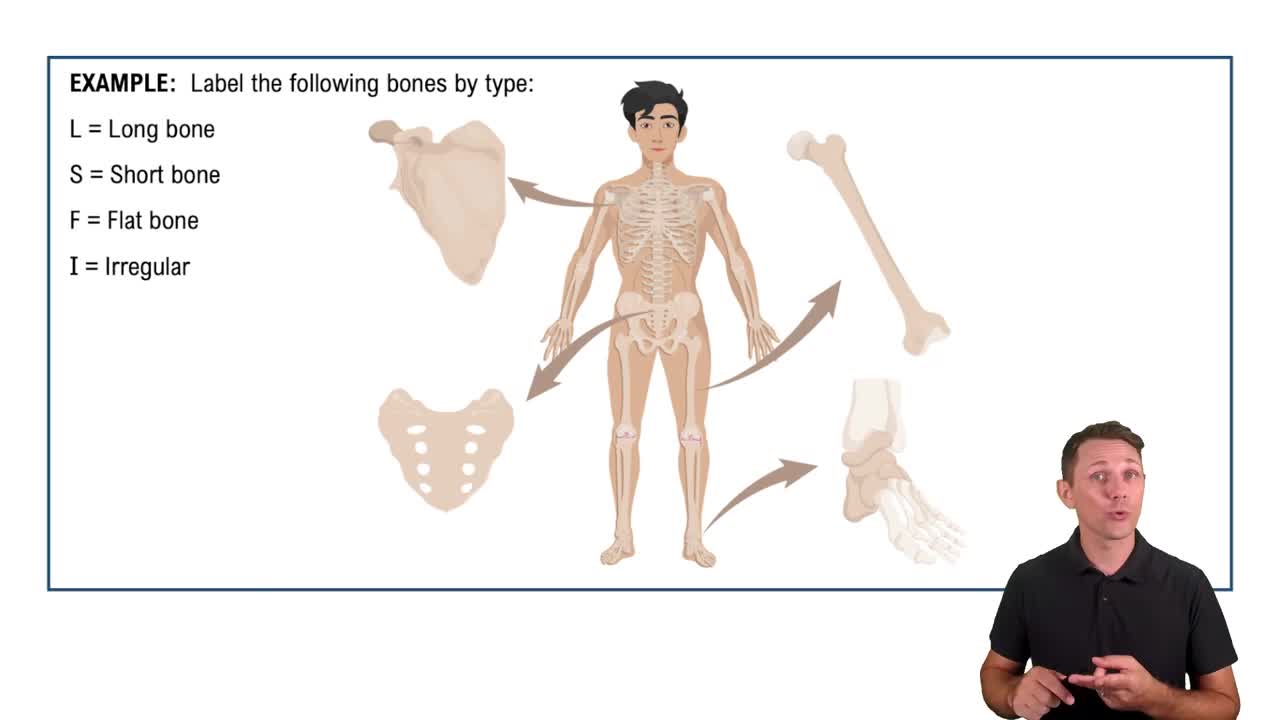
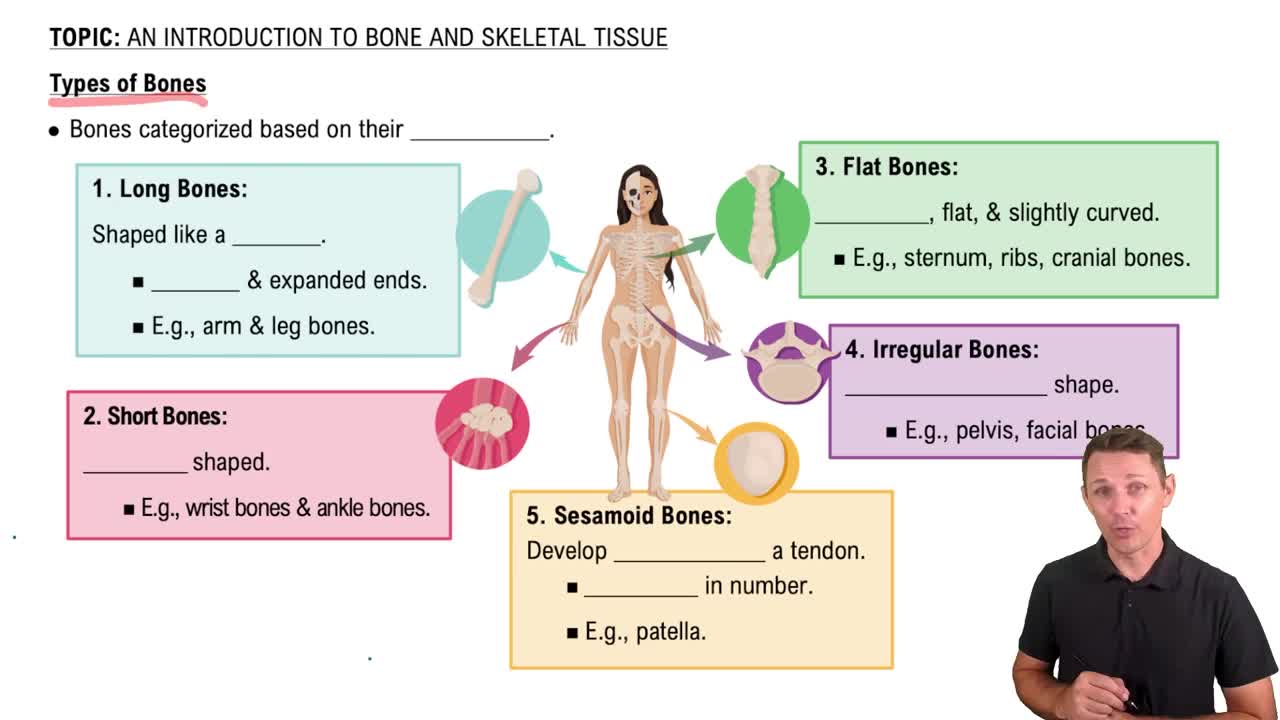
Long bones, short bones, flat bones, and irregular bones.
What distinguishes compact bone from spongy bone?
Compact bone is dense and smooth, forming the outer layer; spongy bone is porous with trabeculae and contains marrow.
What is the structure and function of the osteon?
The osteon is the structural unit of compact bone, consisting of concentric lamellae around a central canal, providing strength and resistance to twisting.
What are the five major cell types in bone tissue?
Osteogenic cells, osteoblasts, osteocytes, bone-lining cells, and osteoclasts.
What is the role of osteoblasts?
Bone-forming cells that secrete unmineralized bone matrix called osteoid.
What is the function of osteocytes?
Mature bone cells that maintain bone matrix, respond to mechanical stimuli, and regulate calcium homeostasis.
What is the role of osteoclasts in bone tissue?
Multinucleate cells responsible for bone resorption by breaking down bone matrix.
What is endochondral ossification?
Bone formation by replacing hyaline cartilage, forming most of the skeleton below the skull.
What is intramembranous ossification?
Bone develops directly from fibrous connective tissue membranes, forming flat bones like the skull and clavicles.
How do long bones grow in length?
By interstitial growth at the epiphyseal plate, where cartilage grows and is replaced by bone.
 Back
 3:56