Back

Bones and Skeletal Tissues - Anatomy & Physiology

Control buttons has been changed to "navigation" mode.
1/20
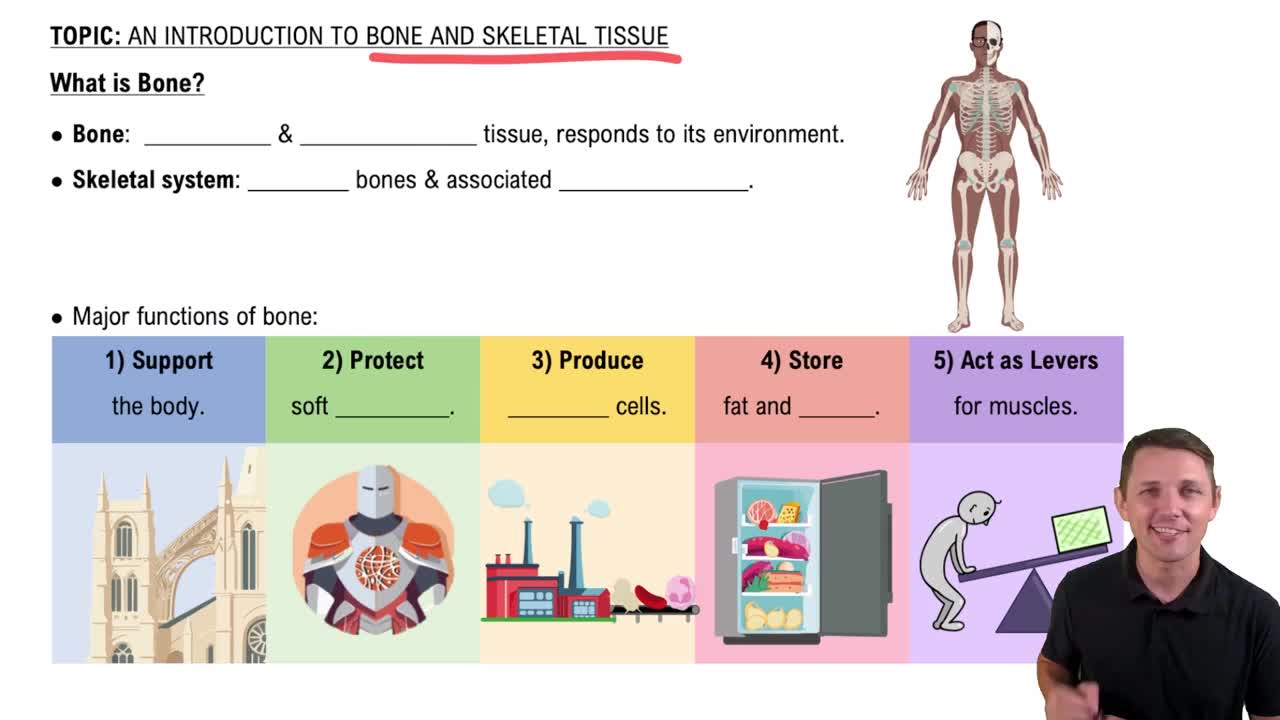
  • What is bone?

    Bone is a dynamic connective tissue that responds to its environment.
  • Major functions of bone

    • Support the body
    • Protect soft organs
    • Produce blood cells
    • Store fat and minerals
    • Act as levers for muscles
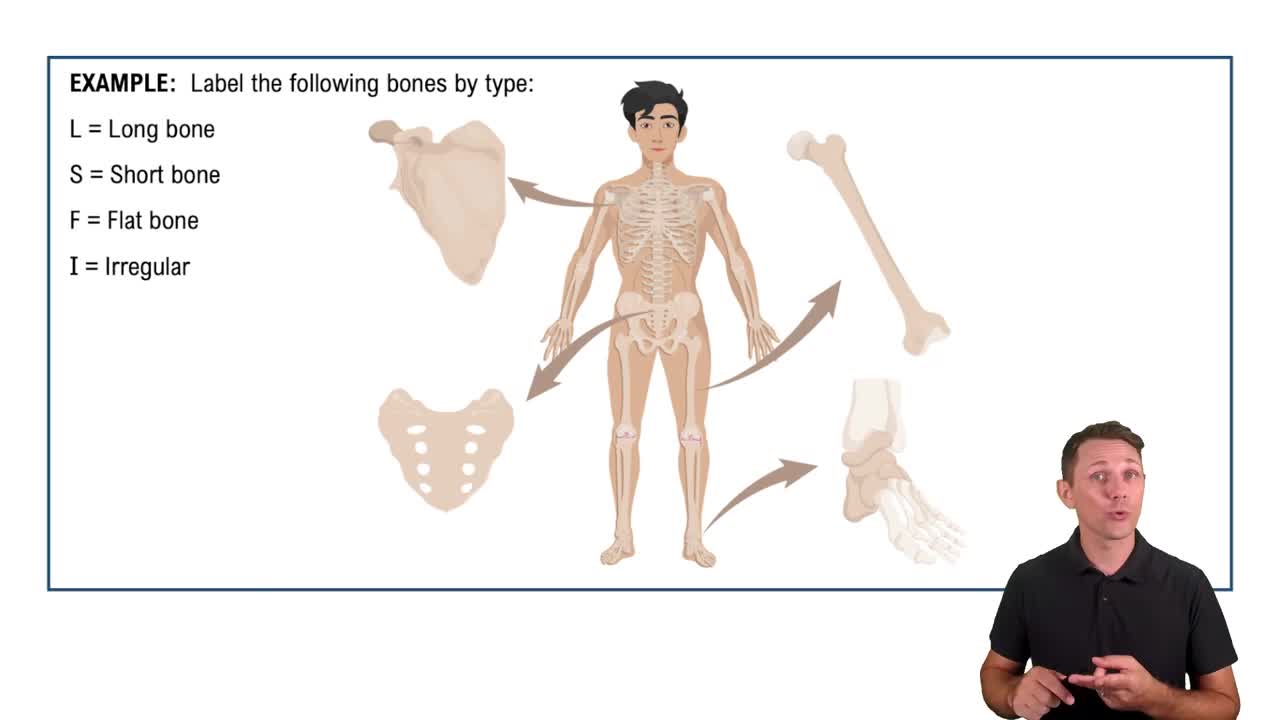
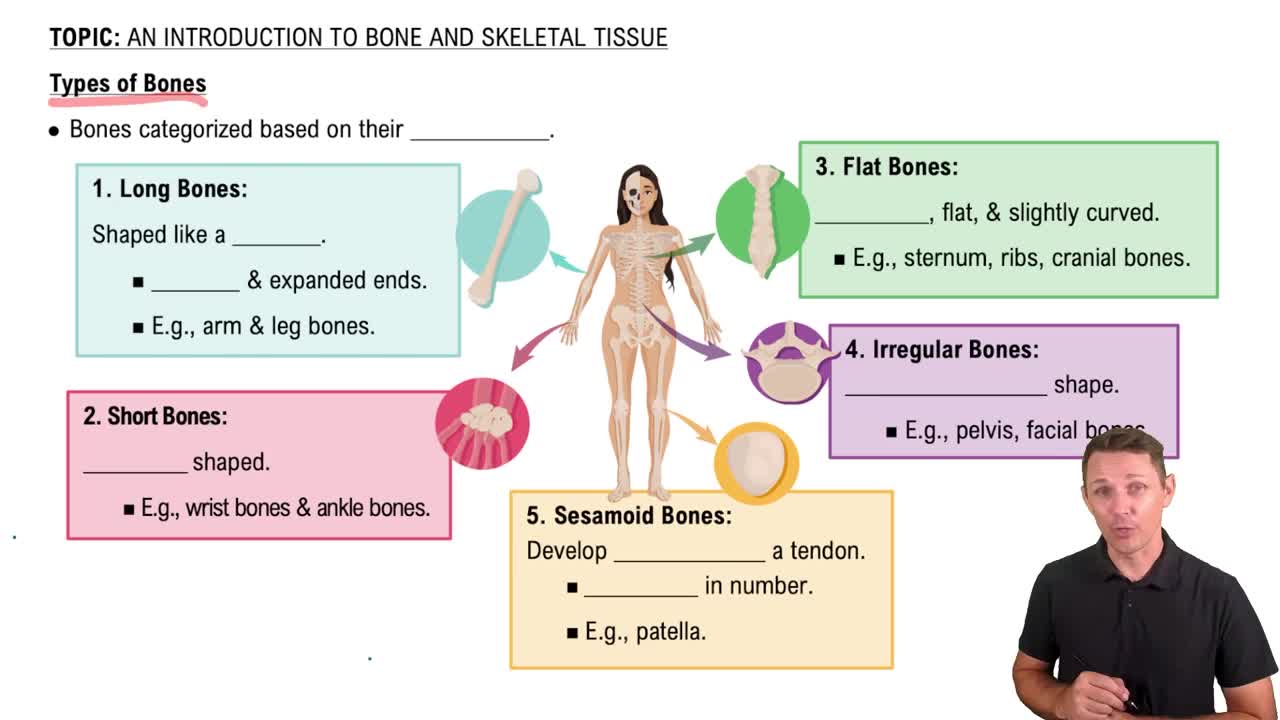
  • Types of bones based on shape

    • Long bones: shaped like a rod, e.g., arm and leg bones
    • Short bones: cube-shaped, e.g., wrist and ankle bones
    • Flat bones: thin, flat, slightly curved, e.g., sternum, ribs, cranial bones
    • Irregular bones: complex shapes, e.g., pelvis, facial bones
    • Sesamoid bones: develop in tendons, e.g., patella
  • Difference between compact and spongy bone

    Compact bone is dense with no visible spaces, optimized for strength and hardness. Spongy bone looks like scaffolding with trabeculae, reduces bone weight, and contains marrow.
  • Periosteum structure and function

    Periosteum covers the outer bone surface with two layers: fibrous (dense connective tissue, vascularized, innervated) and osteogenic (contains bone stem cells).
  • Endosteum characteristics

    Endosteum lines internal bone surfaces, similar in composition to the osteogenic layer of periosteum, containing osteoprogenitor cells.
  • Types of bone marrow and their functions

    • Red marrow: site of hematopoiesis, found in spongy bone of adults and most bones in children
    • Yellow marrow: fat storage, found in medullary cavity, can revert to red marrow
  • Structure of a long bone

    Long bones have epiphysis (ends covered with articular cartilage), diaphysis (shaft with medullary cavity containing marrow), and metaphysis (growth area with epiphyseal plate).
  • Nutrient foramen role

    Small opening in diaphysis allowing blood vessels and nerves to enter bone, supplying the medullary cavity and bone tissue.
  • Inorganic matrix of bone

    Composed of hydroxyapatite crystals (calcium phosphate and calcium hydroxide), making up 65% of bone mass and providing hardness.
  • Organic matrix (osteoid) of bone

    Made of collagen fibers and ground substance, about 35% of bone mass, providing tensile strength and flexibility.
  • Bone cells and their functions

    • Osteoprogenitor cells: bone stem cells
    • Osteoblasts: build bone by secreting matrix
    • Osteocytes: mature cells maintaining matrix
    • Osteoclasts: break down bone for remodeling
  • Osteoblasts role

    Secrete collagen fibers and enzymes for bone matrix formation; active in bone growth and repair; some become osteocytes.
  • Osteocytes characteristics

    Mature bone cells trapped in lacunae; maintain bone matrix; communicate via canaliculi; regulate calcium homeostasis.
  • Osteoclasts function

    Multinucleated cells that dissolve bone matrix by secreting acid and enzymes; essential for bone remodeling and calcium regulation.
  • Osteon (Haversian system)

    Structural unit of compact bone consisting of a central canal with blood vessels, concentric lamellae of matrix, and lacunae containing osteocytes.
  • Function of lamellae arrangement

    Alternating collagen fiber directions in lamellae provide bone strength and resistance to stress from multiple directions.
  • Trabeculae in spongy bone

    Small struts of bone containing lamellae and osteocytes; lack central canals; align with stress lines to provide strength with lightness.
  • Difference between red and yellow marrow locations

    Red marrow is found in spongy bone of epiphyses; yellow marrow fills medullary cavity in diaphysis.
  • Role of perforating fibers

    Collagen fibers that anchor periosteum to the bone matrix, providing strong attachment points for tendons and ligaments.