What is the primary function of the cardiovascular system?
To transport oxygen, nutrients, cell wastes, and hormones to and from cells through a closed system of the heart and blood vessels.
What are the coverings of the heart?
The heart is covered by the pericardium, a double-walled sac consisting of the fibrous pericardium (superficial) and the serous pericardium (deep), which has parietal and visceral layers.
What are the four chambers of the heart and their functions?
Right and left atria (superior receiving chambers) assist in filling ventricles; right and left ventricles (inferior discharging chambers) pump blood into circulation.
What separates the atria and ventricles longitudinally?
The interatrial septum separates the atria, and the interventricular septum separates the ventricles.
Describe the heart's function as a double pump.
The right side pumps blood to the lungs (pulmonary circuit), and the left side pumps oxygen-rich blood to the body (systemic circuit).
What are the major heart valves and their roles?
Atrioventricular valves (bicuspid/mitral and tricuspid) prevent backflow between atria and ventricles; semilunar valves (pulmonary and aortic) prevent backflow from arteries.
How do the atrioventricular valves operate during the cardiac cycle?
They open during heart relaxation to allow blood flow into ventricles and close during ventricular contraction to prevent backflow.
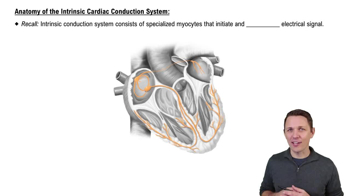
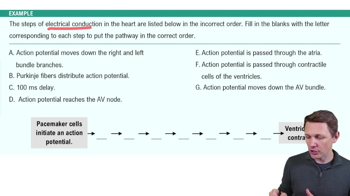
What is the intrinsic conduction system of the heart?
A system of specialized nervous tissue including the sinoatrial node, atrioventricular node, bundle of His, bundle branches, and Purkinje fibers that controls heart rhythm.
What is the normal heart rate set by the sinoatrial node?
Approximately 75 beats per minute.
Define tachycardia and bradycardia.
Tachycardia is a rapid heart rate over 100 beats per minute; bradycardia is a slow heart rate under 60 beats per minute.
What are the two phases of the cardiac cycle?
Systole (contraction) and diastole (relaxation) of the atria and ventricles.
What causes the 'lub' and 'dup' heart sounds?
'Lub' is caused by closing of atrioventricular valves; 'dup' is caused by closing of semilunar valves at the end of ventricular systole.
The volume of blood pumped by each ventricle in one contraction, about 70 milliliters per beat.
Explain Starling's law of the heart.
The stroke volume increases with greater cardiac muscle stretch (preload), resulting in a stronger contraction.
What factors regulate stroke volume extrinsically?
Contractility influenced by the sympathetic nervous system and afterload, the pressure ventricles must overcome to eject blood.
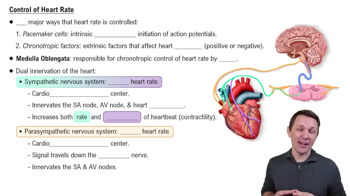
How do neural controls affect heart rate?
Sympathetic nervous system increases heart rate; parasympathetic nervous system decreases and steadies heart rate.
What role do hormones and ions play in heart rate regulation?
Epinephrine and thyroxine increase heart rate; imbalances in calcium, sodium, and potassium ions modify heart activity.
Describe the structure of blood vessel walls.
Three layers: tunica intima (endothelium), tunica media (smooth muscle and elastic tissue), and tunica externa (fibrous connective tissue).
How do arteries and veins differ structurally?
Arteries have thicker, stronger tunica media to withstand high pressure; veins have thinner walls, valves to prevent backflow, and operate under low pressure.
What is the function of capillaries?
Capillaries are one cell layer thick, allowing exchange of gases, nutrients, and wastes between blood and tissues.
What is blood pressure and how is it measured?
Blood pressure is the force blood exerts on vessel walls, measured as systolic (peak contraction) over diastolic (ventricular relaxation) pressure in mm Hg.
What is the normal range for systolic and diastolic blood pressure?
Systolic: 110-140 mm Hg; diastolic: 70-80 mm Hg.
What is hypertension and hypotension?
Hypertension is blood pressure above normal range; hypotension is blood pressure below normal range.
How does capillary exchange occur?
Substances move between blood and tissue cells through capillary walls by concentration gradients, with oxygen and nutrients leaving blood and wastes entering blood.
Name some age-related cardiovascular problems.
Weakening of venous valves, varicose veins, arteriosclerosis, hypertension from vessel elasticity loss, and coronary artery disease from fatty deposits.
 Back
 6:13