 Back
Cardiovascular System: Blood Vessels and Blood Pressure
 14:43

Terms in this set (34)
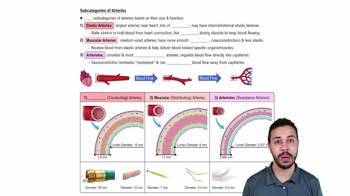
Blood vessels that carry blood away from the heart, usually oxygenated except in pulmonary circulation.
Small branches of arteries that lead to capillaries and regulate blood flow by vasoconstriction and vasodilation.
Sensors located in arteries that detect changes in blood pressure and help regulate it.
The volume of blood moving through a vessel, organ, or entire circulation in a given period.
The force exerted by circulating blood on the walls of blood vessels, measured in mmHg.
Microscopic blood vessels where exchange of gases, nutrients, and wastes occurs between blood and tissues.
A network of capillaries supplying blood to a specific tissue area.
Capillaries with uninterrupted endothelial lining allowing selective permeability.
Regulated by neural, hormonal, and renal mechanisms to maintain homeostasis.
The lowest arterial pressure during ventricular relaxation (diastole).
Large arteries with elastic fibers that stretch and recoil to maintain blood pressure during cardiac cycles.
Capillaries with pores that allow increased permeability for exchange of larger molecules.
Condition of chronically elevated blood pressure above normal ranges.
Condition of abnormally low blood pressure that may cause inadequate tissue perfusion.
The average pressure in arteries during one cardiac cycle; calculated as \(\text{MAP} = \text{DP} + \frac{1}{3}(\text{SP} - \text{DP})\).
Typically done using a sphygmomanometer to record systolic and diastolic pressures.
Assessment of heart rate by palpating arterial expansions caused by blood ejection.
Medium-sized arteries with thick tunica media that distribute blood to specific body regions.
The opposition to blood flow caused by vessel diameter, length, and blood viscosity.
Pathway of blood from the heart to the lungs and back for oxygenation.
The difference between systolic and diastolic pressure; indicates the force generated by the heart.
Kidneys regulate blood volume and pressure via fluid balance and hormone release.
Capillaries with large gaps allowing passage of cells and large molecules, found in liver and bone marrow.
Circulation of blood from the heart to the body tissues and back.
The highest arterial pressure during ventricular contraction (systole).
The outermost layer of blood vessels composed of connective tissue providing support and protection.
The innermost layer of blood vessels lined by endothelium, providing a smooth surface for blood flow.
The middle layer of blood vessels made of smooth muscle and elastic fibers controlling vessel diameter.
Connections between blood vessels that provide alternative pathways for blood flow.
The narrowing of blood vessels due to contraction of smooth muscle in the tunica media.
The widening of blood vessels due to relaxation of smooth muscle in the tunica media.
Blood vessels that carry blood toward the heart, often deoxygenated except in pulmonary circulation.
Structures in veins that prevent backflow of blood and assist venous return to the heart.
Small vessels that collect blood from capillaries and deliver it to veins.