What is the primary function of the Golgi apparatus?
The Golgi apparatus modifies, concentrates, and packages proteins and lipids received from the rough ER, acting as the cell's 'traffic director' for vesicle transport.
Describe the three main steps involved in Golgi apparatus function.
1. Transport vesicles from ER fuse with the Golgi's inner face. 2. Proteins/lipids are modified, tagged, sorted, and packaged. 3. Final vesicles exit the Golgi to their destinations.
What are lysosomes and their main roles?
Lysosomes are spherical membranous bags containing digestive enzymes that digest bacteria, degrade nonfunctional organelles, and break down glycogen and bone to release Ca2+.
What happens during lysosome autolysis?
When cells are damaged, lysosomes can leak digestive enzymes, causing self-digestion or autolysis of the cell.
What are peroxisomes and their function?
Peroxisomes are membranous sacs containing oxidases and catalases that neutralize toxins, break down fatty acids, and detoxify free radicals.
What are free radicals and how are they managed in cells?
Free radicals are toxic, highly reactive molecules produced by metabolism; peroxisomes neutralize them using oxidases and catalases.
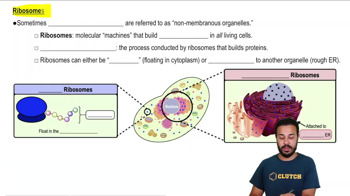
What are ribosomes and their two forms?
Ribosomes are nonmembranous organelles that synthesize proteins. Free ribosomes make soluble proteins; membrane-bound ribosomes make proteins for membranes or export.
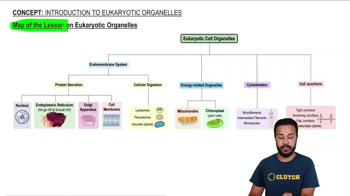
What is the cytoskeleton and its three main components?
The cytoskeleton is a network of rods in the cytosol, including microfilaments, intermediate filaments, and microtubules, providing structure and facilitating movement.
Describe microfilaments and their function.
Microfilaments are the thinnest cytoskeletal elements made of actin; they strengthen the cell surface, resist compression, and aid in cell motility and shape changes.
What are intermediate filaments and their role?
Intermediate filaments are tough, ropelike fibers that resist pulling forces and attach to desmosomes, acting as internal cell 'guy-wires'.
What are microtubules and their cellular functions?
Microtubules are hollow tubes of tubulin that determine cell shape, organize organelles, and serve as tracks for motor proteins moving cargo.
What is the centrosome and what structures does it contain?
The centrosome is the cell's microtubule organizing center near the nucleus, containing a pair of centrioles that help form cilia and flagella.
What are cilia and flagella, and how do they differ?
Cilia are small, hairlike structures that move fluids over cell surfaces; flagella are larger, propelling entire cells, like sperm tails.
What is the function of microvilli?
Microvilli are fingerlike plasma membrane extensions that increase surface area for absorption, supported by actin microfilaments.
What role do motor proteins play in the cytoskeleton?
Motor proteins use ATP to move organelles and substances along microtubules or microfilaments, enabling intracellular transport and cell movement.
What is the nucleus and its main function?
The nucleus is the largest organelle containing DNA, serving as the cell's control center by directing protein synthesis.
Name the three main structures of the nucleus.
The nucleus consists of the nuclear envelope, nucleoli, and chromatin.
What is the nuclear envelope and its features?
The nuclear envelope is a double membrane with pores that encloses nucleoplasm; its outer layer is continuous with rough ER and studded with ribosomes.
What are nucleoli and their function?
Nucleoli are dark-staining bodies in the nucleus involved in rRNA synthesis and ribosome subunit assembly.
What is chromatin composed of and its significance?
Chromatin is DNA wrapped around histone proteins forming nucleosomes; it condenses into chromosomes during cell division to protect DNA.
What is a gene in terms of protein synthesis?
A gene is a DNA segment that holds the code for one polypeptide, specifying the order of amino acids.
How is the genetic code structured in DNA?
The code consists of triplets of nitrogen bases (A, G, T, C), where each triplet specifies an amino acid.
What are the two main steps of protein synthesis?
Protein synthesis occurs in transcription (DNA to mRNA) and translation (mRNA decoded to assemble polypeptides).
What is the role of RNA in protein synthesis?
RNA acts as a go-between linking DNA to proteins, with mRNA carrying the code, rRNA forming ribosomes, and tRNA bringing amino acids.
What is messenger RNA (mRNA)?
mRNA is single-stranded RNA transcribed from DNA that carries the genetic code to ribosomes for protein synthesis.
What is ribosomal RNA (rRNA)?
rRNA is a structural component of ribosomes, essential for translating mRNA into polypeptides.
 Back
 03:45