 Back
Cellular Respiration in Anatomy & Physiology
 01:44

Terms in this set (26)
Glucose and oxygen are the main inputs. The body obtains glucose from food and oxygen from breathing.
Carbon dioxide, water, and ATP are produced. Carbon dioxide is exhaled, water is used or excreted, and ATP powers cellular activities.
Occurs when oxygen is scarce. It allows ATP production without oxygen but produces less ATP and lactate as a byproduct.
Provides quick ATP supply during oxygen shortage and supports short bursts of intense activity.
Occurs when oxygen is available. It produces more ATP efficiently by fully oxidizing glucose.
Generates large amounts of ATP and supports sustained energy needs.
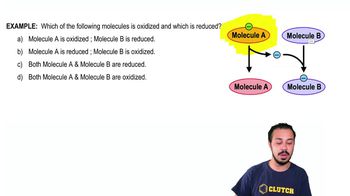
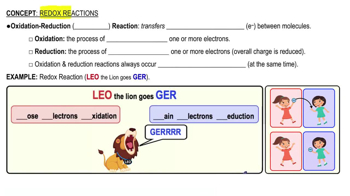
Glucose and pyruvate are oxidized; NAD+ is reduced to NADH.
Carbon-containing molecules like glucose and pyruvate lose electrons (are oxidized).
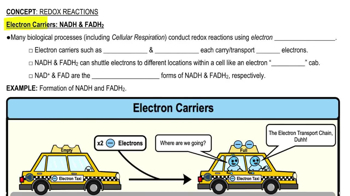
Electron carriers such as NAD+ gain electrons and are reduced to NADH.
In the cytoplasm of the cell.
Glucose is converted into 2 pyruvate molecules, producing a net gain of 2 ATP and 2 NADH.
ATP used early in glycolysis is less than ATP produced later, resulting in a net positive ATP yield.
Lack of NAD+ or glucose availability can stop glycolysis.
Glycolysis occurs in both aerobic and anaerobic respiration.
In the mitochondrial matrix.
Pyruvate is converted to Acetyl-CoA, producing NADH and releasing CO2.
Insufficient oxygen or enzyme dysfunction can stop pyruvate oxidation.
In the mitochondrial matrix.
Acetyl-CoA is oxidized to CO2, producing NADH, FADH2, and ATP.
Lack of Acetyl-CoA or NAD+ can stop the cycle.
In the inner mitochondrial membrane.
NADH and FADH2 donate electrons, becoming oxidized back to NAD+ and FAD.
Electrons are passed through protein complexes, releasing energy to pump protons and create a gradient.
Oxygen acts as the final electron acceptor, combining with electrons and protons to form water.
A higher concentration of protons in the intermembrane space used to drive ATP synthesis.
An enzyme that uses the proton gradient to synthesize ATP from ADP and inorganic phosphate.