 Back
Chapter 1 A&P intro2 - Slideshow 1
 05:04

Terms in this set (22)
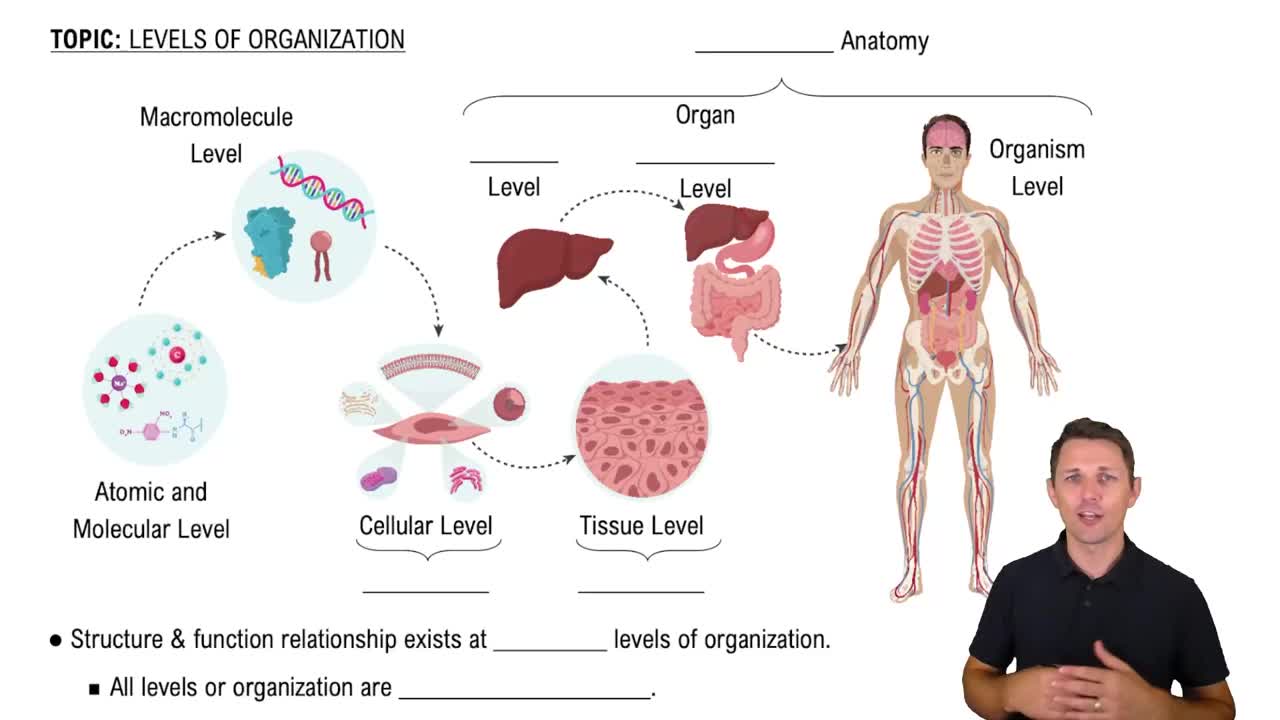
The six levels are Chemical, Cellular, Tissue, Organ, Organ System, and Organism.
The chemical level includes atoms and molecules, such as phospholipid molecules and atoms, which form the basic building blocks of matter.
The cellular level consists of cells, the smallest living units in the body, such as squamous epithelial cells with a cell membrane.
The tissue level is made up of groups of similar cells performing a common function, for example, stratified squamous epithelium.
An organ is a structure composed of at least two tissue types that performs a specific function, such as the esophagus.
An organ system is a group of organs that work together to perform complex functions, like the digestive system.
The organism level is the highest level, representing the entire living human body as a whole.
The 11 organ systems are: Integumentary, Skeletal, Muscular, Nervous, Cardiovascular, Lymphatic, Respiratory, Digestive, Urinary, Reproductive, and Endocrine systems.
It protects the body from external environment, produces vitamin D, retains water, and regulates body temperature.
Supports the body, protects internal organs, provides leverage for movement, produces blood cells, and stores calcium salts.
Produces movement, controls body openings, and generates heat.
Provides body functions control, sensation, movement, automatic functions, and higher mental functions via nerves, brain, and spinal cord.
Regulates body functions through hormones secreted by glands like the thyroid, adrenal, and pancreas.
Pumps and delivers oxygen-poor blood to lungs and oxygen-rich blood to tissues, transports wastes, nutrients, hormones, and antibodies.
Returns excess tissue fluid to the cardiovascular system and provides immunity against disease.
Delivers oxygen to blood, removes carbon dioxide from the body, and maintains acid-base balance of blood.
Digests food, absorbs nutrients into the blood, and removes food wastes while maintaining fluid, electrolyte, and acid-base balance.
Removes metabolic wastes from blood, maintains fluid, electrolyte, and acid-base balance, and stimulates blood cell production.
Produces and transports gametes, secretes hormones, and supports sexual function.
Word roots, combining vowels, prefixes, and suffixes are the main parts used to determine the meaning of medical terms.
The word root is the fundamental unit of a medical word, providing its basic meaning and serving as the base to which prefixes and suffixes are added.
The body stands upright, feet shoulder-width apart, upper limbs at the sides, head and palms facing forward; this is the common frame of reference.