 Back
BackChapter 1 Homework
 3:06
3:06
Terms in this set (14)
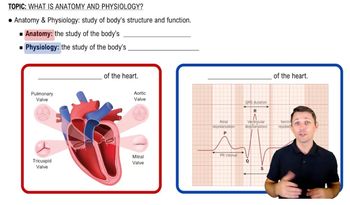
The study of cells and cellular structures is called
Cytology
The study of body structure is called ________.
Anatomy
which level of organization is the heart:
Organism
Chemical
Organ
Tissue
Organ
A collection of cells that work together designates a(n)
Tissue
Which of the following is the simplest level of organization?
organ
tissue
cellular
chemical
system
Chemical
Homeostasis refers to which of the following?
a state of consistent internal environment
a state in which a stimulus is amplified or increased
a state where the body is not functionally normally
a state in which the body does not make any changes
a state of consistent internal environment
The increasingly forceful labor contractions that lead to childbirth are an example of which type of mechanism?
negative feedback
effector shutdown
positive feedback
thermoregulation
receptor activation
Positive Feedback
What sectional plain would be shown if you were looking at the patients side?
Transverse
Horizontal
Frontal
Sagittal
Sagittal
The skin is ________ to the heart.
deep
superficial
distal
anterior
Superficial
Radiopacity is the ability of a substance to stop the passage of x-rays. Areas that are impenetrable by x-rays appear light or white on the exposed film. What body system would have the most radiopaque xray results?
the nervous system
The skeletal system
the integumentary system
The digestive system
Skeletal System
Neural tissue is very active metabolically. What imaging technique allows for the visualization of metabolic and physiological activity in soft neural tissue structures like the brain?
x-rays
positron emission tomography (PET)
computed tomography (CT)
ultrasound
PET
Which one of the nine abdominopelvic regions contains the intersection of all four abdominopelvic quadrants?
right hypochondriac region
left lower quadrant
hypogastric region
umbilical region
Umbilical region
After the chemical level, what is the next or second level of organization?
organ level of organization
organ system level of organization
tissue level of organization
cellular level of organization
Cellular level of organization
What kind of covalent bond is formed when the electrons are NOT shared equally between the bonding atoms, for example, when hydrogen and oxygen atoms bond in a water molecule?
ionic
polar
double
hydrogen
Polar