 Back
Chapter 10: Blood - Anatomy & Physiology
 2:36

Terms in this set (30)
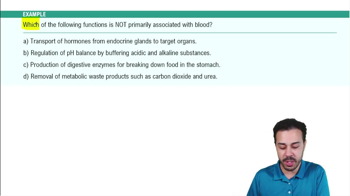
Blood transports gases, nutrients, and wastes; regulates pH and temperature; protects against infection; and prevents blood loss through clotting.
Blood has a pH of about 7.35-7.45, temperature around 38°C (100.4°F), and is slightly viscous and red in color.
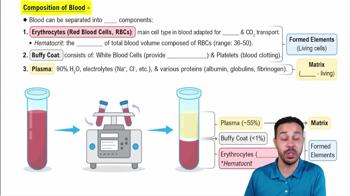
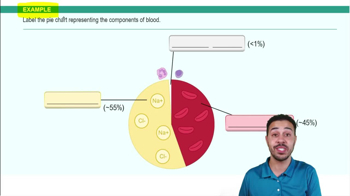
Blood separates into plasma (~55%) and formed elements (~45%) which include red blood cells, white blood cells, and platelets.
RBCs are biconcave, lack nuclei, contain hemoglobin, and number about 5 million per mm3 of blood.
WBCs have nuclei, defend against infection, and number about 4,000-11,000 per mm3 of blood.
Platelets are cell fragments involved in blood clotting, numbering about 150,000-400,000 per mm3 of blood.
Plasma is 90% water and contains proteins like albumin, globulins, fibrinogen, nutrients, hormones, and waste products.
Hematocrit is the percentage of blood volume occupied by red blood cells, typically about 45%.
Hemoglobin binds oxygen in the lungs and releases it in tissues; it also carries some carbon dioxide back to the lungs.
Never Let Monkeys Eat Bananas stands for Neutrophils, Lymphocytes, Monocytes, Eosinophils, Basophils in order of abundance.
Granulocytes have visible granules (neutrophils, eosinophils, basophils); agranulocytes lack granules (lymphocytes, monocytes).
Erythropoiesis is RBC formation stimulated by erythropoietin, a hormone produced by kidneys in response to low oxygen.
Hemoglobin breaks into globin (protein), heme, and iron; heme is further broken down into bilirubin.
Leukopoiesis is WBC formation regulated by colony stimulating factors and interleukins.
Thrombopoiesis is platelet formation stimulated by thrombopoietin hormone.
Hemostasis involves vascular spasms, platelet plug formation, and coagulation to stop bleeding.
Clotting factors activate a cascade converting prothrombin to thrombin, which converts fibrinogen to fibrin to form a clot.
A thrombus is a blood clot attached to a vessel wall; an embolus is a clot that travels through the bloodstream.
An antigen is a substance that triggers an immune response; an antibody is a protein that binds to a specific antigen.
Blood types have specific antigens on RBCs and antibodies in plasma: type A has A antigen and anti-B antibody, etc.
Type O is the universal donor (no A or B antigens); type AB is the universal receiver (no anti-A or anti-B antibodies).
Mismatched transfusion causes immune reaction, clumping, and destruction of donor RBCs, which can be fatal.
Rh factor is a protein on RBCs; Rh+ means presence, Rh- means absence. Mismatches can cause immune reactions.
Occurs when Rh- mother carries Rh+ fetus, causing hemolytic disease of the newborn if untreated.
Rh incompatibility is prevented by giving Rh- mothers Rh immunoglobulin (RhoGAM) to block antibody formation.
Anemia types include iron-deficiency, hemolytic, pernicious, and aplastic, all causing reduced oxygen-carrying capacity.
Polycythemia is an excess of red blood cells, increasing blood viscosity and risk of clotting.
Leukopenia is low WBC count; leukocytosis is high WBC count, often indicating infection or disease.
Leukemia is a cancer of WBCs causing uncontrolled proliferation and impaired immune function.
Thrombocytopenia is a low platelet count leading to increased bleeding risk.