 Back
Chapter 10 The Muscular System - Anatomy & Physiology
 5:39

Terms in this set (20)
Skeletal, cardiac, and smooth muscle tissues.
To produce voluntary movement by contracting and pulling on bones.
It is involuntary, striated, and has intercalated discs for synchronized contraction.
Found in walls of hollow organs; controls involuntary movements like digestion and blood flow.
A single muscle cell, multinucleated and elongated, that contracts in response to stimulation.
The basic contractile unit of a muscle fiber, composed of actin and myosin filaments.
Thin filaments are primarily actin; thick filaments are primarily myosin.
Calcium binds to troponin, causing tropomyosin to move and expose binding sites on actin for myosin.
During contraction, myosin heads pull actin filaments inward, shortening the sarcomere.
The synapse where a motor neuron communicates with a muscle fiber to trigger contraction.
Acetylcholine (ACh) is released to stimulate muscle contraction.
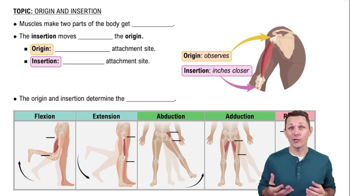
Origin is the fixed attachment point; insertion is the movable attachment point of a muscle.
An increase in muscle size due to growth of individual muscle fibers.
ATP provides energy for myosin head movement and detachment from actin during contraction cycles.
Muscle changes length while tension remains constant, producing movement.
Muscle tension increases but length remains the same; no movement occurs.
A motor neuron and all the muscle fibers it innervates.
Depletion of ATP, accumulation of lactic acid, and ionic imbalances impair contraction.
Stores and releases calcium ions to trigger muscle contraction.
It donates a phosphate group to ADP to rapidly regenerate ATP during short bursts of activity.