What are the two major parts of the integumentary system?
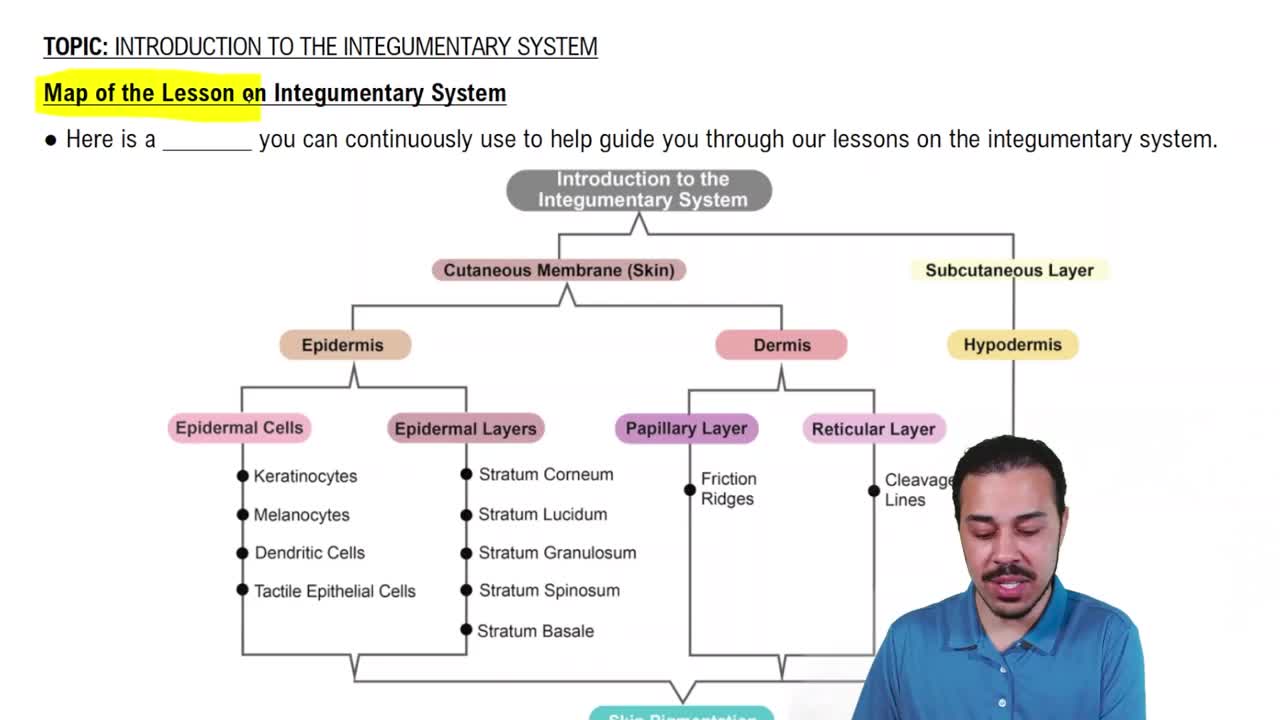
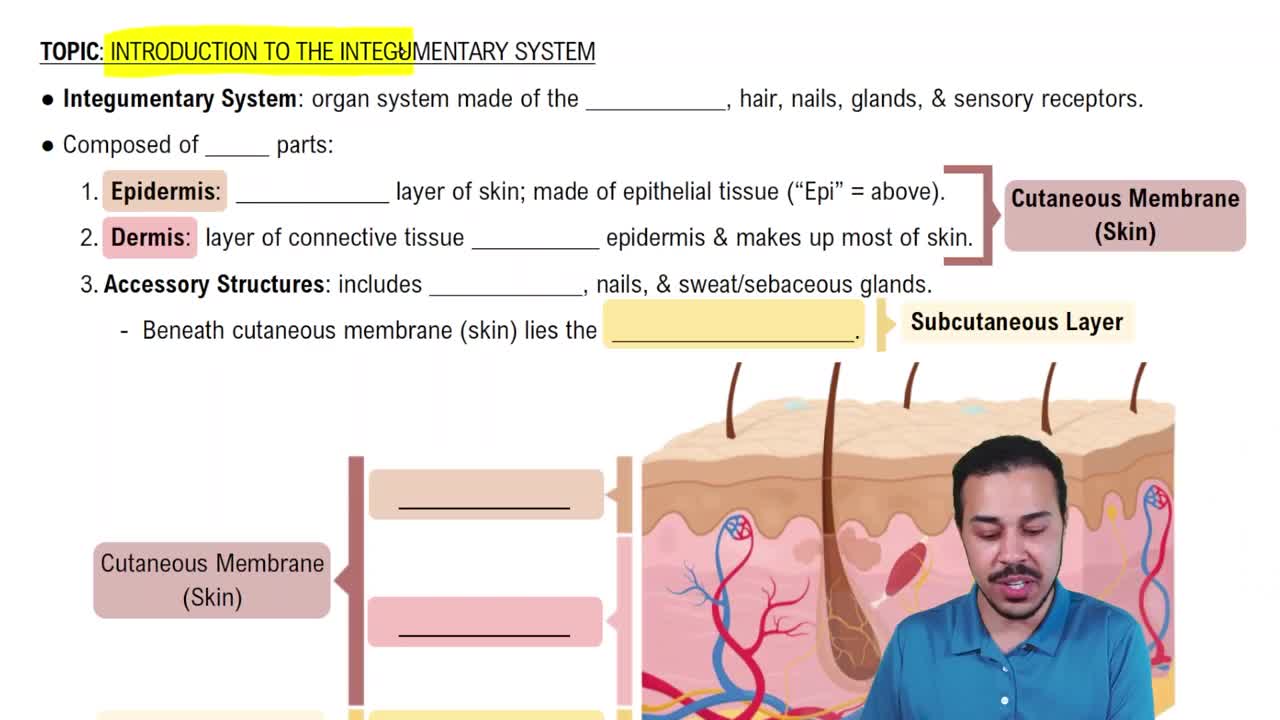
The integumentary system consists of the cutaneous membrane (skin) and accessory structures such as hair, glands, and nails.
What are the main layers of the cutaneous membrane?
The cutaneous membrane has two main layers: the epidermis (outer, superficial epithelium) and the dermis (inner connective tissue).
What is the subcutaneous layer and its function?
The subcutaneous layer (hypodermis) lies below the dermis, consists of loose connective tissue and adipose tissue, and stabilizes the skin's position.
List the functions of the integumentary system.
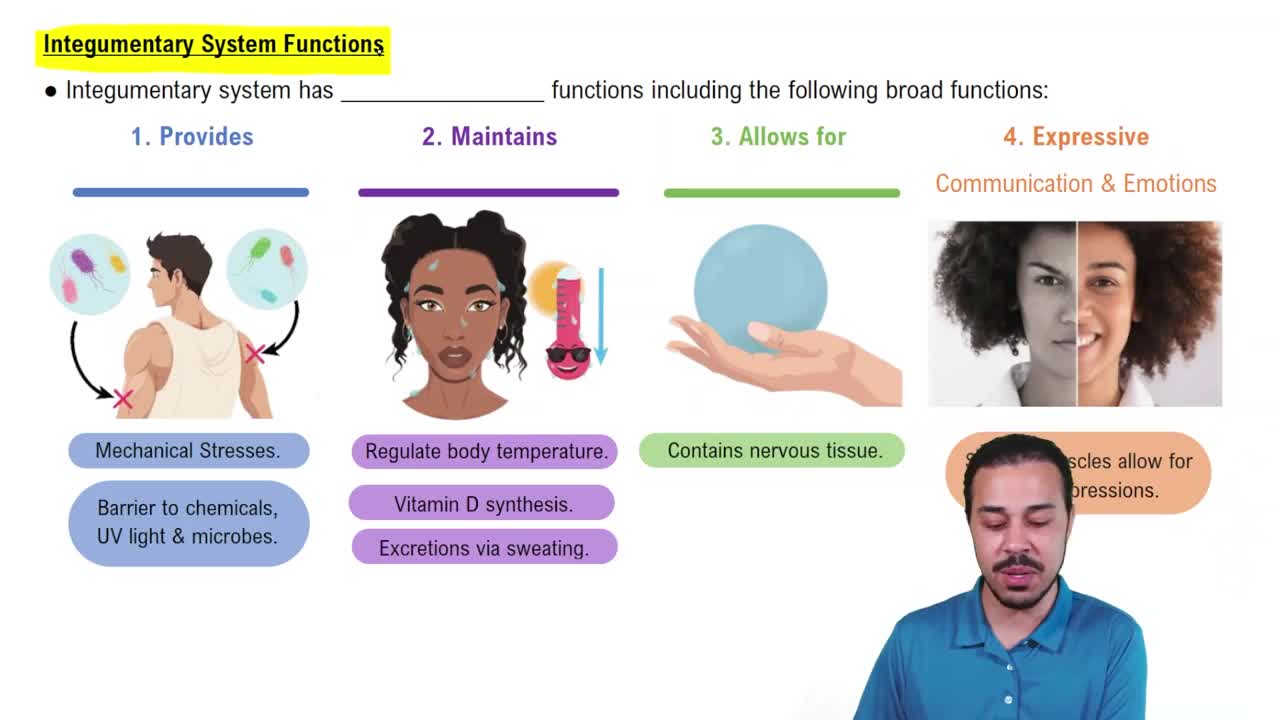
Functions include protection, excretion, thermoregulation, melanin and keratin production, vitamin D3 synthesis, lipid storage, sensation, and immune response coordination.
What type of epithelium composes the epidermis?
The epidermis is composed of stratified squamous epithelium and is avascular, relying on diffusion from dermal capillaries.
What are the two types of skin based on thickness?
Thin skin covers most of the body with four layers of keratinocytes; thick skin covers palms and soles and has five layers.
Name the five strata of keratinocytes in thick skin from deepest to surface.
The five layers are stratum basale, stratum spinosum, stratum granulosum, stratum lucidum, and stratum corneum.
What is the role of the stratum basale?
The stratum basale contains basal stem cells that replace superficial keratinocytes, melanocytes producing melanin, and tactile (Merkel) cells for touch.
What cells are found in the stratum spinosum and their function?
Stratum spinosum contains keratinocytes bound by desmosomes and dendritic (Langerhans) cells that participate in immune responses.
Describe the stratum granulosum and its significance.
Stratum granulosum has 3-5 layers of keratinocytes producing keratin and keratohyalin, promoting dehydration and cross-linking of keratin fibers before cell death.
What is unique about the stratum lucidum?
Stratum lucidum is a clear layer found only in thick skin, covering the stratum granulosum.
What characterizes the stratum corneum?
Stratum corneum is the exposed surface with 15-30 layers of dead, keratinized cells that are water resistant but not waterproof.
How is water lost from the skin?
Water loss occurs via insensible perspiration (diffusion through stratum corneum) and sensible perspiration (excretion by sweat glands).
What is epidermal growth factor (EGF) and its functions?
EGF is a peptide growth factor that promotes basal cell division, keratin production, epidermal repair, and glandular secretion.
What are the two layers of the dermis?
The dermis has an outer papillary layer of areolar tissue and a deeper reticular layer of dense irregular connective tissue.
What is the function of collagen and elastic fibers in the dermis?
Collagen fibers provide strength and resist stretching; elastic fibers allow stretching and recoil, contributing to skin flexibility and resilience.
What are tension lines in the skin?
Tension lines are parallel bundles of collagen and elastic fibers in the dermis that resist forces; cuts parallel to these lines heal better.
Describe the blood supply to the dermis.
The dermis contains the deep cutaneous plexus in the reticular layer and the superficial subpapillary plexus in the papillary layer.
What types of sensory receptors are found in the dermis?
Tactile (Meissner) corpuscles detect light touch in the papillary layer; lamellar (Pacinian) corpuscles detect deep pressure and vibration in the reticular layer.
What determines skin color?
Skin color is influenced by melanin (red-yellow or brown-black pigment) and carotene (orange-yellow pigment), as well as blood flow and oxygenation.
What is the role of melanocytes?
Melanocytes produce melanin stored in melanosomes, which are transferred to keratinocytes to protect skin from UV radiation.
How does vitamin D3 synthesis occur in the skin?
Vitamin D3 is produced by epidermal cells exposed to UV radiation and converted by liver and kidneys into calcitriol, essential for calcium absorption.
What are the main functions of hair?
Hair protects and insulates, guards openings from particles and insects, and serves as sensory receptors.
What are the parts of a hair follicle?
Hair follicles extend into the dermis and include the hair root, hair shaft, connective tissue sheath, internal and external root sheaths, and hair matrix.
What are the types of hair?
Vellus hairs are soft, fine hairs covering most of the body; terminal hairs are heavy, pigmented hairs on the head, eyebrows, and after puberty on other parts.
What are sebaceous glands and their function?
Sebaceous glands are holocrine glands that secrete sebum into hair follicles to lubricate hair and inhibit bacterial growth.
What are the differences between apocrine and eccrine sweat glands?
Apocrine glands secrete thick, odorous fluid into hair follicles in armpits and pubic areas; eccrine glands secrete watery sweat directly onto skin for thermoregulation.
What is the structure and function of nails?
Nails are made of dead keratinized cells protecting finger and toe tips; nail production occurs in the nail root beneath the skin.
How does the skin repair itself after injury?
Repair involves inflammation, scab formation, migration of basal cells, proliferation of fibroblasts producing granulation tissue, and scarring.
What are the effects of aging on the integumentary system?
 Back
 06:54