 Back
BackChapter 6
 3:56
3:56
Terms in this set (15)
The bone cells that contribute to increases in calcium in blood are the
osteoblasts.
chondrocytes.
osteocytes.
osteoclasts.
osteons.
Osteoclasts
The connective tissue covering the outer surface of a bone is (the)
endosteum.
periosteum.
articular cartilage.
matrix.
osteon.
Periosteum
The shaft of a long bone is called the ________.
canaliculus
epiphysis
lamella
diaphysis
trabecula
Diaphysis
The hormone calcitonin functions to
elevate calcium levels in body fluids.
depress calcium levels in body fluids.
stimulate osteoclast activity.
stimulate the absorption of calcium and phosphate ions in the digestive tract.
depress osteoblast activity.
depress calcium levels in body fluids.
The smooth, rounded, or oval articular process of a bone is termed a
ridge.
condyle.
trochlea.
head.
crest.
Condyle
Which of the following is a freely movable joint?
synarthrosis
amphiarthrosis
diarthrosis
syndesmosis
Diathrosis
What kind of cells secrete the synovial fluid?
chondrocytes
fibroblasts
mucosae
plasma cells
Fibroblasts
What is the name of the mature bone cell that lives in the lacunae of bone?
adipocytes
osteocytes
chondrocytes
periosteum
Osteocytes
Which bone cells are responsible for the formation of new bone matrix?
Osteocytes are the bone cells that produce new bone matrix.
Osteoblasts are the bone cells that produce new bone matrix.
Osteoclasts are the bone cells that produce new bone matrix.
Osteoblasts are the bone cells that produce new bone matrix.
What types of joints are freely movable?
gomphoses
diarthroses
synarthroses
amphiarthroses
Diathroses
What is the name of the pelvic joint cavity that articulates with the head of the femur to form the hip joint?
pubic symphysis
trochlea
acetabulum
trochanter
Acetabulum
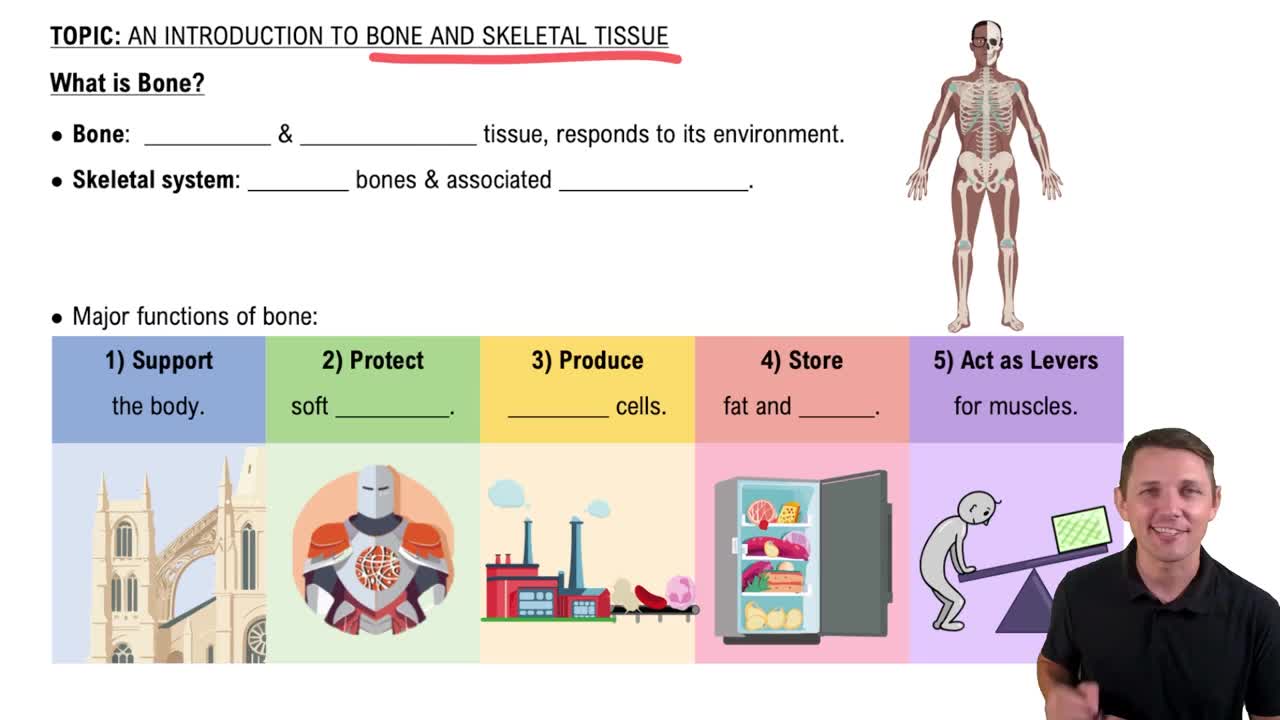
Which of the following is NOT a function of the skeletal system?
Vitamin D3 synthesis
Protects internal organs
Leverage for movement of arms and legs
Production of blood cells
Stores calcium and phosphate
Vitamin D3 synthesis
What is the importance of the lipids that are stored in the skeletal system?
They help remove excess body heat.
They promote absorption of calcium.
They are stored as energy reserves.
They produce red blood cells.
They are stored as energy reserves
Where in the skeletal system are blood cells produced?
Muscles
Mineral reserves
Red bone marrow
Yellow bone marrow
Dermis
Red bone marrow
Which of the following is true?
Skeletal muscles pull on bones to produce movement.
The skin provides structural support for the bones.
Blood cells are produced in the skin.
Bones help remove excess heat from the body.
Calcium, phosphate, and other minerals are stored in the skin.
Skeletal muscles pull on bones to produce movement.