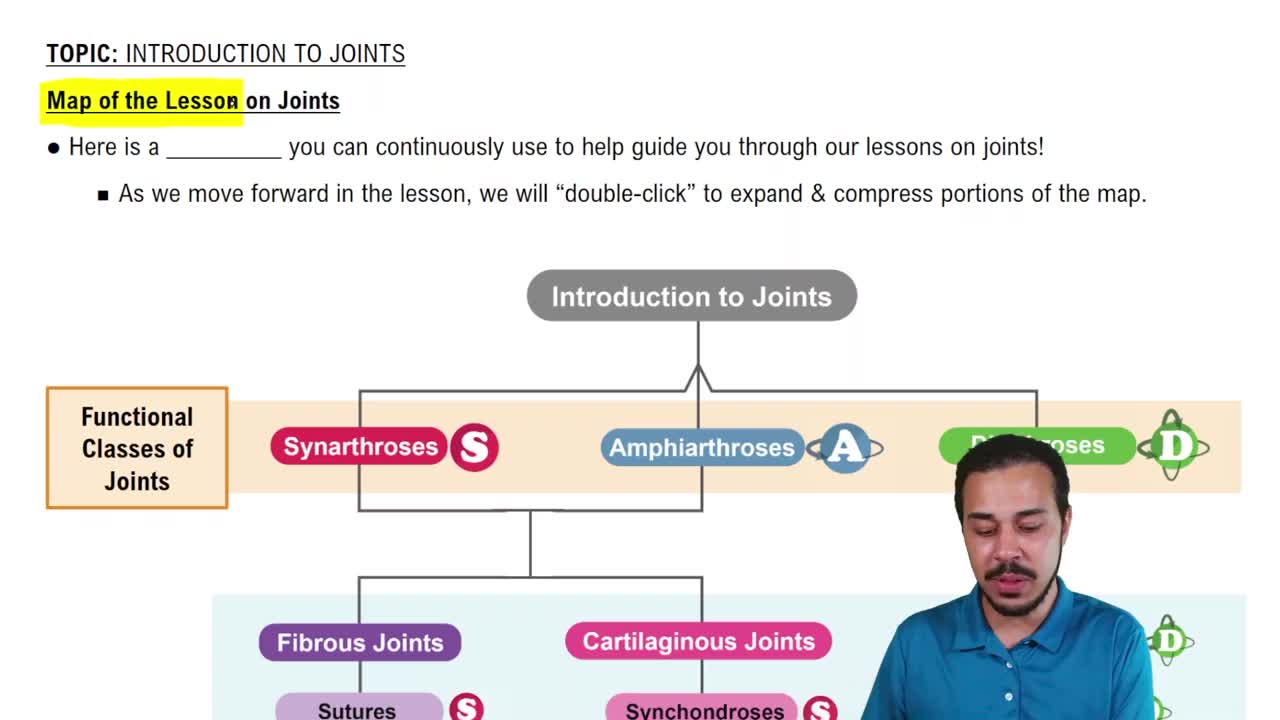
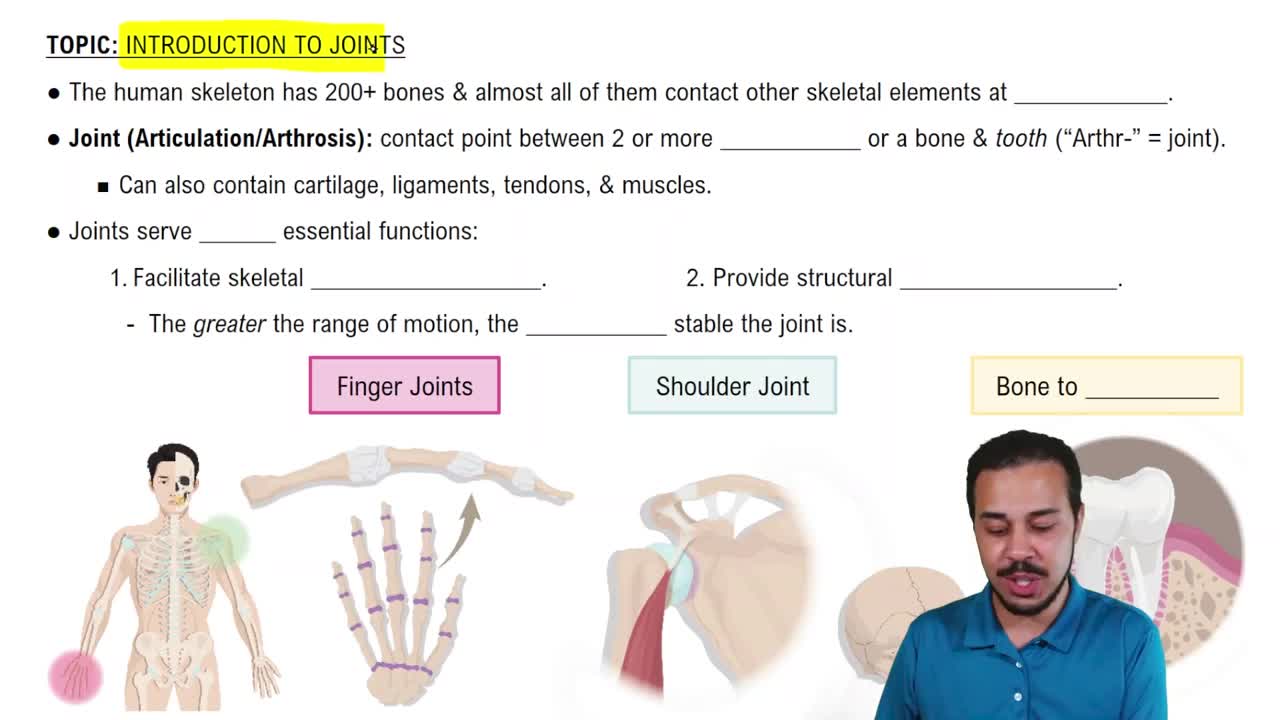
What are the four structural classifications of joints?
Fibrous, Cartilaginous, Bony, and Synovial.
Define synarthrosis and give examples.
An immovable joint that is very strong. Examples include sutures in the skull, gomphosis (teeth sockets), synchondrosis, and synostosis.
What is an amphiarthrosis joint?
A slightly movable joint that is stronger than a diarthrosis. Examples include syndesmosis (bones connected by ligaments) and symphysis (bones connected by fibrocartilage).
Describe the basic structure of a synovial joint.
Contains a joint capsule with a fibrous layer and synovial membrane, a joint cavity filled with synovial fluid, and articular cartilage covering bone surfaces.
What are the primary functions of synovial fluid?
Provides lubrication, nutrient distribution, and shock absorption within the joint cavity.
Name accessory structures that stabilize synovial joints.
Cartilages (menisci), fat pads, ligaments, tendons, and bursae.
What is the function of the meniscus in synovial joints?
A fibrocartilage pad that cushions and stabilizes the joint by improving fit between bones.
Define gliding movement and give an example.
When two flat surfaces slide past each other. Example: movement between carpal bones.
What are angular movements at synovial joints?
Movements that change the angle between bones, including flexion, extension, abduction, and adduction.
Explain circumduction.
A circular movement combining flexion, extension, abduction, and adduction, allowing the distal end of a limb to move in a circle.
What is rotational movement in joints?
Movement around the longitudinal axis of a bone, such as turning the head left or right or rotating limbs medially or laterally.
Describe pronation and supination of the forearm.
Pronation rotates the forearm so the palm faces posteriorly; supination turns the palm anteriorly, as in the anatomical position.
List special movements possible at some synovial joints.
Plane (gliding), hinge, condylar (ellipsoid), saddle, pivot, and ball-and-socket.
What type of movement does a hinge joint allow?
Angular motion in a single plane (monaxial), like bending and straightening the elbow or knee.
Describe the structure and movement of a ball-and-socket joint.
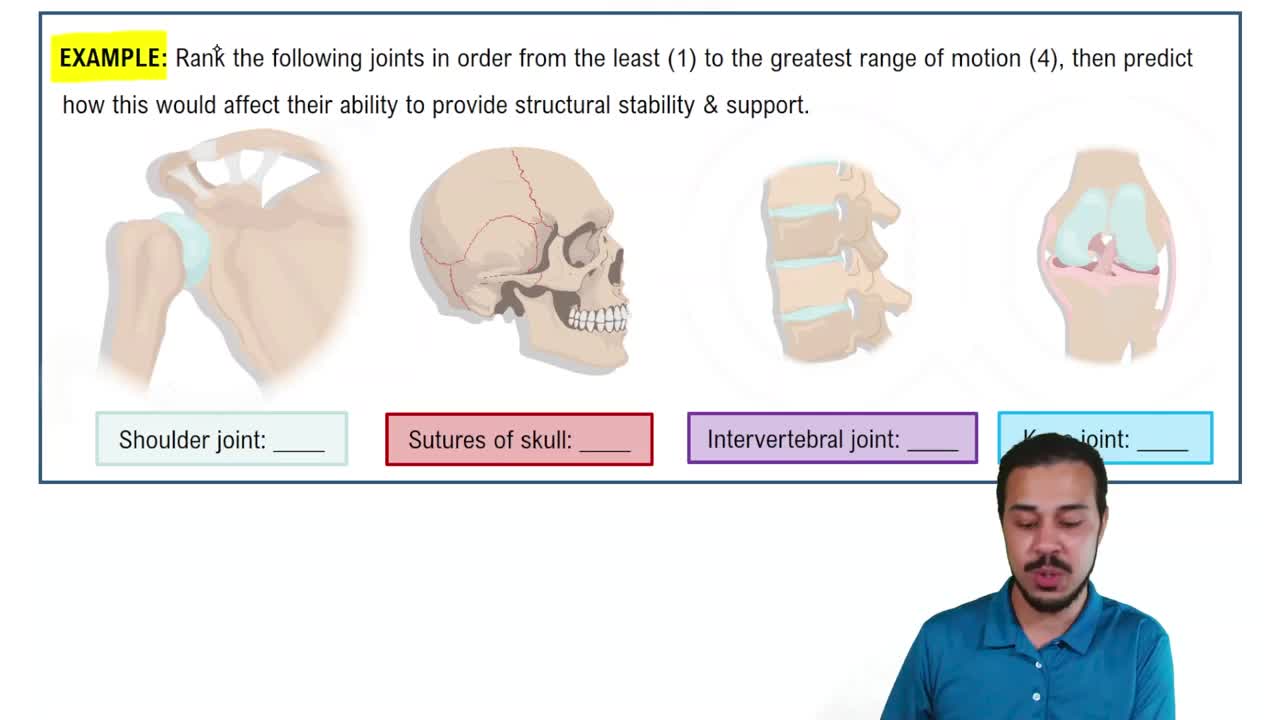
A round head fits into a cup-shaped depression, allowing angular, circumduction, and rotational movements (triaxial). Examples: shoulder and hip joints.
What are the components of an intervertebral disc?
An outer tough fibrocartilage layer called the anulus fibrosus and an inner elastic, gelatinous core called the nucleus pulposus.
What happens in a herniated intervertebral disc?
The nucleus pulposus breaks through the anulus fibrosus, potentially compressing spinal nerves and causing pain.
Name the major ligaments stabilizing the knee joint.
Patellar ligament, two popliteal ligaments, anterior and posterior cruciate ligaments, tibial collateral ligament, and fibular collateral ligament.
What muscles form the rotator cuff in the shoulder joint?
Supraspinatus, infraspinatus, teres minor, and subscapularis muscles.
What is the function of the glenoid labrum in the shoulder joint?
A rim of fibrocartilage that deepens the glenoid cavity and stabilizes the shoulder joint.
List the ligaments supporting the hip joint.
Iliofemoral, pubofemoral, ischiofemoral, transverse acetabular, and ligament of the femoral head.
What are common age-related joint problems?
Osteoarthritis (wear and tear), rheumatoid arthritis (autoimmune inflammation), and gouty arthritis (uric acid crystal buildup).
How does aging affect bones and joints?
Bone mass decreases, bones weaken, fracture risk increases, and joint mobility may decline due to cartilage wear and reduced synovial fluid.
How does the skeletal system interact with other body systems?
Muscles attach to bones for movement; endocrine system regulates bone growth; digestive and urinary systems supply minerals; skeleton stores minerals and produces blood cells.
 Back
 04:06