Skip to main content
Anatomy & Physiology
My Course
Learn
Exam Prep
AI Tutor
Study Guides
Textbook Solutions
Flashcards
Explore
Try the app
My Course
Learn
Exam Prep
AI Tutor
Study Guides
Textbook Solutions
Flashcards
Explore
Try the app
Back
Circulatory Physiology and Blood Vessel Structure
You can tap to flip the card.
What are the three main layers of blood vessel walls?
You can tap to flip the card.
👆
What are the three main layers of blood vessel walls?
Tunica intima
(inner layer),
tunica media
(middle layer with smooth muscle), and
tunica externa
(outer layer with connective tissue).
Track progress
Control buttons has been changed to "navigation" mode.
1/24
Recommended videos
Guided course
3:38
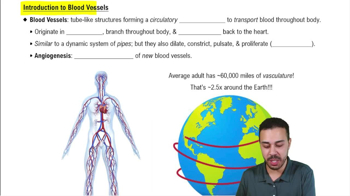
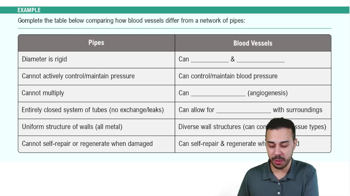
Introduction to Blood Vessels Example 1
6817
views
137
rank
Guided course
4:59
Blood Vessels
9792
views
219
rank
2
comments
Guided course
2:04
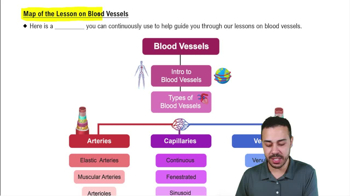
Map of the Lesson on Blood Vessels
7000
views
219
rank
1
comments
Terms in this set (24)
Hide definitions
What are the three main layers of blood vessel walls?
Tunica intima
(inner layer),
tunica media
(middle layer with smooth muscle), and
tunica externa
(outer layer with connective tissue).
What is the primary function of arteries?
Arteries
carry blood away from the heart
and have thick, elastic walls to absorb pressure waves from heartbeats.
How do arterioles regulate blood flow?
Arterioles control blood flow into capillary beds by
vasoconstriction
and
vasodilation
, adjusting diameter to regulate resistance.
What is the role of capillaries in circulation?
Capillaries are the
smallest blood vessels
where exchange of gases, nutrients, and wastes occurs between blood and tissues.
Describe the structure of capillaries.
Capillaries consist of a single layer of
endothelial cells
and a thin basement membrane, lacking tunica media and externa.
What are the three types of capillaries?
Continuous
(muscle),
fenestrated
(kidney, endocrine glands), and
sinusoids
(liver, spleen, bone marrow).
What is the function of precapillary sphincters?
Precapillary sphincters regulate blood flow into capillaries by opening or closing in response to tissue needs.
How does blood velocity change through the vascular system?
Blood velocity is
fastest in the aorta
, slows down in capillaries due to large cross-sectional area, and increases again in veins.
What is the significance of the large cross-sectional area of capillaries?
The large total cross-sectional area slows blood flow, allowing adequate time for exchange between blood and tissues.
What is the role of metarterioles?
Metarterioles act as
arteriovenous shunts
that can bypass capillary beds and regulate blood flow to multiple capillaries.
How do veins differ structurally from arteries?
Veins have thinner walls, larger lumens, less elastic tissue, and contain valves to prevent backflow.
What mechanisms assist venous return to the heart?
Venous return is aided by the
muscular pump
,
respiratory pump
, and
venoconstriction
under sympathetic control.
What is autoregulation in blood flow?
Autoregulation is the
intrinsic adjustment
of blood flow to tissues by changing arteriole diameter independent of mean arterial pressure.
What are the two types of autoregulation controls?
Metabolic controls
(respond to tissue chemical changes) and
myogenic controls
(vascular smooth muscle response to stretch).
How do metabolic controls regulate blood flow?
Metabolic controls cause vasodilation in response to low O2, high H+, K+, adenosine, prostaglandins, and inflammatory chemicals.
What is the myogenic response in blood vessels?
Vascular smooth muscle constricts when stretched by increased pressure and dilates when pressure decreases to maintain constant perfusion.
What happens during long-term autoregulation?
Long-term autoregulation involves
angiogenesis
, increasing vessel number and size to meet tissue nutrient demands.
How does blood flow change during exercise?
Blood flow increases to skeletal muscles, heart, and lungs; decreases to nonessential organs; brain flow remains constant.
What cardiovascular adaptations occur during hemorrhaging?
Short-term: increase heart rate, vasoconstriction, venoconstriction. Long-term: fluid retention, increased thirst, and red blood cell production.
What is the Frank–Starling principle?
Increased venous return stretches the heart atria, leading to increased cardiac output during exercise.
How does the cardiovascular system prioritize blood flow to the brain?
Brain blood flow is maintained by cerebral vessel dilation when peripheral vessels constrict to ensure high oxygen supply.
What causes a cerebrovascular accident (stroke)?
Blockage or rupture of a cerebral artery that stops blood flow to brain tissue.
How is blood flow to the lungs regulated?
Pulmonary vessels dilate in response to high alveolar O2 and constrict when O2 is low.
What are the effects of regular moderate exercise on cardiovascular health?
Reduces LDL cholesterol, slows plaque formation, lowers heart attack risk, and improves recovery after cardiac events.
 BackBack
 3:38