 Back
BackDevelopment and Inheritance - Anatomy & Physiology
 0:42
0:42
Terms in this set (31)
Continuous process from fertilization to maturity involving gradual modification of anatomical structures and physiological characteristics.
Creation of different cell types during development through selective changes in genetic activity; some genes turn off, others turn on.
Fusion of a secondary oocyte and spermatozoon forming a zygote with 46 chromosomes (23 pairs).
Process spermatozoa must undergo in female reproductive tract to fertilize the oocyte, involving contact with seminal gland secretions and female tract conditions.
Release enzymes hyaluronidase and acrosin to penetrate corona radiata and zona pellucida toward oocyte surface during fertilization.
Contact and fusion of sperm and oocyte membranes; oocyte completes meiosis II and becomes mature ovum.
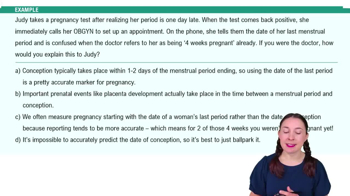
Fusion of female and male pronuclei; moment of conception when zygote with 46 chromosomes is formed.
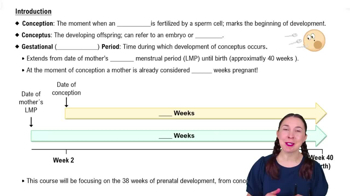
Period of prenatal development divided into three trimesters: first (embryological and early fetal), second (organ development), and third (rapid growth and organ function).
Sequence of rapid cell divisions after fertilization transforming zygote into multicellular blastocyst.
Attachment of blastocyst to uterine endometrium about 7 days after fertilization, initiating embryonic structure formation.
Formation of three embryonic germ layers (ectoderm, mesoderm, endoderm) via cell migration through primitive streak.
Complex organ allowing exchange between maternal and embryonic blood, supporting fetus during second and third trimesters.
Hormone produced by placenta soon after implantation; basis for pregnancy tests and supports mammary gland preparation.
Hormone increasing pubic symphysis flexibility, dilating cervix, and delaying labor contractions by suppressing oxytocin release.
Forcible expulsion of fetus involving uterine contractions that begin near the top and move toward the cervix.
Dilation (cervix dilates), expulsion (fetus delivered), and placental (afterbirth ejection) stages.
Fraternal twins from two separate fertilized oocytes; genetically different.
Identical twins from splitting of blastomeres or inner cell mass; genetically identical.
Neonatal, infancy, childhood, adolescence, maturity, and senescence stages after birth.
Genotype is the genetic makeup; Phenotype is the observable physical and physiological traits.
Pairs of chromosomes (23 pairs) in somatic cells; one from each parent.
22 pairs of non-sex chromosomes affecting somatic traits.
23rd chromosome pair determining genetic sex: XY male, XX female.
Different forms of a gene that determine specific traits.
Both chromosomes carry the same allele for a gene.
Chromosomes carry different alleles for a gene; phenotype depends on allele interaction.
Dominant allele is always expressed; recessive allele expressed only if both alleles are recessive.
Both dominant and recessive phenotypes are expressed simultaneously.
Traits controlled by multiple genes, producing complex phenotypes like hair color and height.
Individuals heterozygous for a recessive mutation who do not show symptoms but can pass it to offspring.
Genes on X chromosome affecting somatic traits; males more affected due to single X chromosome.