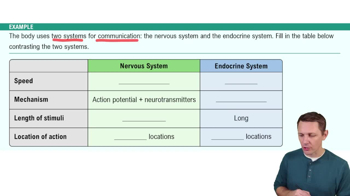
What is the primary function of the endocrine system?
The endocrine system uses hormones as chemical messengers to send signals through the bloodstream, regulating growth, metabolism, reproduction, electrolyte balance, and stress responses.
How do hormones in the endocrine system reach their target cells?
Hormones are released by endocrine glands into the blood and travel to target cells that have the specific receptors to respond to them.
Describe the hypothalamic-pituitary-endocrine axis.
The hypothalamus releases hormones that regulate the pituitary gland, which then releases hormones to target endocrine glands. These glands release hormones that feedback to regulate the hypothalamus and pituitary.
What is the role of negative feedback in the endocrine system?
Hormones from target glands circulate back to the hypothalamus and pituitary to reduce further hormone release, maintaining homeostasis.
Explain the thyroid hormone feedback loop.
Hypothalamus releases TRH → pituitary releases TSH → thyroid releases T3 and T4 → high T3/T4 levels inhibit TRH and TSH release.
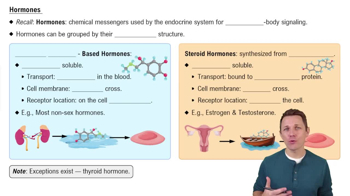
Differentiate between water-soluble and lipid-soluble hormones.
Water-soluble hormones bind to membrane receptors and use second messengers for fast, short-term effects. Lipid-soluble hormones cross membranes, bind intracellular receptors, and regulate gene expression for slower, long-term effects.
Give examples of water-soluble hormones.
Amino acid-based hormones like epinephrine, norepinephrine, insulin, glucagon, TSH, and ACTH.
Give examples of lipid-soluble hormones.
Steroid hormones such as cortisol, aldosterone, estrogen, testosterone, and thyroid hormones T3 and T4.
Describe the short-term stress response (alarm phase).
Triggered by the sympathetic nervous system and adrenal medulla releasing epinephrine and norepinephrine, causing increased heart rate, blood pressure, blood glucose, and alertness.
Describe the long-term stress response (resistance phase).
Controlled by the HPA axis: hypothalamus releases CRH → pituitary releases ACTH → adrenal cortex releases cortisol, increasing blood glucose, suppressing immunity, and raising blood pressure.
What are the three stages of General Adaptation Syndrome (GAS)?
1) Alarm (short-term stress), 2) Resistance (long-term adaptation), 3) Exhaustion (depletion of resources and health decline).
What is the function of insulin and its antagonistic hormone?
Insulin lowers blood glucose by promoting uptake into cells; glucagon raises blood glucose by stimulating glycogen breakdown in the liver.
How do calcitonin and parathyroid hormone (PTH) act antagonistically?
Calcitonin lowers blood calcium by inhibiting bone breakdown; PTH raises blood calcium by stimulating bone breakdown and increasing calcium absorption.
What is the antagonistic relationship between aldosterone and atrial natriuretic peptide (ANP)?
Aldosterone increases sodium and water retention to raise blood pressure; ANP promotes sodium and water loss to lower blood pressure.
Which hormone targets kidneys to promote water reabsorption?
Antidiuretic hormone (ADH) from the posterior pituitary.
What hormone increases metabolic rate in most cells?
Thyroid hormones T3 and T4.
Which hormones regulate growth and metabolism from the anterior pituitary?
Growth hormone (GH) targets liver, bone, and muscle to stimulate growth and metabolism.
What hormones do the ovaries and testes produce?
Ovaries produce estrogens and progesterone; testes produce testosterone.
 Back
Back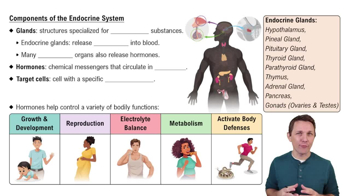
 7:06
7:06