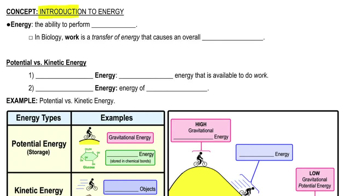
Energy is the capacity to do work, including chemical work (making/breaking bonds), transport work (moving molecules), and mechanical work (movement or shape change).
Distinguish between kinetic and potential energy.
Kinetic energy is energy of motion (thermal, radiant, electrical), while potential energy is stored energy (chemical, mechanical, nuclear).
State the first law of thermodynamics.
Energy in the universe is constant; it can neither be created nor destroyed. The human body is an open system exchanging energy.
State the second law of thermodynamics.
Processes proceed in a direction that spreads out energy, such as breaking large molecules into smaller ones or diffusion from high to low concentration.
What is free energy in chemical reactions?
Free energy is the potential energy stored in chemical bonds available to do work during reactions.
Define exergonic reactions.
Reactions where free energy of reactants is greater than products, releasing energy and proceeding spontaneously. Example: catabolic reactions.
Define endergonic reactions.
Reactions where free energy of reactants is less than products, requiring energy input and not proceeding spontaneously. Example: anabolic reactions.
What is activation energy?
The energy barrier that must be overcome for reactants to reach the transition state and form products, limiting reaction speed.
How do enzymes affect activation energy?
Enzymes lower the activation energy, speeding up chemical reactions without being consumed.
Name the four major categories of enzymatic reactions.
Explain oxidation and reduction in redox reactions.
Oxidation is loss of electrons; reduction is gain of electrons. They always occur together in redox reactions.
What is hydrolysis and condensation?
Hydrolysis breaks bonds using water; condensation (dehydration) forms bonds releasing water.
Describe allosteric regulation of enzymes.
A modulator binds to the enzyme's regulatory site, changing its shape and activity, which can increase or decrease enzyme function.
Describe covalent regulation of enzymes.
Enzyme activity is altered by forming or breaking covalent bonds (commonly phosphate groups) with the enzyme, switching it between active and inactive states.
What is feedback inhibition in metabolism?
The end product of a pathway inhibits an earlier step, preventing overproduction and regulating the pathway.
Define metabolism and distinguish catabolic from anabolic reactions.
Metabolism is the sum of all chemical reactions in cells. Catabolic reactions break down molecules; anabolic reactions build molecules.
List five ways cells control metabolic pathways.
1. Control enzyme concentrations 2. Produce modulators 3. Use different enzymes for reversible reactions 4. Compartmentalize enzymes 5. Maintain ATP/ADP ratio.
Outline the stages of aerobic glucose metabolism.
1. Glycolysis 2. Linking step (pyruvate to Acetyl CoA) 3. Krebs cycle 4. Oxidative phosphorylation (electron transport chain).
What happens during glycolysis?
Glucose (6C) splits into two pyruvate (3C), producing 2 ATP (net) and 2 NADH in the cytosol.
What is the role of the Krebs cycle?
Acetyl CoA is converted to citrate and broken down, releasing energy to reduce coenzymes NAD+ and FAD to NADH and FADH2.
Describe the electron transport chain (ETC).
ETC uses electrons from NADH and FADH2 to pump H+ across the mitochondrial membrane, creating an electrochemical gradient.
What is chemiosmosis and ATP synthase function?
H+ flows back through ATP synthase, which uses this energy to phosphorylate ADP to ATP.
How does anaerobic metabolism produce ATP?
With low oxygen, glycolysis continues by converting pyruvate to lactate, producing 2 ATP per glucose.
What is the efficiency of glucose oxidation to ATP?
About 38.8% of energy from glucose oxidation is captured in ATP; the rest is lost as heat.
 Back
Back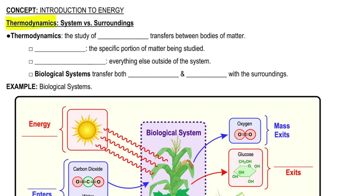
 04:21
04:21