What are the main substances transported by blood?
Nutrients, wastes, hormones, and body heat are transported by blood through blood vessels.
What are the two main components of blood?
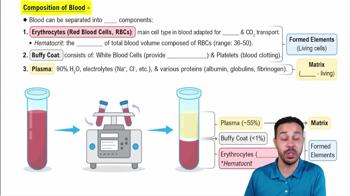
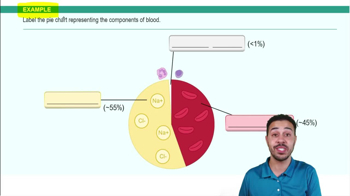
Formed elements (living cells) and plasma (nonliving fluid matrix).
What percentage of blood is plasma and what percentage is erythrocytes?
Plasma is 55% of blood, and erythrocytes (red blood cells) make up 45%, known as the hematocrit.
What is the buffy coat in blood?
A thin, whitish layer between erythrocytes and plasma containing leukocytes (white blood cells) and platelets, less than 1% of blood.
Describe the physical characteristics of blood.
Blood is a sticky, opaque fluid, heavier and thicker than water, with a pH between 7.35 and 7.45, and temperature slightly higher than body temperature.
What is the typical blood volume in a healthy adult?
About 5–6 liters or 6 quarts, making up about 8% of body weight.
What is plasma mostly composed of?
About 90% water with dissolved substances including nutrients, salts, respiratory gases, hormones, plasma proteins, and waste products.
Name the main plasma proteins and their functions.
Albumin (blood buffer, osmotic pressure), clotting proteins (stem blood loss), and antibodies (immune defense).
What are erythrocytes and their main function?
Red blood cells that carry oxygen; they are anucleate, lack mitochondria, and contain hemoglobin.
How many hemoglobin molecules does each erythrocyte contain?
Each erythrocyte contains about 250 million hemoglobin molecules, each binding 4 oxygen molecules.
What causes anemia?
A decrease in oxygen-carrying ability due to low RBC count or abnormal hemoglobin, including sickle cell anemia.
What is polycythemia?
A disorder with an excessive increase in RBCs, caused by bone marrow cancer or living at high altitudes, increasing blood viscosity.
What are leukocytes and their key features?
White blood cells that defend against disease, are complete cells with nuclei, can move in/out of vessels, and respond to chemical signals.
What is leukocytosis and leukopenia?
Leukocytosis is high WBC count (infection response); leukopenia is abnormally low WBC count, often drug-induced.
Differentiate granulocytes and agranulocytes.
Granulocytes have stained cytoplasmic granules and lobed nuclei; agranulocytes lack visible granules and have round or kidney-shaped nuclei.
List the five types of white blood cells from most to least abundant.
 Back
 2:36