 Back
BackFemale Reproductive System - Anatomy & Physiology
 2:08
2:08
Terms in this set (21)
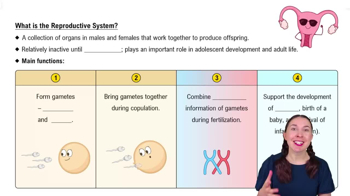
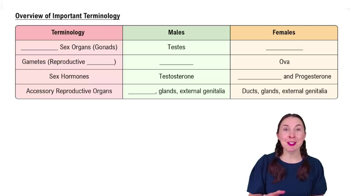
Ovaries, uterine (fallopian) tubes, uterus, vagina, vulva, and mammary glands.
Produce eggs (ova) and female hormones; located in the upper pelvic cavity on each side of the uterus.
Ovarian ligament attaches ovary to uterus; suspensory ligament attaches ovary to lateral pelvic wall.
Muscular tubes about 5 inches long that transport eggs to the uterus; lined with cilia and smooth muscle to propel the ovum.
Finger-like projections that catch the ovum after ovulation and help guide it into the fallopian tube.
In the lateral third of the fallopian tubes.
Endometrium (mucosa), myometrium (thick smooth muscle), and serosa (visceral peritoneum).
Broad ligament, round ligament, and lateral ligament.
Muscular tube 3-4 inches long from cervix to external genitalia; pH 3.5-4.5; contains blood vessels and smooth muscle; includes the fornix and hymen.
External female genitalia including mons pubis, labia majora, labia minora, clitoris, vestibule, urethral and vaginal orifices, Skene's and Bartholin's glands.
A 28-day cycle involving maturation and release of the ovum, including follicle development, ovulation, and corpus luteum formation.
Primary follicles develop under FSH stimulation; one follicle matures into a Graafian follicle; estrogen production increases.
A surge in luteinizing hormone (LH) triggers ovulation, typically on day 14 of the cycle.
Formed from the ruptured follicle after ovulation; produces progesterone to prepare the endometrium for implantation.
The corpus luteum degenerates into the corpus albicans, progesterone and estrogen levels drop, and menstruation begins.
A 28-day cycle involving growth and shedding of the endometrium, synchronized with the ovarian cycle.
Menstrual phase (days 1-5), proliferative phase (days 6-13), ovulation (day 14), and secretory phase (days 15-28).
Estrogen rises during the follicular phase to thicken endometrium; progesterone rises in luteal phase to maintain it.
Glands in the breast that produce milk; contain lobes, lobules, alveoli, and ducts leading to the nipple.
Support the breast by connecting skin to deep fascia; made of collagen fibers and non-elastic.
Suckling stimulates oxytocin release from the posterior pituitary, causing myoepithelial cells to contract and release milk.