Back

Fundamentals of Anatomy & Physiology: Chemical Level of Organization

1 student found this helpful
Control buttons has been changed to "navigation" mode.
1/29
  • What are the three subatomic particles that compose an atom?

    Protons (positively charged), neutrons (neutral), and electrons (negatively charged).
  • Where are protons and neutrons located in an atom?

    Protons and neutrons are found within the nucleus at the center of an atom.
  • What is the atomic number of an atom?

    The number of protons in an atom, which is unique for each element.
  • What is an electron cloud?

    A spherical area around the nucleus where electrons travel at high speed.
  • What is the difference between an electron cloud and an electron shell?

    An electron cloud is a 3D area where electrons move; an electron shell is a 2D representation of this cloud showing energy levels.
  • What defines an element?

    A pure substance composed of atoms with the same number of protons that cannot be broken down by ordinary physical means.
  • What are isotopes?

    Forms of the same element with different numbers of neutrons but similar chemical properties.
  • What is a radioisotope?

    An isotope with an unstable nucleus that spontaneously breaks down and emits radiation.
  • What is the half-life of a radioisotope?

    The time required for half of a given amount of the isotope to decay.
  • What is the significance of electron shells in atoms?

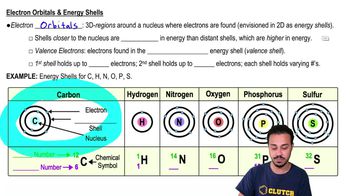
    Electron shells hold electrons at specific energy levels; the first shell holds up to 2 electrons, the second and third up to 8 each.
  • What is the valence shell?

    The outermost electron shell of an atom that determines its chemical properties and reactivity.
  • What makes an atom stable or unstable?

    An atom with a filled valence shell is stable; an atom with an unfilled valence shell is unstable and reactive.
  • What is a molecule?

    Two or more atoms held together by shared electrons.
  • What is a compound?

    A chemical substance composed of atoms of two or more different elements.
  • What is the difference between molecules and compounds?

    All compounds are molecules, but not all molecules are compounds (e.g., O2 is a molecule but not a compound).
  • What is an ion?

    An atom or group of atoms with an electrical charge, either positive (cation) or negative (anion).
  • How do atoms become ions?

    By losing or gaining electrons, resulting in an unequal number of protons and electrons.
  • What is an ionic bond?

    A chemical bond formed by the attraction between positively charged cations and negatively charged anions.
  • What is a covalent bond?

    A bond formed when atoms share electrons to complete their valence shells.
  • What is the difference between nonpolar and polar covalent bonds?

    Nonpolar bonds share electrons equally; polar bonds share electrons unequally, creating partial charges.
  • What are hydrogen bonds?

    Weak electrical attractions between the partial positive charge of hydrogen in a polar covalent bond and the partial negative charge of oxygen, nitrogen, or fluorine in another polar covalent bond.
  • What is a decomposition reaction?

    A chemical reaction that breaks a molecule into smaller fragments, often involving hydrolysis.
  • What is a synthesis reaction?

    A chemical reaction that assembles a larger molecule from smaller molecules, often involving dehydration synthesis.
  • What is an exchange reaction?

    A chemical reaction where components are rearranged to form new products, involving both decomposition and synthesis.
  • What is a reversible reaction?

    A reaction where reactants form products and products can revert to reactants, seeking equilibrium.
  • How is pH defined?

    The concentration of hydrogen ions (H+) in a solution.
  • What pH value is neutral, acidic, and basic?

    Neutral pH is 7; acidic is less than 7; basic (alkaline) is greater than 7.
  • Why is blood pH regulation important?

    Because abnormal pH can damage cells and tissues by breaking chemical bonds and altering protein shapes.
  • What is the normal blood pH range?

    Between 7.35 and 7.45.