Transport dissolved gases, nutrients, hormones, and wastes; regulate pH and ion composition; restrict fluid loss at injury sites; defend against toxins and pathogens; stabilize body temperature.
What are the characteristics of blood?
Temperature of 38ºC (100.4ºF), high viscosity, slightly alkaline with pH 7.35–7.45, and volume about 7% of body weight.
What is whole blood composed of?
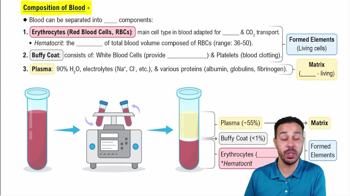
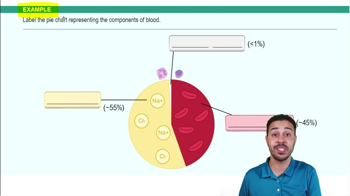
Plasma (fluid matrix) and formed elements (cells and cell fragments).
What percentage of blood volume does plasma make up and what is its main component?
Plasma makes up about 55% of blood volume and is over 90% water.
What are the three types of formed elements in blood?
Platelets, white blood cells (WBCs), and red blood cells (RBCs).
What is hemopoiesis?
The process of producing formed elements (blood cells and fragments).
What are the major plasma proteins and their functions?
Albumins (60%) regulate osmolarity and transport; Globulins (35%) include antibodies and transport proteins; Fibrinogen (4%) functions in clotting.
Where are most plasma proteins produced?
More than 90% are made in the liver; antibodies are made by plasma cells.
What is the function of red blood cells (RBCs)?
Transport oxygen and carbon dioxide using hemoglobin.
Describe the structure of a mature red blood cell.
Small, biconcave disc shape, anucleate, lack mitochondria and ribosomes, live about 120 days.
What is hemoglobin composed of?
Four globular protein subunits (two alpha and two beta chains), each with one heme containing an iron ion that binds oxygen.
What is erythropoiesis and where does it occur in adults?
The formation of red blood cells, occurring in myeloid tissue (red bone marrow) in adults.
What hormone stimulates erythropoiesis and when is it secreted?
Erythropoietin (EPO), secreted by kidneys and liver when oxygen levels in peripheral tissues are low (hypoxia).
How is hemoglobin recycled after RBCs are broken down?
Macrophages engulf aged RBCs, break hemoglobin into heme and globin; iron is recycled, heme is converted to biliverdin then bilirubin, which is excreted.
What determines blood type?
Presence or absence of surface antigens A, B, and Rh (D) on red blood cells.
What antibodies are present in the plasma of type A, B, AB, and O blood?
Type A has anti-B antibodies; Type B has anti-A antibodies; Type AB has no anti-A or anti-B antibodies; Type O has both anti-A and anti-B antibodies.
What is agglutination in blood transfusion reactions?
Clumping of foreign red blood cells caused by antibodies binding to incompatible surface antigens.
What are the three phases of hemostasis?
Vascular phase (vascular spasm), platelet phase (platelet adhesion and aggregation), and coagulation phase (blood clotting).
What role do platelets play in hemostasis?
Platelets adhere to damaged vessel walls, aggregate to form a plug, and release chemicals that promote clotting and vessel repair.
What are the intrinsic and extrinsic pathways in coagulation?
Intrinsic pathway is activated by exposure to collagen; extrinsic pathway is triggered by tissue factor from damaged cells; both activate Factor X leading to clot formation.
What is the function of thrombin in coagulation?
Converts fibrinogen to insoluble fibrin and activates positive feedback to accelerate clotting.
What substances inhibit clotting to regulate hemostasis?
Antithrombin-III, heparin, thrombomodulin, protein C, and prostacyclin.
Why are calcium ions and vitamin K important in clotting?
Calcium ions are required for all clotting pathways; vitamin K is necessary for synthesis of four clotting factors.
What is fibrinolysis?
The gradual process of dissolving a blood clot by plasmin digesting fibrin strands.
 Back
Back
 2:36
2:36