What are the two main subdivisions of the skeletal system?
Axial skeleton (longitudinal axis of the body) and Appendicular skeleton (bones of limbs and girdles).
List the five primary functions of bones.
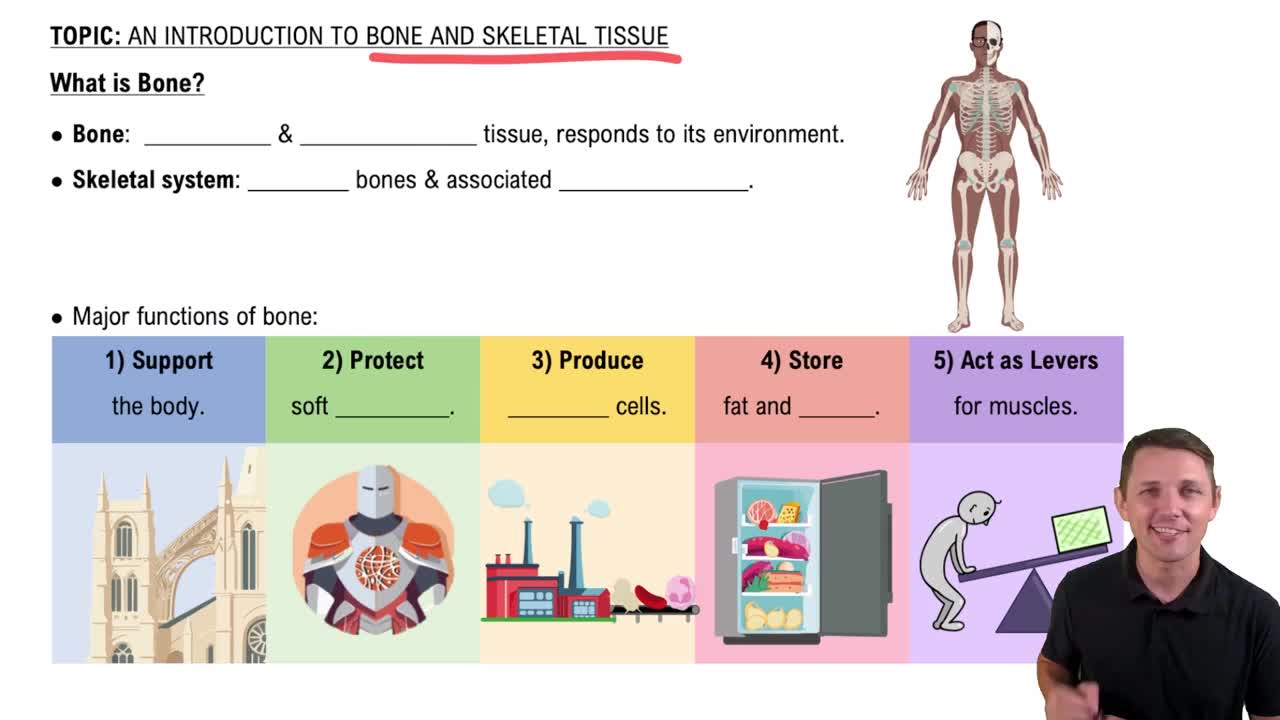
Support, protection of soft organs, movement due to attached skeletal muscles, storage of fats and minerals, blood cell formation.
What are the two basic types of bone tissue?
Compact bone (dense and smooth) and Spongy bone (needle-like pieces with many open spaces).
Describe the gross anatomy of a long bone.
Consists of a diaphysis (shaft, compact bone), epiphyses (ends, mostly spongy bone), articular cartilage (hyaline cartilage covering epiphyses), epiphyseal plate (growth plate in youth), and medullary cavity (contains marrow).
What is the function of the periosteum?
A fibrous connective tissue membrane that covers and protects the diaphysis and contains Sharpey’s fibers to secure it to the bone.
What are bone markings and their categories?
Surface features of bones that serve as attachment sites or passages. Categories include projections/processes (grow out from bone) and depressions/cavities (indentations).
Name the microscopic structures of compact bone.
Osteon (Haversian system), lamellae, lacunae, central (Haversian) canal, canaliculi, and perforating (Volkmann’s) canals.
What bones make up the axial skeleton?
Skull, vertebral column, and bony thorax (rib cage and sternum).
What are the two sets of bones in the skull?
Cranium (encloses brain) and facial bones (hold eyes, attachment for muscles).
How are skull bones joined?
By sutures, which are interlocking, immovable joints, except the mandible which has a freely movable joint.
List the eight bones of the cranium.
Frontal, 2 parietal, 2 temporal, occipital, sphenoid, and ethmoid bones.
What are paranasal sinuses and their functions?
Hollow portions of bones around the nasal cavity that lighten the skull and amplify sounds during speech.
What is unique about the hyoid bone?
It does not articulate with any other bone and serves as a movable base for the tongue aiding in swallowing and speech.
Describe the vertebral column structure.
Consists of 24 vertebrae separated by intervertebral discs, plus fused sacrum and coccyx at the base.
What are the primary and secondary curvatures of the spine?
Primary curvatures: thoracic and sacral (convex, present at birth). Secondary curvatures: cervical and lumbar (concave, develop after birth).
What are the three parts of the bony thorax?
Sternum, ribs (true, false, floating), and thoracic vertebrae.
What bones compose the pectoral girdle?
Clavicle (collarbone) and scapula (shoulder blade).
Name the bones of the upper limb.
Humerus (arm), radius and ulna (forearm), carpals (wrist), metacarpals (palm), and phalanges (fingers).
What bones form the pelvic girdle?
Two coxal bones, each composed of ilium, ischium, and pubis.
What bones make up the lower limbs?
Femur (thigh), tibia and fibula (lower leg), tarsals (ankle), metatarsals (foot), and phalanges (toes).
How are joints functionally classified?
Synarthroses (immovable), amphiarthroses (slightly movable), and diarthroses (freely movable).
What are the three structural classifications of joints?
Fibrous (immovable), cartilaginous (immovable or slightly movable), and synovial (freely movable).
Describe the features of synovial joints.
Articular cartilage, fibrous articular capsule lined with synovial membrane, joint cavity filled with synovial fluid, and reinforcing ligaments.
What are bursae and tendon sheaths?
Bursae are fibrous sacs filled with synovial fluid that reduce friction; tendon sheaths are elongated bursae that wrap around tendons.
List the types of synovial joints based on shape.
Plane, hinge, pivot, condyloid, saddle, and ball-and-socket joints.
Give an example and movement type of a hinge joint.
Elbow joint; uni-axial angular movement in one axis.
 Back
 3:56