 Back
BackGeneral Chemistry and Biochemistry Basics for Anatomy & Physiology
 02:13
02:13
Terms in this set (23)
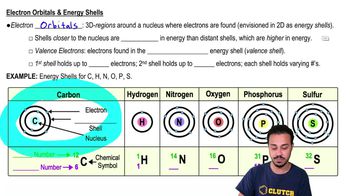
Atomic Number is the number of protons in the nucleus; unique to each element.
Atomic Mass is the average mass of an atom, including protons and neutrons.
Isotopes are atoms of the same element with different numbers of neutrons; can be stable or radioactive.
Radioactive isotopes spontaneously decay, emit radiation, and can be used as tracers or tumor treatments.
Oxygen (O) makes up 65% of the body; part of water and organic molecules; needed for cellular ATP production.
Carbon (C) forms the backbone of all organic molecules including carbohydrates, lipids, proteins, and nucleic acids.
Hydrogen (H) part of water and organic molecules; ionized form (H+) causes acidity in body fluids.
Calcium (Ca) contributes to bone hardness and is necessary for muscle contraction, nerve impulses, and blood clotting.
Protons and neutrons are in the nucleus; electrons orbit the nucleus. Protons are positive, neutrons neutral, electrons negative.
A molecule is two or more atoms bonded by sharing electrons; if all atoms are the same element, it is still an element (e.g., O2).
A compound is a chemical substance of two or more different elements bonded together with different properties than the elements.
Ionic bonds are attractions between oppositely charged ions that bind them together.
Cation is a positively charged ion (electron donor); Anion is a negatively charged ion (electron acceptor).
Oxidation is loss of electrons; Reduction is gain of electrons.
Non-polar covalent bonds share electrons equally; polar covalent bonds share electrons unequally.
Hydrogen bonds are weak attractions between a partially positive hydrogen and a partially negative atom (O, N, F) in another molecule or part of the same molecule.
Water has high heat capacity, is a universal solvent, participates in chemical reactions, and acts as a lubricant and cushion.
Percent solution is mass of solute (g) per 100 mL of solution. Example: 15g sugar in 100mL = 15% solution.
Dissociation is when a compound breaks into ions in water, such as ionic salts dissolving.
Strong acids fully dissociate H+ ions; strong bases fully dissociate OH- ions; weak acids and bases partially dissociate.
The pH scale ranges 0-14; <7 acidic, 7 neutral, >7 basic. It is logarithmic: each unit change = 10x change in H+ concentration.
Buffers are solutes that resist changes in pH to maintain stable body fluid acidity.
Salts are electrolytes made of cations (not H+) and anions (not OH-); they dissociate in water and conduct electricity.