 Back
Genetic Inheritance in Anatomy & Physiology
 03:39

Terms in this set (20)
A gene is a factor that controls a heritable characteristic, located on a chromosome, storing information in a DNA segment that encodes for protein synthesis.
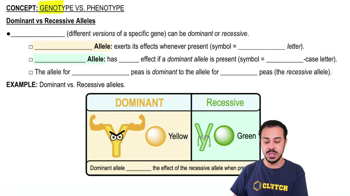
An allele is an alternate form of a gene coding for the same trait, with one allele on each homologous chromosome.
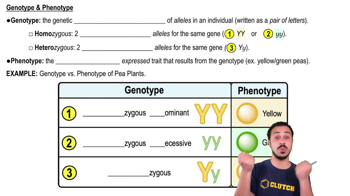
Genotype is the genetic composition (e.g., Bb), while phenotype is the physical expression of a gene (e.g., brown eyes).
Dominant alleles are expressed alone or in pairs (capital letter), while recessive alleles are expressed only without a dominant allele (lowercase letter).
Homozygous means having two identical alleles: either dominant (BB) or recessive (bb).
Heterozygous means having two different alleles (Bb).
A mutation is a permanent change in the nucleotide sequence of a gene, often altering the amino acid sequence of the protein.
PKU is caused by a mutation in the gene for phenylalanine hydroxylase, leading to a non-functional enzyme and inability to break down phenylalanine.
In dominant-recessive inheritance, the phenotype reflects the dominant allele if present, masking the recessive allele.
A Punnett square predicts possible genotypes and phenotypes of offspring from parental allele combinations.
Incomplete dominance occurs when neither allele is dominant, and heterozygotes show a blended phenotype.
Sickle cell disease results from a mutation in hemoglobin gene; heterozygotes have sickle cell trait, homozygous recessive have anemia.
The sickle cell allele persists because it confers resistance to malaria in heterozygous carriers.
Multiple-allele inheritance involves genes with more than two alleles, such as ABO blood types with IA, IB, and i alleles.
Blood types A and B are co-dominant; O is recessive. Genotypes determine blood type phenotype (e.g., IAIB = AB blood).
Polygenic inheritance involves traits controlled by multiple genes, producing a range of phenotypes often in a bell curve distribution.
Complex inheritance involves multiple genes and environmental factors influencing traits like skin color and height.
A karyotype is the complete set of chromosomes arranged by size, shape, and centromere position.
Sex is determined by 23 pairs of chromosomes; 22 autosomes and 1 pair of sex chromosomes (XX female, XY male).
Sex-linked inheritance involves genes on the X chromosome, such as red-green color blindness, affecting mostly males.