 Back
Genetics & Heredity - Anatomy & Physiology
 03:39

Terms in this set (20)
A gene is a unit of DNA that codes for a specific trait.
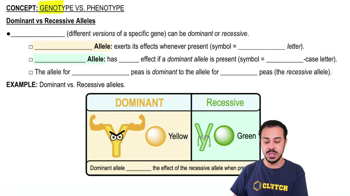
An allele is a different form of a gene, such as brown or blue eye color.
Every non-reproductive eukaryote cell has 2 alleles for every gene.
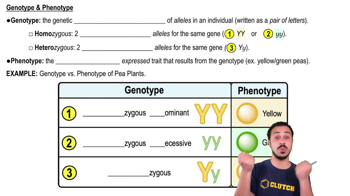
A homozygote has two identical alleles for a trait, either both dominant or both recessive.
A heterozygote has two different alleles for a trait and can carry a recessive trait.
A monohybrid cross is a mating that follows one trait or phenotype.
A dihybrid cross is a mating that follows two traits or phenotypes.
Genotypes are AA, Aa, and aa with phenotypic ratio 3 dominant : 1 recessive.
The father determines sex by contributing either an X or Y chromosome; mother always contributes an X.
A human female has two X chromosomes: genotype XX.
A human male has one X and one Y chromosome: genotype XY.
Traits carried on the X chromosome follow a different pattern called sex-linked inheritance.
Examples include colorblindness, hemophilia, sweat gland formation, and hair color in cats.
The Y chromosome carries about 3 genes, all related to male development.
All offspring will show the dominant phenotype.
All offspring will show the recessive phenotype.
Half the offspring will show the dominant phenotype and half the recessive phenotype.
Fertilization combines an egg (X) and sperm (X or Y) to form offspring with sex chromosome combinations: XX or XY.
X and Y chromosomes pair up during meiosis despite differences, allowing proper segregation into gametes.
The X chromosome carries genes for many traits other than sex organs, affecting various phenotypes.