 Back
BackHomeostasis and Chemistry Basics
 01:59
01:59
Terms in this set (25)
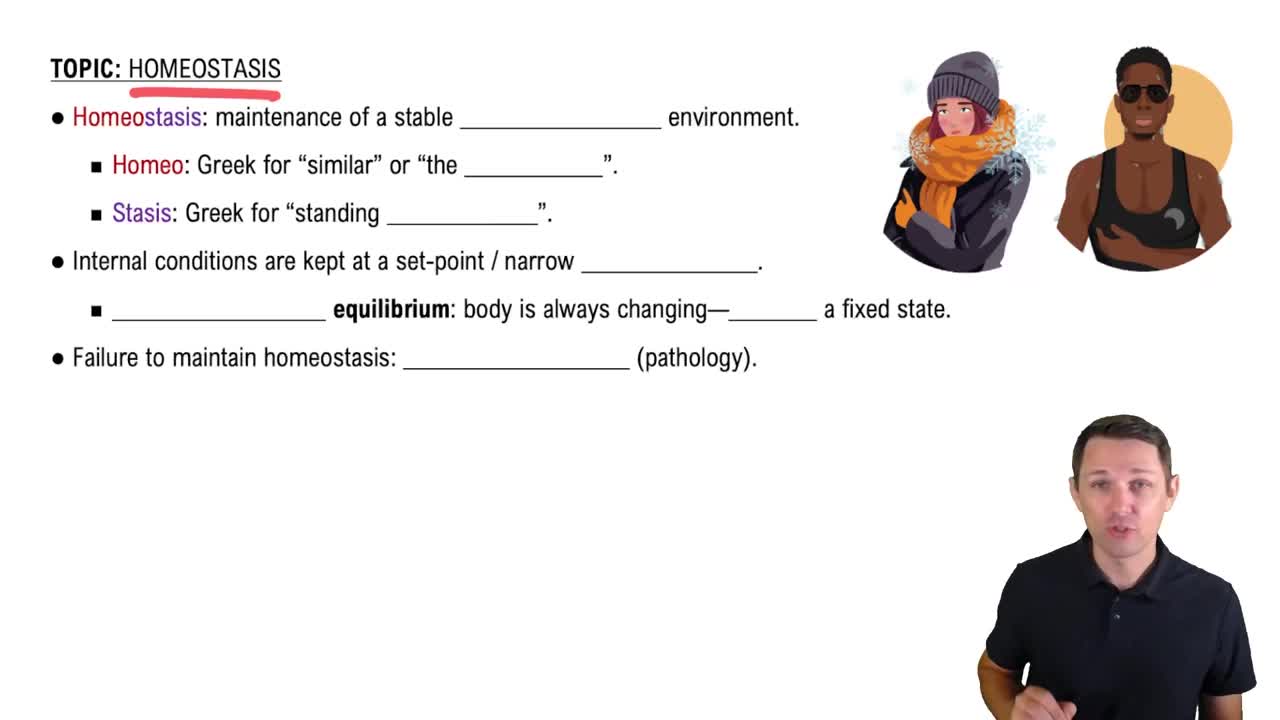
Homeostasis is the body’s ability to maintain a relatively stable internal environment despite continuous external changes, resulting in a dynamic state of equilibrium.
It maintains stable conditions necessary for survival and proper function of cells and organs, preventing disease and dysfunction.
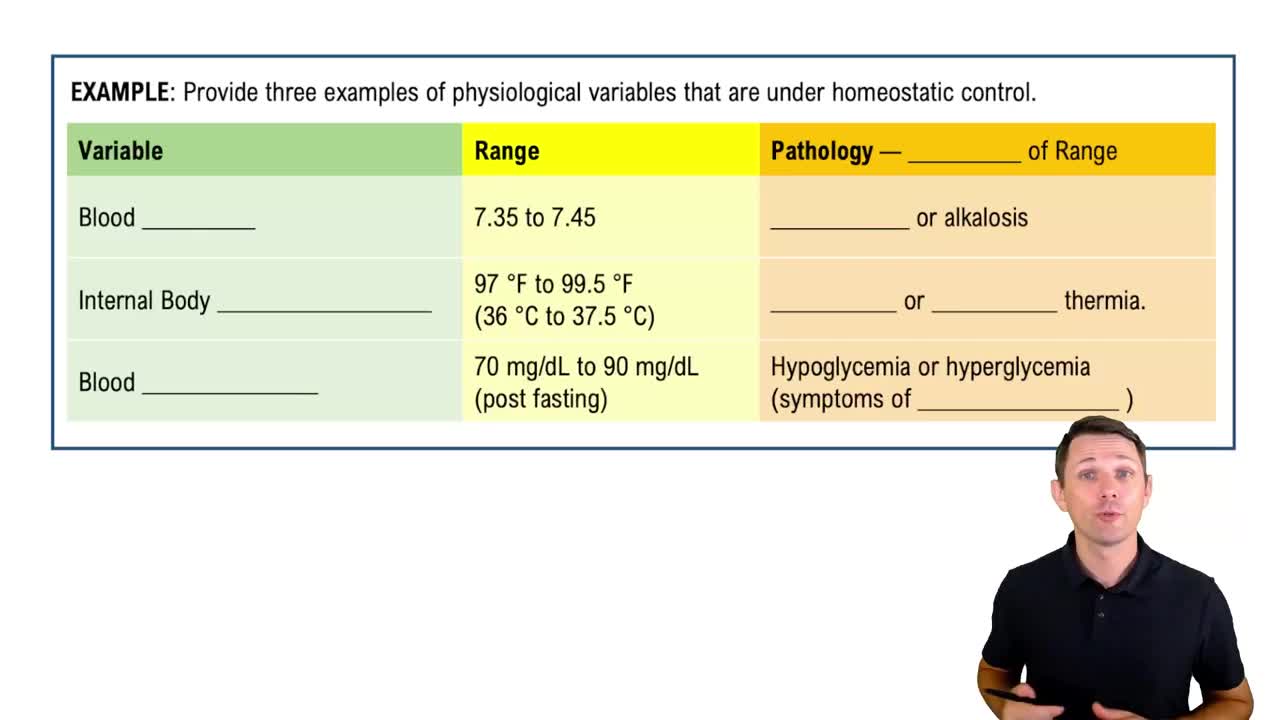
Examples include body temperature, blood glucose levels, and blood pressure.
Disturbance of homeostasis increases the risk of disease, such as chronic stress leading to cardiovascular disease.
1. Nutrients
2. Oxygen
3. Water
4. Normal body temperature
5. Appropriate atmospheric pressure
Nutrients like carbohydrates, fats, proteins, vitamins, and minerals provide energy and building blocks for growth and repair.
Oxygen is required for cellular respiration to produce ATP, the cellular energy currency.
Water is the medium for most biological reactions and acts as a transport medium for nutrients and waste.
It influences the speed of chemical reactions and overall body processes.
It drives gas exchange between air and blood; lower pressure means less oxygen availability.
Receptor (detects change), Control center (determines set-point), Effector (initiates response).
A self-regulating system where the output reduces or shuts off the original stimulus to maintain stability, e.g., body temperature regulation.
When body temperature rises, mechanisms activate to cool the body, shutting off once normal temperature (~37°C) is reached.
A system where the output enhances or exaggerates the original stimulus, amplifying the response, e.g., uterine contractions during childbirth.
Stretching of the uterus causes contractions, which cause more stretching, amplifying the process until delivery.
Negative feedback opposes the stimulus to maintain stability; positive feedback amplifies the stimulus to quickly increase a body variable.
A pure substance that cannot be broken down further, containing only one type of atom.
The smallest unit of an element with a neutral charge that retains the element's properties.
Charged particles formed when atoms gain or lose electrons; cations are positive, anions are negative.
The number of electrons in its outermost (valence) shell; full shells are inert, unfilled shells are reactive.
Chemical bonds formed by the transfer of electrons from one atom to another, creating oppositely charged ions that attract.
Chemical bonds formed when atoms share one or more pairs of electrons to fill their valence shells.
Oxygen attracts shared electrons more strongly than hydrogen, creating partial positive and negative poles.
Attractions between the slightly positive pole of one polar molecule and the slightly negative pole of another.
Hydrogen bonds are weaker attractions between molecules, not bonds formed by electron transfer or sharing within molecules.