 Back
Homeostasis and Feedback Systems in Anatomy & Physiology
 01:59

Terms in this set (20)
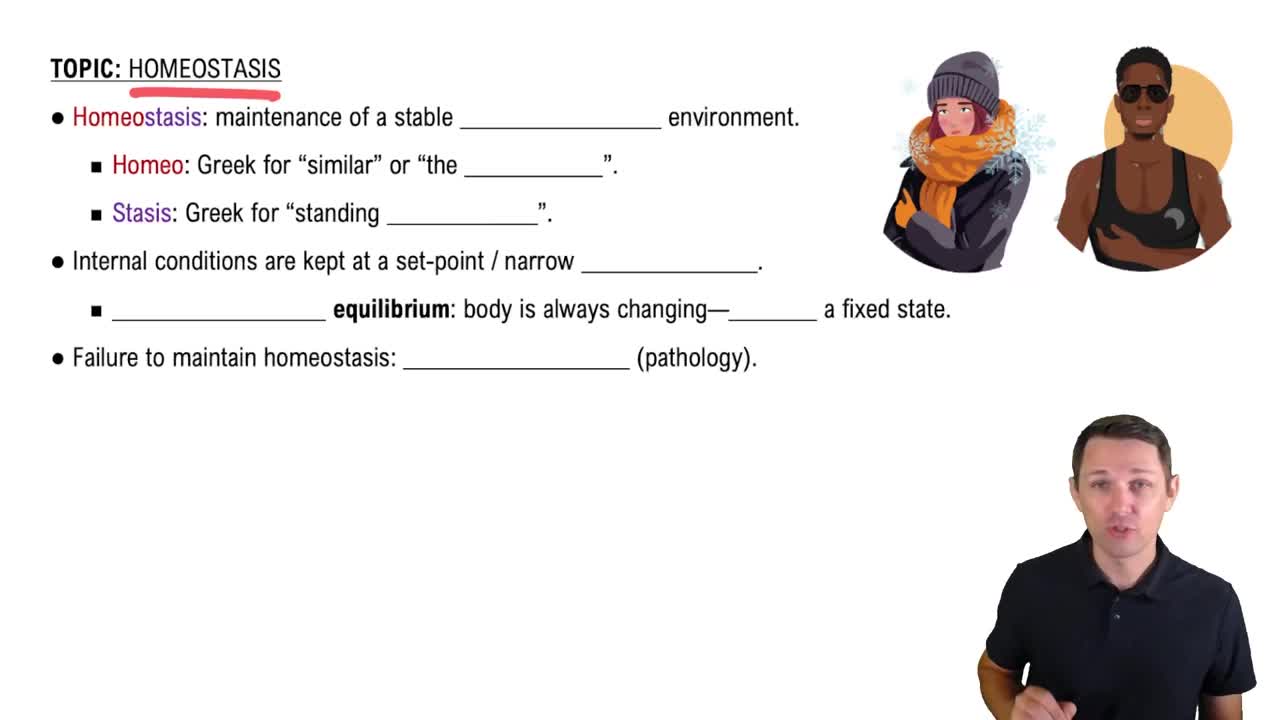
"The constant conditions which are maintained in the body ... which may vary, but which [are] relatively constant."
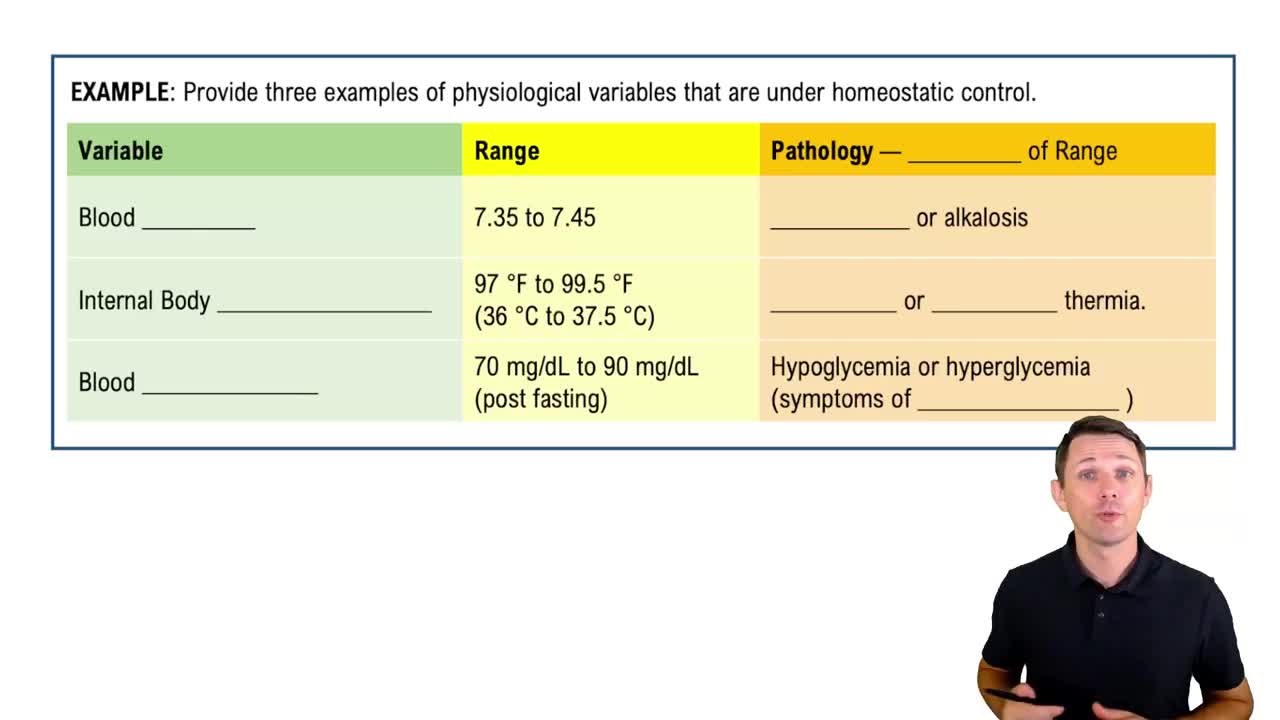
The condition in which the body's internal environment remains relatively constant within certain physiological limits.
1. Extracellular fluid (e.g. plasma)
2. Cytoplasm
Open, dynamic, and living system.
Closed, static, and non-living system (e.g. sealed beaker of water).
1. Sensor detects changes
2. Circuit carries signals
3. Effector produces effect
4. Response from effector
5. Feedback detected by sensor
6. Shut-off when normalized
Receptors detect stimuli and transduce signals; they also act as shut-off devices.
Glands and muscles that produce secretion or contraction.
Shivering, piloerection, peripheral vasoconstriction, and increased thyroid hormone.
Sweat glands activation, peripheral vasodilation, and decreased thyroid hormone.
Negative feedback reverses the stimulus and stabilizes; positive feedback enhances the stimulus and is destabilizing.
Because it stabilizes physiological variables and maintains homeostasis.
Self-reinforcing loops like the cartoon example where a stimulus causes a response that increases the stimulus.
It receives input information, processes it, and sends output information to effectors.
Produces a response that affects the variable to restore homeostasis.
Detects changes in the variable and sends information to the control center.
The physiological factor or condition being regulated (e.g. temperature, pH).
Steady state requires energy and is dynamic; equilibrium is static and requires no energy.
Integumentary, endocrine, lymphatic, skeletal, muscular, cardiovascular, respiratory, nervous, digestive, and urinary systems.
Feedback allows the body to detect changes and adjust responses to maintain internal stability.