What is the function of the coronal suture in the skull?
The coronal suture is the joint that connects the frontal bone to the two parietal bones of the skull.
Name the bone that contains the supraorbital foramen.
The frontal bone contains the supraorbital foramen, which allows passage of nerves and blood vessels to the forehead.
What is the significance of the foramen magnum?
The foramen magnum is a large opening in the occipital bone that allows the spinal cord to connect with the brain.
Identify the bone that forms the lower jaw.
The mandible is the bone that forms the lower jaw and holds the lower teeth.
What is the anatomical name for the 'Adam's apple' area in the vertebral column?
The 'Adam's apple' corresponds to the laryngeal prominence of the thyroid cartilage, but in the vertebral column, the prominent vertebra is C7, known as the vertebra prominens.
How many cervical vertebrae are there and what is their curvature?
There are 7 cervical vertebrae (C1–C7) with a concave curvature anteriorly.
What is the unique feature of the atlas (C1) vertebra?
The atlas (C1) lacks a body and spinous process and supports the skull, allowing nodding motion.
What is the dens (odontoid process) and which vertebra has it?
The dens is a tooth-like projection on the axis (C2) that acts as a pivot for rotation of the atlas and skull.
Describe the difference between true ribs, false ribs, and floating ribs.
True ribs (1–7) attach directly to the sternum, false ribs (8–12) attach indirectly or not at all, and floating ribs (11–12) do not attach to the sternum.
What bone articulates with the clavicle at the acromion?
The scapula articulates with the clavicle at the acromion process.
Name the two processes found on the scapula important for muscle attachment.
The coracoid process and acromion are two processes on the scapula for muscle attachment.
What is the function of the deltoid tuberosity on the humerus?
The deltoid tuberosity is the site on the humerus where the deltoid muscle attaches.
Which bones form the forearm and how are they positioned?
The forearm consists of the radius (lateral) and ulna (medial).
What is the anatomical term for the wrist bones?
The wrist bones are called carpals.
What bones make up the pelvic girdle?
The pelvic girdle is formed by two coxal bones (hip bones), each consisting of the ilium, ischium, and pubis.
What is the acetabulum?
The acetabulum is the deep socket on the coxal bone that articulates with the head of the femur.
Name the largest bone in the human body.
The femur is the largest and strongest bone in the human body.
What is the patella and its function?
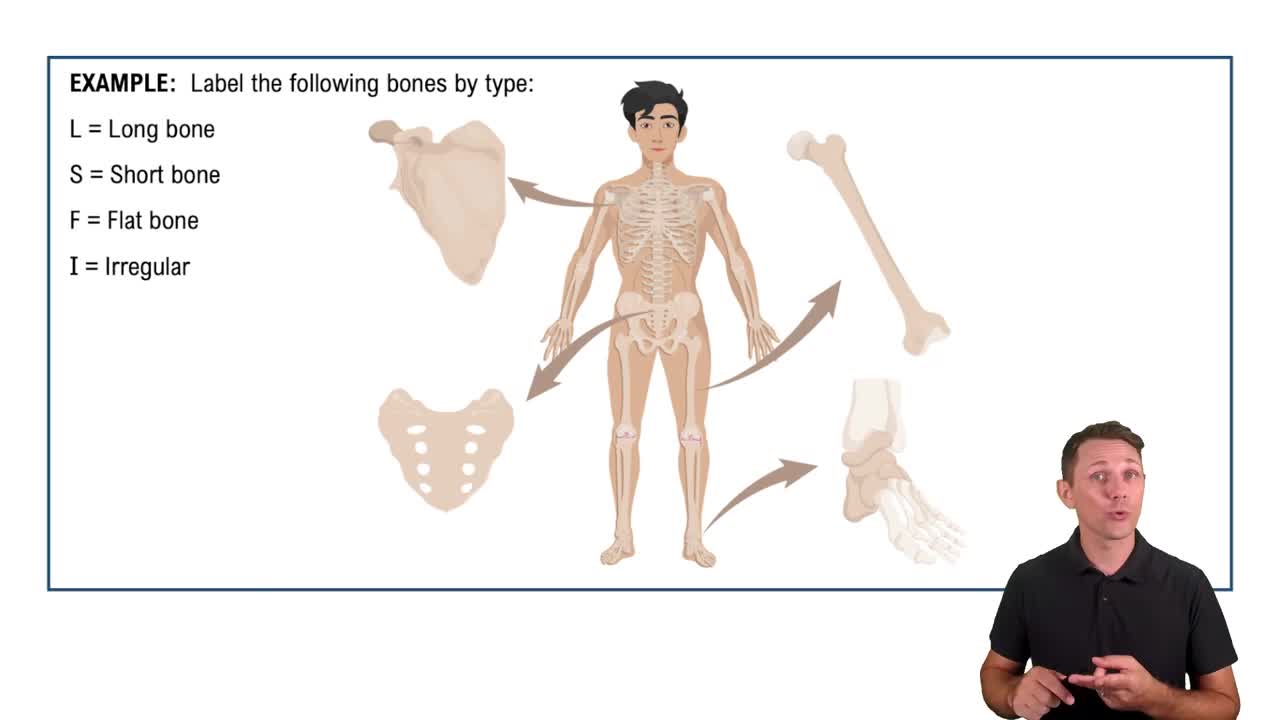
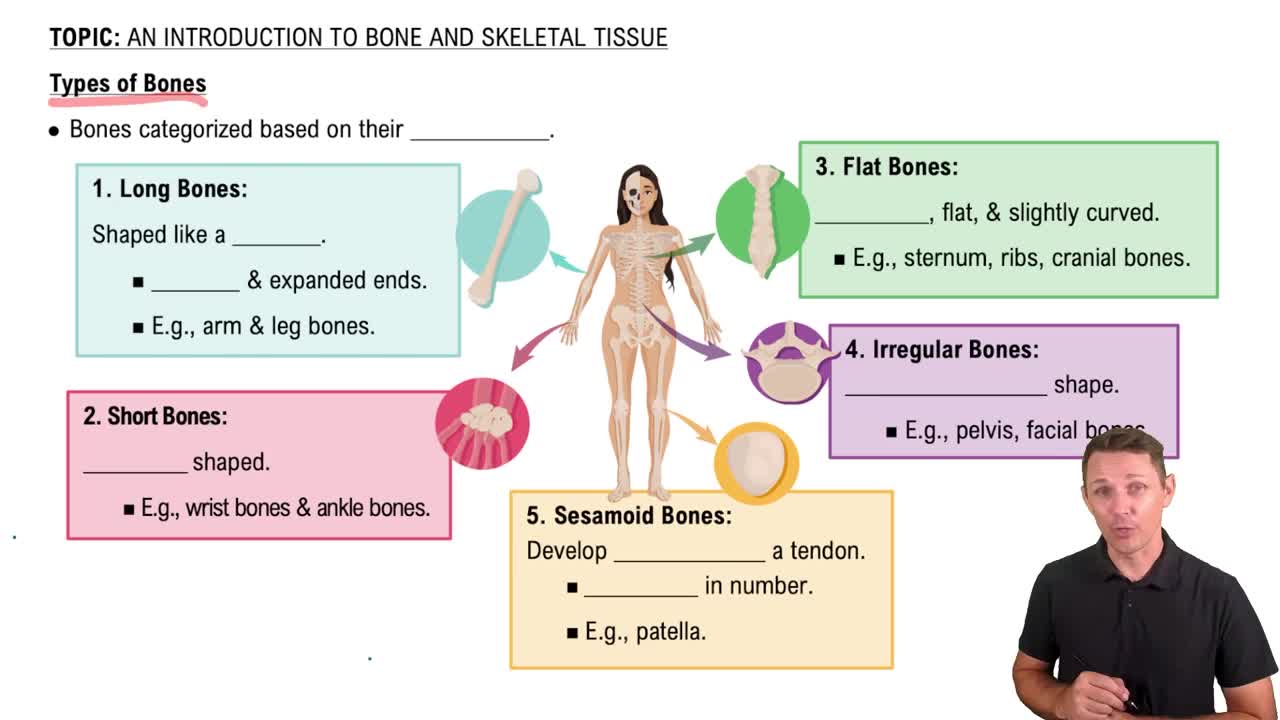
The patella is the kneecap, a sesamoid bone that protects the knee joint and improves leverage of the thigh muscles.
Which bones form the lower leg?
The lower leg is formed by the tibia (medial) and fibula (lateral).
What are the tarsals?
The tarsals are the seven bones that make up the ankle and proximal foot.
How many phalanges are in each finger and toe?
Each finger and toe has 3 phalanges (proximal, middle, distal), except the thumb and big toe which have 2.
 Back
 3:56