What is the primary function of the immune system?
To distinguish 'self' from 'non-self' and protect the body by identifying and eliminating pathogens.
What are pathogens?
Pathogens are disease-causing microorganisms such as viruses, bacteria, parasites, and fungi.
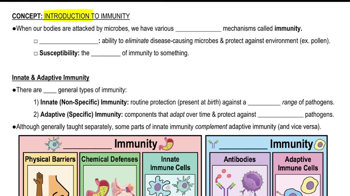
What are the two main types of immunity?
Innate immunity (nonspecific, present at all times) and adaptive immunity (specific, acquired over a lifetime).
What are the four main functions of immunity?
Immunological recognition, immune effector functions, immune suppression, and immunological memory.
What are surface barriers in innate immunity?
Skin and mucous membranes that provide a physical barrier and secrete antimicrobial substances like acid mantle, enzymes, mucin, and defensins.
What role do pattern recognition receptors play in innate immunity?
They recognize common molecular patterns on pathogens, such as Toll-like receptors detecting microbial molecules.
How do opsonins assist phagocytosis?
Opsonins coat pathogens to provide 'handles' that phagocytes can recognize and bind to for easier engulfment.
What is the function of natural killer (NK) cells?
NK cells release perforin to create pores in target cells and granzymes to induce apoptosis, killing infected or abnormal cells.
What triggers inflammation in innate immunity?
Tissue damage and pathogen invasion cause release of inflammatory mediators, leading to vasodilation, increased permeability, and immune cell recruitment.
What are interferons and their role?
Proteins released by virus-infected cells that stimulate nearby cells to block viral replication and activate NK cells and macrophages.
What is the complement system?
A group of proteins that enhance inflammation, opsonize pathogens, and form membrane attack complexes to lyse target cells.
How does fever support immune defense?
Fever raises body temperature setpoint, sequesters iron and zinc to limit bacterial growth, and increases metabolic rate to speed tissue repair.
What are the two broad categories of adaptive immunity?
Humoral immunity (antibody-mediated by B cells) and cellular immunity (T cell-mediated).
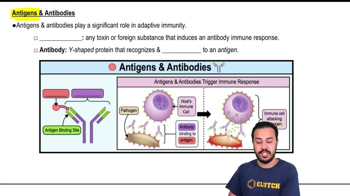
What is an antigen?
A substance that can mobilize adaptive immune responses by being recognized by lymphocytes and antibodies.
What are antigenic determinants?
Specific parts of an antigen that antibodies and lymphocytes bind to, also called epitopes.
What is the difference between complete antigens and haptens?
Complete antigens stimulate immune responses alone; haptens are small molecules that become immunogenic only when attached to a carrier protein.
How do antigen-presenting cells (APCs) activate T cells?
APCs engulf antigens and present antigen fragments on MHC proteins to T cells for recognition and activation.
What is the difference between MHC class I and class II proteins?
Class I MHC displays endogenous antigens on all nucleated cells; Class II MHC displays exogenous antigens on APCs.
What is the role of helper T (TH) cells?
TH cells secrete cytokines to activate and enhance other immune cells but do not kill pathogens directly.
How do cytotoxic T (TC) cells kill infected cells?
TC cells release perforin and granzymes to induce apoptosis in infected or abnormal cells.
What is the basic structure of an antibody?
Four polypeptide chains (two heavy, two light) with variable antigen-binding regions and constant regions that determine antibody class.
What is immunological memory?
The adaptive immune system's ability to remember specific pathogens for faster and stronger responses upon re-exposure.
What causes immediate hypersensitivity (allergies)?
Allergens crosslink IgE on mast cells and basophils, triggering histamine release and symptoms like itching, redness, and swelling.
What is severe combined immunodeficiency (SCID)?
A genetic disorder causing deficits in B and/or T cells, leading to severe immune deficiency and vulnerability to infections.
How does HIV cause acquired immunodeficiency syndrome (AIDS)?
HIV infects CD4+ T cells, integrates into their genome, replicates, and destroys these cells, weakening the immune system.
What leads to autoimmunity?
Failure of self-tolerance due to ineffective lymphocyte education, gene mutations, or molecular mimicry causing immune attack on self.
 Back
 5:52