Skip to main content
Anatomy & Physiology
My Course
Learn
Exam Prep
AI Tutor
Study Guides
Textbook Solutions
Flashcards
Explore
Try the app
My Course
Learn
Exam Prep
AI Tutor
Study Guides
Textbook Solutions
Flashcards
Explore
Try the app
Back
Immune System: Innate and Adaptive Defenses - Anatomy & Physiology
You can tap to flip the card.
What are the two intrinsic systems of the immune system?
You can tap to flip the card.
👆
What are the two intrinsic systems of the immune system?
The immune system consists of the
innate (nonspecific) defense system
and the
adaptive (specific) defense system
.
Track progress
Control buttons has been changed to "navigation" mode.
1/29
Recommended videos
5:52
Introduction to Immunity
4074
views
84
rank
2:58
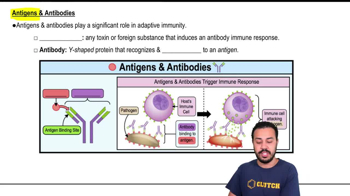
Antigens & Antibodies
2981
views
110
rank
Terms in this set (29)
Hide definitions
What are the two intrinsic systems of the immune system?
The immune system consists of the
innate (nonspecific) defense system
and the
adaptive (specific) defense system
.
What constitutes the first line of defense in innate immunity?
The first line of defense includes
external body membranes
such as the skin and mucous membranes.
What are the main components of the second line of defense in innate immunity?
The second line of defense includes
phagocytes, natural killer cells, inflammation, antimicrobial proteins, and fever
.
How do surface membranes provide protection in the first line of defense?
Surface membranes act as
mechanical barriers
and produce secretions like acidity, lysozyme, mucus, and defensins that inhibit microbial growth.
What is the role of keratin in the skin's defense?
Keratin provides resistance against
weak acids, bases, bacterial enzymes, and toxins
.
Describe the process of phagocytosis.
Phagocytosis involves
recognition, adherence, engulfment, digestion
of pathogens, and
exocytosis
of indigestible material.
What is opsonization in phagocytosis?
Opsonization is when
antibodies or complement proteins coat pathogens
, enhancing phagocyte binding and engulfment.
What are natural killer (NK) cells and their function?
NK cells are
large granular lymphocytes
that kill virus-infected and cancerous cells by inducing apoptosis.
What are the four cardinal signs of acute inflammation?
The four cardinal signs are
redness, heat, swelling, and pain
. Impaired function may be a fifth sign.
What triggers the inflammatory response?
Inflammation is triggered by
tissue injury
caused by trauma, heat, chemicals, or infections.
What are the three stages of inflammation?
The stages are
inflammatory chemical release, vasodilation and increased vascular permeability, and phagocyte mobilization
.
Name key inflammatory chemicals released during inflammation.
Key chemicals include
histamine, kinins, prostaglandins, complement, and cytokines
.
How does fever enhance the immune response?
Fever
inhibits pathogen reproduction, increases metabolic rate, enhances phagocyte activity
, and promotes sequestration of iron and zinc.
What are interferons and their role?
Interferons are proteins secreted by virus-infected cells that
warn neighboring cells to produce antiviral proteins
.
What is the complement system and its functions?
The complement system is a group of plasma proteins that
enhance phagocytosis, promote inflammation, and cause cell lysis
.
Describe the membrane attack complex (MAC).
MAC is formed by complement proteins that
create pores in microbial membranes
, causing cell lysis.
What are antigens?
Antigens are substances that
mobilize adaptive defenses and provoke an immune response
.
What are antigenic determinants?
Antigenic determinants are
specific parts of an antigen that antibodies or lymphocyte receptors bind to
.
What are MHC proteins and their role?
MHC proteins are glycoproteins on cell surfaces that
present antigen fragments to T cells
and mark cells as self.
What are the main types of lymphocytes in adaptive immunity?
The main lymphocytes are
B cells (humoral immunity) and T cells (cellular immunity)
.
Outline the five general steps of lymphocyte development and activation.
Steps:
origin, maturation and education, seeding, activation, and proliferation
.
What is clonal selection in lymphocytes?
Clonal selection is when a lymphocyte binds its specific antigen, triggering
proliferation and differentiation
into effector and memory cells.
What is the difference between active and passive humoral immunity?
Active immunity involves
B cells producing antibodies
after antigen exposure; passive immunity involves
receiving antibodies
from another source.
Describe the basic structure of an antibody.
An antibody is a
Y-shaped protein
with two heavy and two light chains, containing variable and constant regions.
Name the five major classes of antibodies.
The classes are
IgM, IgA, IgD, IgG, and IgE
.
What are the main functions of antibodies?
Antibodies
neutralize antigens, agglutinate, precipitate, activate complement, and tag antigens for destruction
.
What are the roles of helper T cells?
Helper T cells
activate B cells, other T cells, macrophages, and release cytokines
to coordinate immune responses.
What is the function of cytotoxic T cells?
Cytotoxic T cells
directly kill infected, cancerous, or foreign cells
by inducing apoptosis.
What role do regulatory T cells play?
Regulatory T cells
maintain immune tolerance and suppress excessive immune responses
.
 BackBack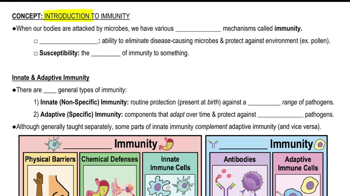
 5:52
5:52