 Back
Immune System: Innate and Adaptive Immunity
 5:52

Terms in this set (20)
- Phagocyte adheres to pathogen or debris.
- Phagocyte engulfs particles forming a phagosome.
- Phagosome fuses with lysosome forming a phagolysosome.
- Lysosomal enzymes digest particles.
- Exocytosis removes indigestible residue.
- Redness
- Heat
- Swelling
- Pain
- Leukocytosis: neutrophils enter bloodstream.
- Margination: neutrophils cling to capillary walls.
- Diapedesis: neutrophils flatten and squeeze out of capillaries.
- Chemotaxis: neutrophils follow chemical trail to damage site.
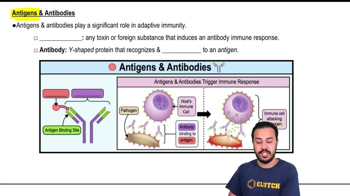
An antigen is a substance that provokes an adaptive immune response. Antigenic determinants are specific parts of the antigen where antibodies or lymphocytes bind.
Humoral immunity involves antibodies produced by B cells. Cell-mediated immunity involves T cells directly killing infected cells or producing chemicals to damage cells.
- Naturally acquired: response to infection.
- Artificially acquired: response to vaccine with dead or attenuated pathogens.
- Naturally acquired: antibodies passed from mother to fetus or infant.
- Artificially acquired: injection of antibodies like gamma globulin.
Antibodies have 2 heavy chains and 2 light chains connected by disulfide bonds. The variable region forms the antigen-binding site, and the constant region is the same for each antibody.
- Neutralization: block dangerous parts of pathogens.
- Agglutination: bind multiple antigens.
- Precipitation: clump soluble antigens.
- Complement activation: triggers inflammation and cell lysis.
Helper T cells mobilize both humoral and cellular immunity by signaling B cells to produce antibodies and CD8 cells to become cytotoxic T cells.
- Class I MHC: displayed by all cells except RBCs, present endogenous antigens to CD8 cytotoxic T cells.
- Class II MHC: displayed by antigen-presenting cells, present exogenous antigens to CD4 helper T cells.
CD4 T cells bind only to class II MHC proteins on APCs, while CD8 T cells bind only to class I MHC proteins. Cytotoxic T cells then seek the same antigen on any cell with class I MHC.
- Bind antigen on MHC I proteins.
- Release perforin to form pores in target membrane.
- Release granzymes that enter pores and trigger apoptosis.
- Detach and seek new targets.
Regulatory T cells suppress the immune response and help prevent autoimmune diseases.
SCID is a genetic defect causing a marked deficit in B and T cells due to defective adenosine deaminase enzyme, leading to toxic metabolite accumulation that kills T cells.
HIV infects and destroys helper T cells, crippling cellular immunity. It uses reverse transcriptase to integrate viral DNA into host cells, leading to immune collapse and opportunistic infections.
- Fusion inhibitors block viral entry.
- Integrase inhibitors block viral DNA integration.
- Reverse transcriptase and protease inhibitors block viral replication enzymes.
Autoimmune diseases occur when the immune system loses self-tolerance, producing autoantibodies and sensitized T cells that attack body tissues.
- Immune suppression with anti-inflammatory drugs.
- Blocking cytokine action or co-stimulatory molecules.
- Research into activating regulatory T cells and inducing self-tolerance.
Foreign antigens may resemble self-antigens, causing cross-reactive antibodies, or new self-antigens may appear due to mutations, hapten attachment, or tissue damage.