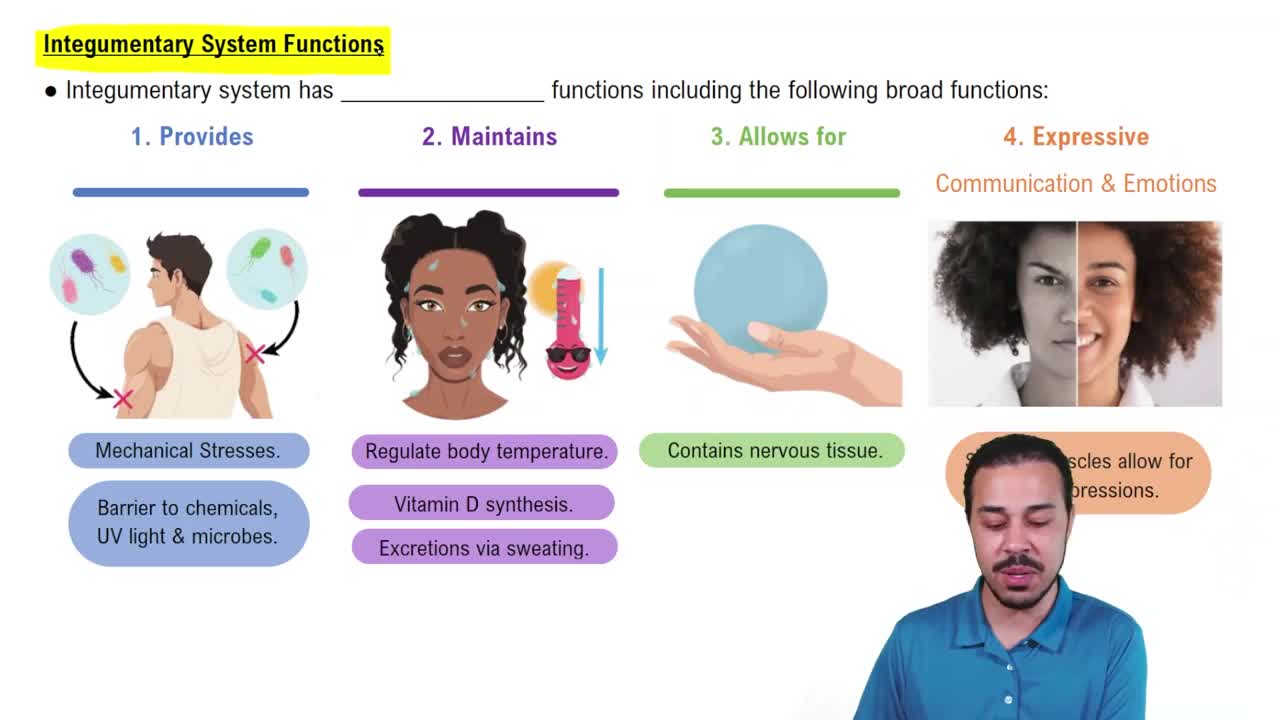
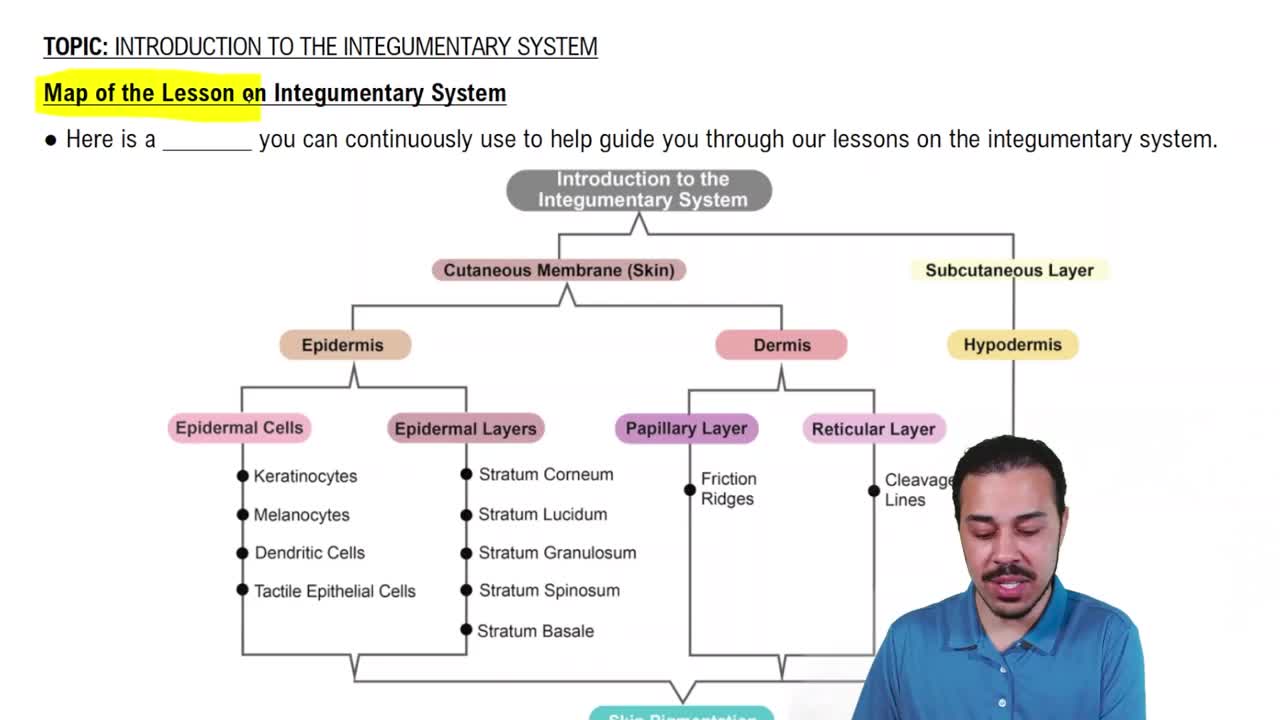
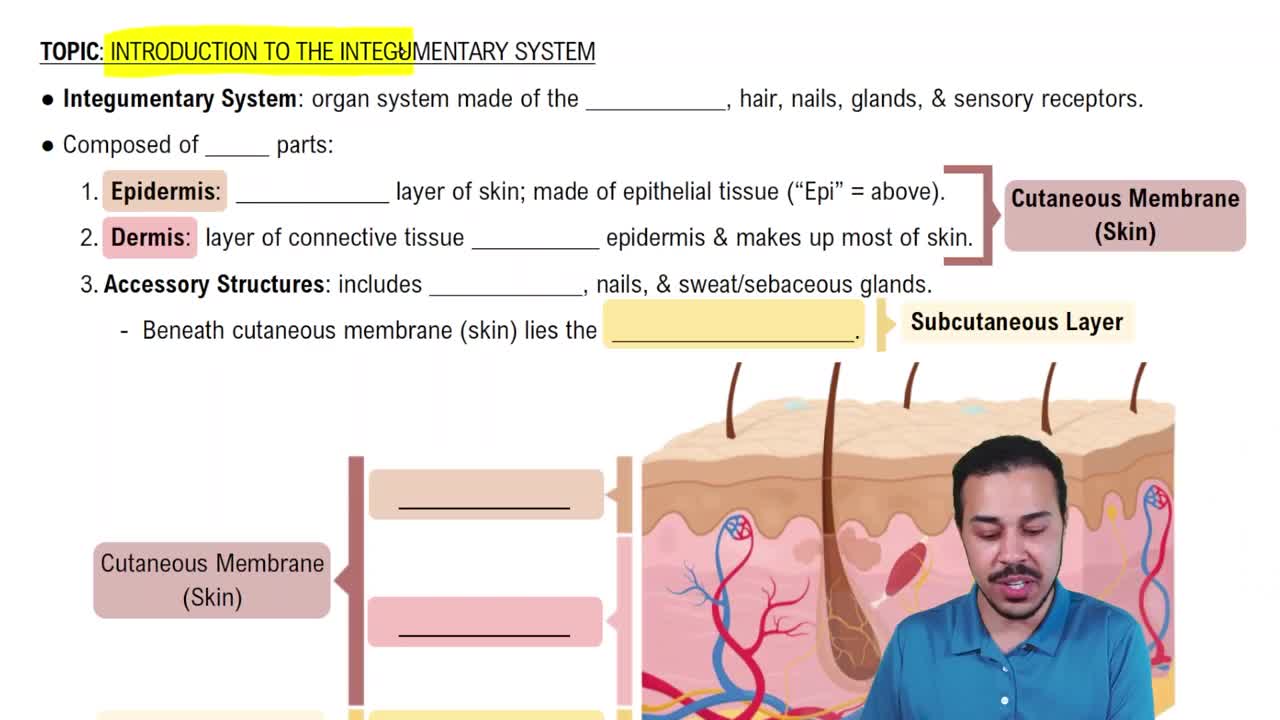
Also called the subcutaneous layer, it anchors skin to muscles, acts as a shock absorber and insulator, and contains pressure-sensitive Pacinian corpuscles.
Name the four types of cells found in the epidermis.
Keratinocytes, melanocytes, Langerhans cells, and Merkel cells.
What is the role of keratinocytes?
Produce keratin, a fibrous protein that waterproofs and protects the skin; they make up most epidermal cells.
Where are melanocytes located and what do they produce?
Located in the deepest epidermis; produce melanin, the pigment responsible for skin color and UV protection.
What are the five layers of the epidermis from deepest to most superficial?
Stratum basale, stratum spinosum, stratum granulosum, stratum lucidum (only in thick skin), and stratum corneum.
Describe the stratum basale.
Deepest epidermal layer; single layer of mitotic cells including 10-25% melanocytes; replaces dead cells.
What is the function of the stratum corneum?
Many layers of dead, keratinized cells that protect deeper layers, prevent water loss, and act as a physical barrier.
What are the two layers of the dermis?
Papillary layer (areolar connective tissue with dermal papillae) and reticular layer (dense irregular connective tissue).
What are dermal papillae and their function?
Fingerlike projections of the papillary layer containing capillaries and touch receptors; contribute to fingerprints.
What causes cleavage (tension) lines in the reticular layer?
Parallel running collagen fibers; important for surgical incisions as cuts parallel to these lines heal better.
Which pigments contribute to skin color?
Melanin, carotene, and hemoglobin.
What is the function of melanin?
Protects skin DNA from UV damage by absorbing sunlight; produced by melanocytes in the stratum basale.
Describe the structure of a hair shaft.
Composed of medulla (central core), cortex (flattened cells surrounding medulla), and cuticle (outer overlapping cells).
What is the arrector pili muscle and its function?
A small smooth muscle attached to hair follicles; contracts to cause hair to stand up, producing 'goose bumps'.
What are the main parts of a nail?
Free edge, nail plate, root, nail matrix (growth area), nail folds, eponychium (cuticle), and hyponychium.
What are sebaceous glands and their secretion?
Oil glands associated with hair follicles; secrete sebum to lubricate skin and inhibit bacterial growth.
Differentiate between eccrine and apocrine sweat glands.
Eccrine glands regulate temperature via watery sweat; apocrine glands (axillary/genital) secrete milky sweat with proteins, active from puberty.
 Back
 06:54